
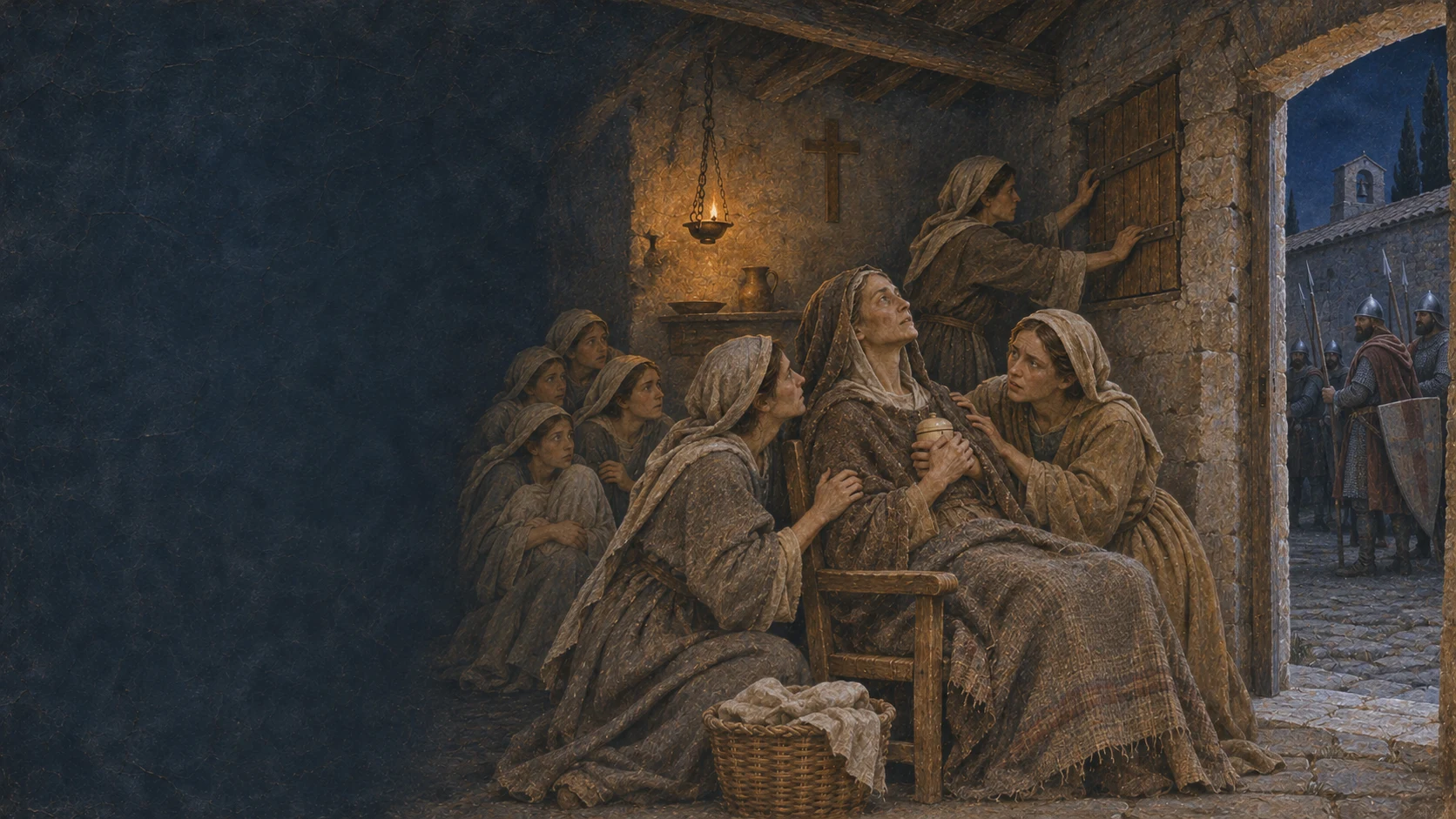
Philippa remembered the men on the wall. According to her testimony, some soldiers climbed down into San Damiano’s cloister, and the sisters were very afraid. The house that organized prayer, work, and care faced violence it could not overcome by its own strength.
When questioned in 1253, the religious woman said she had been present. They asked about the day and month. She did not remember. This small limit is part of the testimony’s value: an intense memory can preserve an event and lose its date.
The scene is usually placed around 1240. It became one of the best-known images of Clare, almost always raising a monstrance before an army. But before looking at the painting, we need to listen to the women. What they said is more precise and, in some respects, quite different from what art has taught our eyes to expect.
The war had a history
Assisi was involved in disputes between Frederick II’s imperial power and the papacy. Troops passed through the region, threatening towns, fields, and religious houses. San Damiano stood outside the city walls, in an especially vulnerable position.
Christian sources use the word Saracens for some of the soldiers. It is a broad medieval designation, generally applied to Muslims, rather than an individual identification of every combatant. The imperial military context helps explain these troops’ presence, but it does not give us a list of the invaders.
Nor should we turn the episode into an accusation against all Muslims. The religious women described men who threatened them in a specific war. The sources’ hostile religious vocabulary belongs to that context. Repeating it without explanation would turn a memory of violence into a generalization about an entire faith.
Clare could not protect them alone
Philippa recalls Clare encouraging the sisters and offering herself as a guarantee in the face of danger. The language expresses trust in Christ, but also responsibility. The abbess does not withdraw to save only her own life.
Another witness, Francesca of Col de Mezzo, gives details of the prayer beside the Eucharist. She says that Clare, who was ill, was carried to the refectory door. She ordered a small box in which Christ’s body was kept to be brought before her.
That location and object come from testimony. We need not replace them with a climb onto the walls or a solitary march before armed ranks. Clare’s frailty, supported by other women, belongs to the memory’s power. The community does not disappear so that the abbess can seem invincible.
The prayer admits a limit
In Francesca’s memory, Clare asks the Lord to guard his servants, because she herself cannot guard them. That admission makes the scene human. A woman responsible for others recognizes that she does not control what she most wishes to protect.
We do not know the sound of her voice, the prayer’s length, or what each sister thought. A literary reconstruction could imagine breathing, footsteps, and the noise of weapons, but those details would not be new evidence. Here we stay with what the witness declared.
Francesca also says she heard a very gentle reply promising protection. The same witness links the experience to another sister, already dead at the time of questioning, who was also said to have heard it. For this second perception, Francesca depends on what her companion had told her.
Who heard what
This chain needs to remain clear. We have a witness who states that she heard a voice. We have her report that another woman said she had heard it. We have no recording, nor a declaration from everyone present saying they perceived the same thing.
The Process records the experience as part of an investigation of holiness. That is historical evidence of a statement made under oath. It does not turn the voice’s supernatural origin into a conclusion that historical method can verify on its own.
A believer may receive the account as a miracle. A historian can examine proximity, language, questions, and transmission. These are different ways of relating to the same material. We need neither ridicule the witness nor present her religious interpretation as though it were an independent military observation.
The remembered withdrawal
The testimonies state that the soldiers left without causing the harm the community feared. The sisters attributed their preservation to Clare’s prayer. The closeness between prayer and withdrawal belongs to the way the event was remembered.
In this body of sources, we have no report from the attackers explaining why they retreated. We do not know every command decision, the conditions of the attack, or other reasons that might have influenced it. We should therefore not assert a single military cause that the sources do not demonstrate.
Nor would it be rigorous to invent a rational explanation and declare the matter settled. Saying it was merely a strategic order, a fright, or a troop movement would require its own documentation. The limit is the same for explanations we like and those we find strange: we need evidence.
A date with open edges
Francesca remembered September and said she thought it had been a Friday, near the hour of Terce. That hour corresponded to midmorning, within the liturgical organization of time. Her language preserves different degrees of certainty.
Philippa did not remember the month or day. This difference does not require us to reject both; it shows how two people can retain different aspects of the same danger. The most common chronological reconstruction places the attack in 1240, without turning the testimony into a complete calendar.
It would be wrong to present an exact date as though all witnesses had confirmed it. It would also be wrong to confuse this entry into the cloister with the siege commanded by Vitale of Aversa, usually placed in the following year. The sources preserve related but distinct episodes of war.
The Legend’s work
Clare’s early Legend takes up the invasion and organizes a more continuous narrative. It describes the Eucharistic container as made of precious materials and presents the reply as a child’s voice. The text seeks to show the divine protection granted to the community through the saint’s intercession.
This is hagiography, written after her death and canonization. Its author uses memories and organizes them for a religious purpose. He is not producing an account of a military campaign. His language about the attackers also carries a stronger moral opposition.
Comparing the Legend with the Process reveals choices. Some details become more vivid, while other uncertainties move away from the center. The repetition of an episode in two related works does not automatically amount to two independent confirmations of every element in the scene.
How the familiar image arose
Artistic tradition began to represent Clare with a monstrance, sometimes luminous and very large. The object makes the saint recognizable and communicates her trust in the Eucharist. An image needs to concentrate a story into a visible sign.
But the artistic sign cannot travel back into the thirteenth century as material evidence. The closed container mentioned in the sources is not simply the same transparent object seen in many later paintings. Nor do painted rays demonstrate that the soldiers saw light coming from it.
Iconography tells the history of reception: it shows how generations learned to recognize Clare and what they wanted to emphasize. It deserves its own study. To narrate the event rigorously, however, we begin with the testimonies and say when an image comes from that later tradition.
Fear is not removed from the memory
The witnesses did not make every sister seem brave from the first instant. They preserved the fear. This detail brings the community closer to real people, who could tremble and seek protection while still remaining together.
They also preserved the need to support Clare. The image of a sick woman carried by others does not diminish her authority; it shows how she depended on the cooperation she sought to strengthen. The prayer was remembered within that network of hands and presences. Removing the companions from the scene to produce a solitary heroine would impoverish the testimony itself.
Later, when Francesca answered the questions, she had to separate her perception from what the other sister had told her. Even in an extraordinary account, that difference appeared. Preserving it is a form of respect for the precision with which a woman tried to transmit a difficult experience, many years after feeling that the house was in danger.
Women who could continue living
The accessible historical core is a memory from people close to danger, prayer, and preservation, recorded by the sisters. The procedural document preserves testimonies; the Legend gives them hagiographic form; later images belong to tradition. Chronology and connections between fragments require reconstruction, with explicit limits.
These limits do not make the scene small. Philippa remembered the wall; Francesca remembered the door, box, and prayer. The community was frightened, and Clare too depended on other women’s hands to reach where she wished to be.
The memory ends with the soldiers gone. For the survivors, the house would again need food, work, and care. It was this preserved life, made up of people who could gather again, that they recognized as grace when recounting what they had lived through.
Sources and paths for further reading
- Fonti Clariane — writings, Process, and documentsPrimary testimonies. Process: testimony of Philippa and Francesca of Col de Mezzo; check presence, uncertain date, container, and experience of the voice.
- Legend of Saint Clare — Italian textHagiography. The chapter on the soldiers develops the prayer and protection; its wording is not an independent military source.
- Regis J. Armstrong — Clare of Assisi: The LadySpecialist edition. Keeps the Process and Legend accessible with their contexts and differences of genre.
- Catherine M. Mooney — Clare of Assisi and the Thirteenth-Century ChurchAcademic research. Places the community’s memories within Clare’s life and thirteenth-century Church conditions.
- Miles Pattenden — The Canonisation of Clare of Assisi and Early Franciscan HistoryAcademic study. Explains the context and purpose of the investigation and the shaping of Clare’s holiness.
- La voce di Chiara e delle compagne — study of the Process and LegendAcademic comparison. Analyzes how the Legend’s selection changes the presentation of memories from the Process.
- Alexander IV — Clara claris praeclaraPapal document. The canonization bull shows official reception of her holiness; it does not provide independent military proof of the withdrawal.
Levels of evidence: the soldiers’ entry and withdrawal are witness memories; the voice is a declared religious experience; the Legend is hagiographic reworking; the large monstrance belongs to reception in religious imagery. The military cause of the withdrawal remains without independent demonstration.