
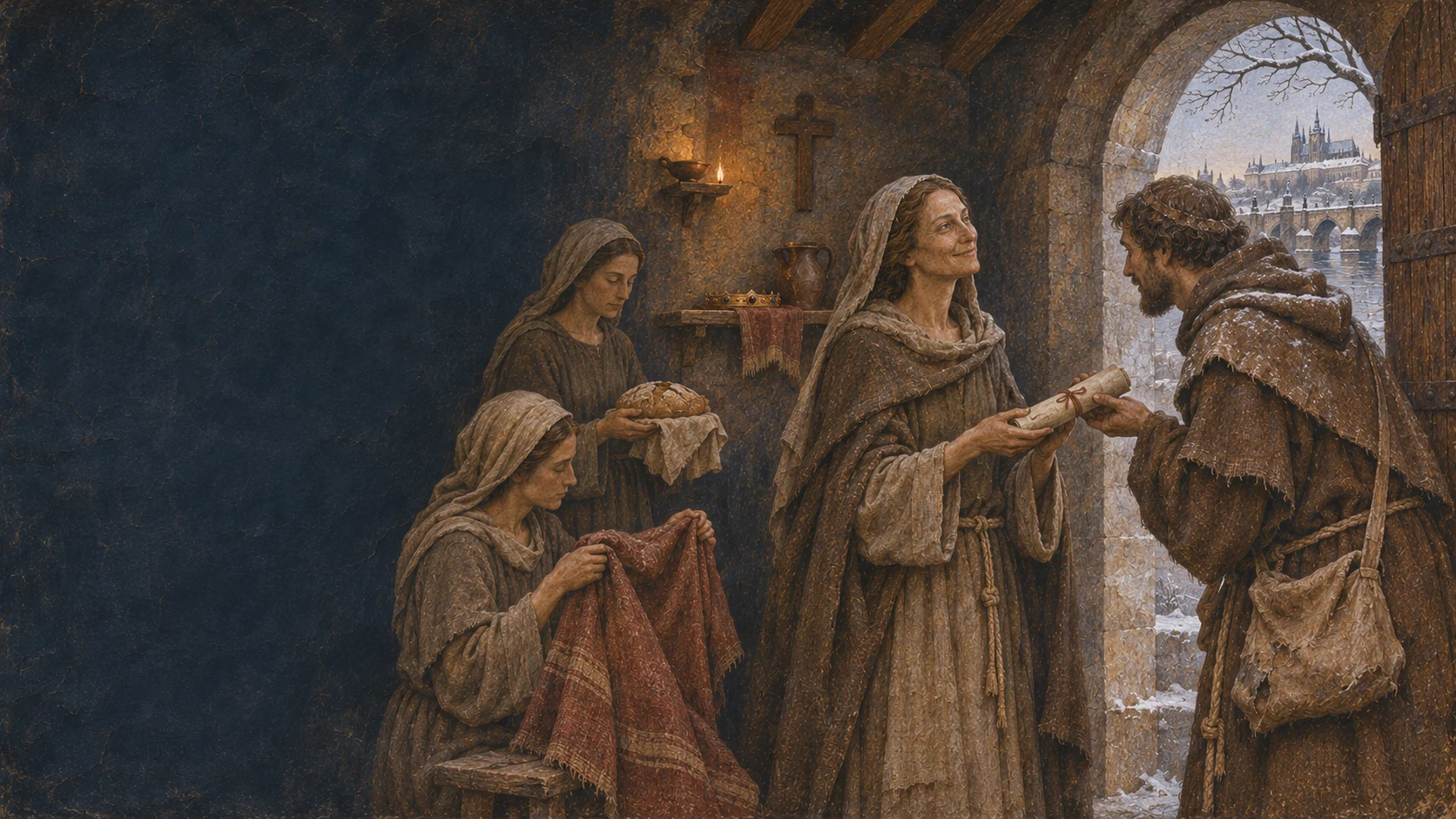
Agnes of Prague’s name reached Assisi before any of her messages could be opened. She belonged to Bohemia’s royal family. Her choice of religious life carried weight because a king’s daughter could be destined for alliances involving other kingdoms.
Clare heard about that choice and wrote. The first surviving letter is usually dated to 1234, at the beginning of Agnes’s community. Over the years, admiration became conversation. The two began discussing poverty, conflicting advice, food, prayer, and distance.
There is no evidence that they met in person. Their friendship grew through words and people who traveled. Their difference in background did not disappear: Agnes remained connected to the court and her family’s possibilities. But in Clare she found someone able to discuss her decision without reducing her to the title of princess.
A future negotiated by others
In Agnes’s youth, marriage plans had a political dimension. Documentation and biographical memory place her in dynastic negotiations, although not every detail of the proposals should carry the same certainty. A marriage could bring rulers closer, consolidate rights, and reorganize relationships between powerful families.
Choosing religious life meant removing herself from some of those negotiations. It did not necessarily mean breaking every family tie. Agnes continued to rely on royal support for charitable projects and the organization of her community.
It is better to recognize this combination than to tell the story of a princess who simply escaped from a castle. Her action involved resources, relatives, authorities, and public decisions. The path could be religious and political at the same time, because these dimensions were not separated as we might wish to draw them today.
Hospital and monastery were not the same house
Agnes took part in creating a hospital and a monastery in Prague. The two projects were connected, but had different functions and needs. The hospital needed to sustain care for poor and sick people; the monastery sought a form of life linked to Franciscan poverty.
This difference brought a difficult question: should the property intended for the hospital also guarantee the religious women’s income? An affirmative answer could seem prudent. People needed to eat, buildings needed maintenance, and enclosed women had limited opportunities to seek support.
For Agnes, however, linking the monastery to a base of property could alter the choice she wished to make. The issue was not despising the sick or abandoning economic responsibility. It was organizing two institutions without erasing the religious community’s identity. Papal documents allow us to follow stages of this problem.
Clare answers a woman who acts
The first letter praises Agnes’s renunciation of the advantages of a prestigious marriage. Bridal language presents Christ as bridegroom. This vocabulary was religious and familiar in traditions of consecrated life; it does not mean Clare was writing a courtly love story with the names changed.
Later, the letters grow closer. Clare counsels perseverance, comments on guidance received, and answers concrete questions. The recipient does not appear as someone accepting everything in silence. She asks, negotiates, and seeks support.
We preserve only one side of this correspondence directly. Agnes’s voice must therefore be sought carefully in the replies, without being fabricated. When Clare says she received a question about fasting, we know there was a question. We do not know its exact wording, tone, or the occasion on which it was asked.
The king also intervenes
Debates over Prague’s organization involved Agnes’s brother, King Wenceslaus I. The family’s presence helps explain why the community could take its requests to such high authorities. The former princess had not lost all her networks by putting on the habit.
This does not diminish her choice of poverty. It does show, however, that renouncing ownership did not mean living without relationships of power. The question was how to use connections and protection without turning the monastery into an extension of the court’s interests.
Clare knew another kind of influence, built over decades of experience and connection with Francis. The two women did not offer each other exactly the same resources. That was precisely why the friendship could be fruitful: it joined different experiences around similar problems.
A pope wants order
Gregory IX followed the Prague community through letters and decisions. In 1238, the document Angelis gaudium responded to Agnes’s attempt to obtain confirmation for a form of life linked to the one received from Francis. The pope argued for the institutional discipline already established.
The document matters because it preserves a position different from Clare’s. If we read only the friend’s letters, we might imagine that choosing poverty and finding courage was enough. Papal correspondence shows legal limits and concerns about unity among monasteries.
We need not turn Gregory into a simple villain. His concern for stability was real; so was the women’s desire to preserve an experience of their own. History emerges when we let the positions meet, rather than handing all wisdom to one character and all wickedness to the other.
Cold changes a rule
Documents about food remind us that Prague was not Assisi. Climate and food availability changed the burden of certain observances. A rule conceived in one setting could become especially difficult when applied in another.
Clare answered questions about fasting days and passed on what she remembered of Francis’s guidance. At the same time, she asked her friend for moderation. Faithfulness did not require treating the body as though it had no limits.
In 1243, Innocent IV granted dietary adaptations and insisted on attention to the sick. This continuing documentation shows that the problem did not disappear with a single letter. Feeding the community was an ongoing responsibility. Spirituality needed to find eggs, milk, oil, bread, and real conditions for survival.
News travels through people
The exchange between Assisi and Prague depended on friars and other intermediaries. The Fourth Letter mentions the lack of messengers and the dangers of the roads. It commends the bearers by name, reminding us that a connection between communities did not circulate on its own.
As a general reconstruction, we can imagine a letter being read to other sisters. We cannot state in which room it happened, who was beside Agnes, or what tears appeared. The document does not record its reception.
Even so, the presence of community greetings shows that the correspondence went beyond a private dialogue. There were women in two cities interested in the same path. News could strengthen others’ resolve, and a distant difficulty could become a reason for prayer and advice.
The gap we cannot fill
Between the third and fourth surviving letters lies a long gap in the documentation. We cannot turn this absence into fifteen years of absolute silence. Nor can we invent a regular exchange to make the friendship more continuous.
We know messages were lost and that other contacts may have taken place through intermediaries. The exact number remains unknown. History does not need to pretend to a completeness it lacks in order to recognize a mature bond.
In the final letter, Clare addresses Agnes with expressions of great affection and asks for prayers for herself and her sisters. The woman who once encouraged a foundress now also entrusts her with her own need. The friendship reveals reciprocity, even in an archive that mostly preserved one of the voices.
The question that returns to Assisi
There is something important in the correspondence’s movement: the center of the world does not always remain beside the author. A difficulty arising in Prague makes Clare interrupt her own routine to consider another reality. The winter, resources, and pressures surrounding Agnes require an answer that cannot be simple repetition.
We do not know the material preparation of each letter, but we know the result of this attention. Clare passes on experience and adapts advice to the person seeking her out. Friendship crosses kingdoms because it accepts that the distant place has questions of its own. The Prague community did not need to disappear inside San Damiano’s model to be recognized as a sister.
This difference is part of the bond. Two houses can desire the same path and need different decisions to sustain it, especially when their bodies, food, and possibilities of protection are not subject to the same conditions.
Agnes’s life continued
Clare died in 1253. Agnes of Prague lived until 1282. Those nearly thirty years prevent her biography from ending with her friend’s last parchment. She continued to live in a community and a kingdom that were changing.
The letters are documents; the Process preserves testimony about Clare; the Legend and other religious lives belong to hagiography; devotion and its revivals belong to tradition. Testimony about Assisi does not directly prove events in Prague. Agnes’s later memory took shape through religious biography, devotion, and tradition. These materials must be distinguished from contemporary letters and papal documents. A late scene can show how the saint was remembered without offering direct access to a thirteenth-century event.
In this chapter, reconstruction brings fragments together without speaking on behalf of lost messages. We see a princess who chooses, a foundress who negotiates, and a friend who asks questions. Distance between kingdoms did not make these women identical; it offered room for each to recognize the other and entrust her with something she needed to sustain.
Sources and paths for further reading
- Clare — First Letter to Agnes of PraguePrimary document. Places Clare’s initial admiration for Agnes’s religious choice in context.
- Clare — Second Letter to Agnes of PraguePrimary document. Responds to tensions over poverty and guidance; reveals a recipient seeking advice.
- Clare — Third Letter to Agnes of PraguePrimary document. Preserves practical questions about fasting and the request for moderation.
- Clare — Fourth Letter to Agnes of PraguePrimary document. Explains difficult communication and preserves the messengers’ names.
- Gregory IX — Angelis gaudium, May 11, 1238Papal document. Records Gregory IX’s response to Agnes’s initiatives concerning rules in 1238.
- Innocent IV — dietary concessions to Prague, 1243Papal document. The 1243 concessions show Prague’s specific material conditions.
- Regis J. Armstrong — Clare of Assisi: The LadySource edition. Offers the full set of letters and documents for comparison.
- Catherine M. Mooney — Clare of Assisi and the Thirteenth-Century ChurchAcademic research. Examines Clare’s and Agnes’s actions amid the institutional decisions of the thirteenth century.
Unequal voices: Clare’s letters survive; Agnes’s questions and initiatives can be recognized in the replies and papal documents. The text of lost messages and delivery details have not been invented.