
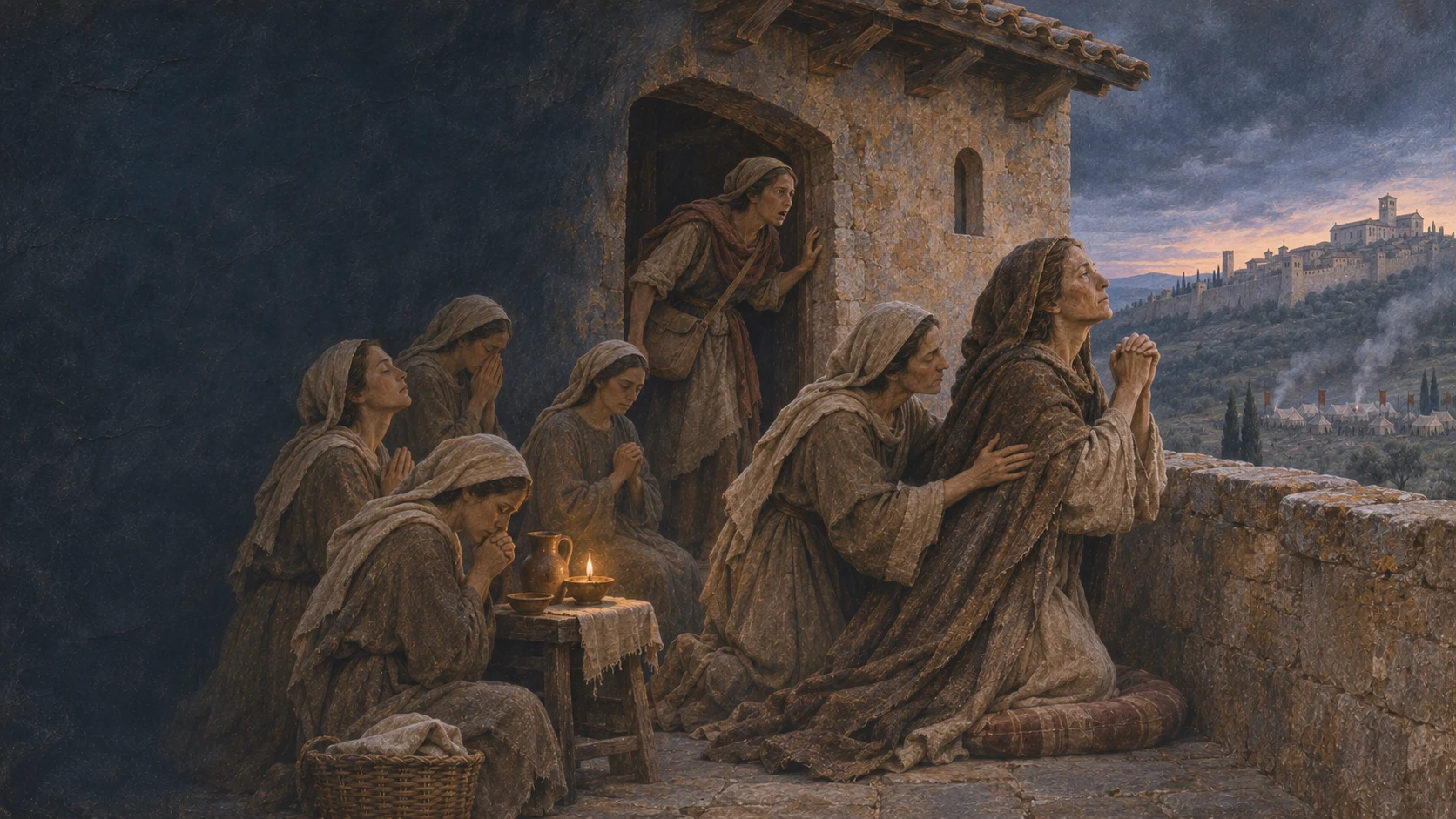
News of Assisi reached San Damiano before the sisters could know the outcome. The city was threatened by an army commanded by Vitale of Aversa. According to the memory preserved in the Process, people said he would not leave before conquering it.
Clare could not personally check every piece of information. She received what others told her. This detail remains in Philippa’s testimony and helps us imagine the community’s position: women outside the walls, dependent on news brought by others, unable to know how the next day would end.
The remembered response was to gather the sisters. Clare asked for ashes and placed them on her own head; then she did the same for the others. Prayer for the city began with a gesture all could recognize, without weapons or a promise that they knew the enemy’s movements.
Another episode of the same war
This siege should not be confused with the soldiers’ entry into the cloister. The sources bring the stories close because both show Clare’s prayer in the face of violence. But they present different situations: in one, danger reaches inside San Damiano; in the other, the community intercedes for besieged Assisi.
The chronology generally places Vitale’s siege in 1241, in the context of imperial campaigns in Umbria. The commander’s name helps anchor the memory in a real war. We do not, however, have a complete sequence of military orders from the religious women’s testimonies.
It is important to keep each narrative’s center. The small Eucharistic box belongs to the account of the cloister invasion. Ashes and the whole community’s prayer characterize this episode. Mixing the signs would create a more spectacular scene, but one less faithful to the sources.
What losing a city meant
A siege endangered far more than walls. People needed food, water, movement, and protection. Surrounding fields could suffer from passing troops. Those living outside the city’s defenses were not separated from danger by a safe line.
These are general conditions of medieval war, used here to explain the threat’s reach. We do not know which families lost crops during this siege, how many doors were closed, or the state of every food reserve. We should not fill these spaces with invented numbers or episodes.
For Clare, Assisi was not a distant point on a map. It was the city she came from, of people she knew and women who had relatives inside it. Concern could also reach people unnamed in the records, whose lives remained necessary to the community’s support.
An acknowledged debt
In the Legend, Clare reminds the sisters of benefits received from the city. This wording makes a material and moral connection explicit. San Damiano had chosen poverty, but did not live outside relationships of help. It received food and support from people around it.
Prayer appears in this narrative as a response to the care received. The religious women could not defend the walls, but they could take the city’s danger as their own concern. It was not merely a matter of asking the soldiers to ignore the monastery and attack somewhere else.
This dimension deserves attention because it prevents a narrow image of enclosure. The sisters’ space was limited, but their relationships went beyond the door. Receiving bread meant depending on work, generosity, and routes coming from outside. War threatened this network of survival too.
Ashes change the gesture
Ashes were a Christian sign of penance and fragility. They recalled that a person does not control her own existence and needs to turn to God. They were not presented as a substance capable of striking soldiers at a distance.
Philippa remembers Clare beginning with herself and then placing ashes on the sisters. The gesture’s order matters: the abbess takes part in the supplication she asks of others. She does not remain outside, assigning a task that only her companions should bear.
We do not know the words of every prayer. We can describe the rite’s meaning because it belongs to the sources’ religious vocabulary. We cannot compose a complete speech and attribute it to Clare as a quotation. The scene’s emotion rests on women gathered in shared uncertainty, rather than a speech we would have to invent.
Testimony preserves a sequence
The testimony contains news of the siege, the community’s gathering, the use of ashes, prayer, and the army’s departure. Philippa presents the withdrawal as God’s answer. This sequence is what the sisters preserved and brought to the investigation of holiness.
The record was made in 1253, years after the events. Its closeness is valuable, but it does not amount to a diary written during the siege. The commission’s questions also directed the account toward facts capable of demonstrating Clare’s holiness.
This does not make the memory useless. It shows how to use it. We can recognize declared community actions and the interpretation given to them. We cannot treat the testimony as though it also recorded the commander’s meetings, supply calculations, and every reason he decided to withdraw his troops.
The night of withdrawal
Philippa says that Vitale left with the army the following night. The sentence creates a strong closeness between supplication and outcome. It is understandable that threatened women should recognize a protection beyond their own strength there.
Even so, causality needs careful wording: the sisters attributed the withdrawal to prayer. In these accounts, we possess no independent explanation from the military side that could demonstrate this cause or replace the religious interpretation with another certainty.
It would be equally unwise to invent a storm, an illness in the camp, or an imperial order received before dawn to make the episode more understandable. If a later version adds details, we need to identify it and study it as such. A lack of explanation should not be filled for narrative convenience.
The spared city remained within history
Assisi’s preservation in religious memory does not mean all dangers ended forever. The city remained involved in conflicts, interests, and needs. One episode of withdrawal did not turn its population into a group without differences.
Nor do we know how every resident interpreted the outcome. The sources about Clare present recognition of divine protection, but they do not provide an opinion poll among artisans, soldiers, noble families, and field workers. Collective memory should not be confused with documented unanimity.
What we can follow is the connection built between the city and Clare’s holiness. The monastery kept a memory of intercession; urban history received and celebrated it. In that encounter, a woman living outside the walls came to be remembered as someone decisive for their protection.
From memory to celebration
Assisi’s tradition associated the city’s liberation with the feast of the vow, celebrated in June. This civic and religious reception has its own importance. It shows how an urban community returned to the past to express gratitude and identity.
But a feast’s date and details of a later celebration do not automatically have the same value as a contemporary record of the siege. Tradition can preserve and organize a memory, choosing forms that matured over centuries.
When narrating, we need to let each layer appear under its own name. The Process records testimonies; the Legend is hagiography; the feasts belong to the history of tradition. Historical reconstruction seeks to relate these layers to political chronology, keeping uncertain points visible.
The name of the person bringing bread
The sources do not preserve every donor who helped San Damiano. The reference to the city, however, prevents bread from seeming to appear without human work. Someone planted, milled, prepared, carried, or shared it. The sisters’ chosen poverty was lived within these relationships.
When the city was threatened, so were the people from whom help came. The connection was not an account in which a prayer paid for a meal. It was recognition of belonging: suffering outside affected those living within.
This interpretation finds support in the gratitude expressed by the Legend and needs to be presented as an interpretation of the account. We do not know every benefactor’s face or the words with which a family asked for help. We can, however, leave room for these people without inventing their identities. The story of prayer reaches a population the documents cannot name in full.
Sharing life again
It is possible to read this episode without reducing prayer to a strategy or presenting it as a mechanism that forces events. The sisters remembered that Clare gathered them to entrust a threatened city to God. The gesture expressed faith and responsibility for other people.
The community had no control over the army. Nor did it remain indifferent because the greater danger seemed to lie inside the walls. It took on a need extending beyond its house, recognizing how closely its life was connected to life outside.
When the threat receded, there would still be bread to receive, people to help, and news to hear. The ashes did not erase those bonds. In the witnesses’ memory, they made visible that the women of San Damiano belonged to the same history as a city trying to go on living.
Sources and paths for further reading
- Fonti Clariane — writings, Process, and documentsPrimary testimony. Process: Philippa recounts Vitale, the gathering, ashes, and departure; other testimonies should be compared without assuming independence.
- Legend of Saint Clare — Italian textEarly hagiography. The chapter on the city’s liberation makes explicit the gratitude to inhabitants who supported the sisters.
- Regis J. Armstrong — Clare of Assisi: The LadySpecialist edition. Gathers the early versions and documents of the Church context.
- Catherine M. Mooney — Clare of Assisi and the Thirteenth-Century ChurchAcademic research. Places San Damiano among local relationships, conflicts, and thirteenth-century institutions.
- Miles Pattenden — The Canonisation of Clare of Assisi and Early Franciscan HistoryAcademic research. Explains the testimonies’ purpose and the production of a memory of holiness.
- Alexander IV — Clara claris praeclaraPapal document. Attests later official recognition; it does not replace military sources about the siege.
- How Saint Clare of Assisi Guided Her SistersAcademic study. Helps explain the authority Clare exercised through actions shared with the community.
Causality and chronology: Vitale’s siege is distinct from the cloister invasion. Prayer and ashes are remembered by the witnesses; the withdrawal is interpreted as divine protection. Later civic tradition does not, on its own, supply all military details.