
Clare never met Agnes of Prague face to face, at least there is no document proving a meeting. Between Assisi and Prague lay mountains, cities, languages and weeks of travel. Even so, the two women built a friendship capable of crossing Europe on sheets of parchment.
Around 1234, Clare wrote the first surviving letter addressed to Agnes. She called her the daughter of the king of Bohemia, but also sister, bride of Christ and a woman who had chosen a different nobility.
Agnes could have occupied a throne. Instead, she founded a hospital and a community of poor women in Prague. This choice had political consequences. Princesses’ marriages united dynasties; refusing them was not simply saying “I don’t want to.” It meant withdrawing her own body from negotiations conducted by kings, emperors and relatives.
Who Agnes was
Agnes was born into the Přemyslid dynasty, the daughter of King Ottokar I of Bohemia and Constance of Hungary. From girlhood she was involved in marriage plans. She lived in courtly and religious settings, received an education and knew a princess’s responsibilities.
Negotiations connected her with different possible husbands, including Emperor Frederick II. Political and Church sources record the interest in marriage, although popular versions sometimes simplify complex years into a single proposal refused before everyone.
In the early 1230s, Agnes directed her resources toward religious and charitable works in Prague. She founded a hospital and a community connected to the Franciscan movement. She entered that house in 1234.
She did not become poor because she had never had power. She became poor while bringing with her memory, relationships and the ability to found institutions. This difference helps explain Clare’s enthusiasm.
How the news reached Assisi
The letter shows that Clare had heard about Agnes’s decision. Messengers connected to the friars, the curia and royal houses could carry information. Papal documents circulated too. But we do not know the name of the person who first told her, or the day the news entered San Damiano.
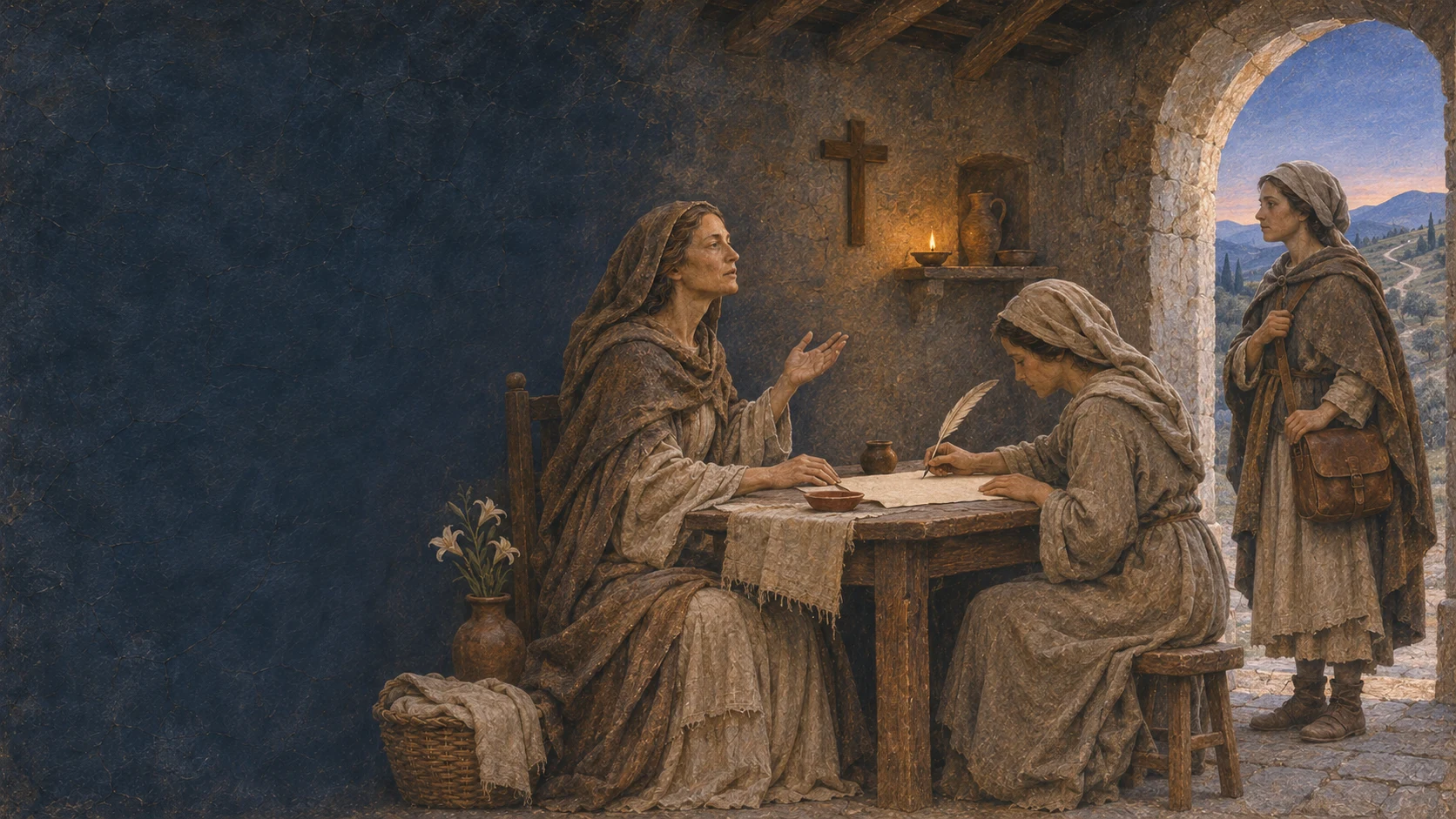
The image of a sister waiting beside Clare as a messenger leaves is an artistic reconstruction. The secure fact is the text itself: Clare knew Agnes’s social position, her refusal of marriage and her religious choice.
She writes with joy. She says the new sister’s fame reached not only her but almost the whole world. This is an expression of admiration, not an audience measurement.
The letter begins with titles
Today’s readers may find the long medieval greeting strange. Clare introduces Agnes through titles of birth and spiritual titles. Then she calls herself an “unworthy servant of Jesus Christ” and a “useless servant of the enclosed ladies of San Damiano.”
This is more than low self-esteem. Humility in letters was part of religious language. At the same time, Clare knows her authority: she advises a princess, interprets her choice and speaks for a community.
She shifts the titles. Agnes is a king’s daughter, but her great dignity comes from having chosen the poor Christ. Clare is socially lower than a princess, but becomes a sister and guide.
The noblest bridegroom
The letter’s central language is bridal. Clare presents Christ as a spouse of incomparable beauty, nobility and power. She speaks of union, love and reward.
This language comes from the Bible, liturgy and a long Christian tradition. The Song of Songs, the parables of the bridegroom and images of the Church as bride offered a vocabulary for religious women and men.
Today we need to read it without imagining a modern romance. Clare does not replace an earthly prince with an invisible prince in a sugary story. The bridal image expresses total commitment, spiritual intimacy and covenant. It also gives Agnes a way to say that her life was not empty because she did not make a political marriage.
Beauty and poverty
Clare brings together words that seem opposed. The bridegroom is more beautiful, nobler and richer, but chose to become poor. Agnes, born amid wealth, finds dignity in following that poverty.
This is not about pretending hunger is beautiful. Clare knew real deprivation. In the letter, poverty is participation in the life of Christ, who did not dominate through wealth and coercion. It is freedom from the court’s measures, where value could be counted in lands, dowries and alliances.
This idea holds a risk. When comfortable people romanticize others’ poverty, they hide injustice. Clare writes from within a choice she has made, and to a woman equally able to choose. The letter should not be used to tell people in need that their misery is good.
“A wonderful exchange”
Clare calls Agnes’s choice a wonderful exchange or bargain: leaving temporal possessions to receive eternal ones; exchanging earthly things for heavenly ones.
The economic vocabulary may be surprising. Assisi was a city of trade, and Clare had grown up in a world of property and dowries. She uses familiar language to reverse it. The greatest gain comes not from accumulating, but from ceasing to be possessed by what one possesses.
This is not a mathematical calculation of merit. It is a metaphor speaking to someone surrounded by dynastic negotiations. Her refusal was not a meaningless loss; Clare interprets it as the choice of another treasure.
Two women and many institutions
The correspondence may seem like private conversation, but it was connected to friars, popes and kingdoms. Agnes was negotiating her form of life with Gregory IX. Clare knew similar tensions. Their friendship offered support for resisting models that allowed more extensive property.
Later letters make this function even clearer. Clare does not write only to console. She helps Agnes discern conflicting advice and remain on the path she had chosen.
The First Letter already lays the ground for that trust. Clare does not treat Agnes as a distant follower. She recognizes her decision and promises spiritual union between the two communities.
What the document does not tell
We do not have Agnes’s reply to this letter. Nor do we know how she read it: alone, before the sisters, with a translator’s or a friar’s help. Latin was the international language of the Church and court, but community reading could take varied forms.
We do not know whether Clare wrote every word in her own hand. People in authority often dictated to scribes. The letters have thematic coherence and a voice of their own, but the physical work of the pen may have been someone else’s.
These silences do not make the correspondence false. They simply prevent us from filming with certainty what the documents do not show.
Document, testimony and tradition
The letter is a primary document transmitted as Clare’s work. Its vocabulary can be compared with the other letters, the Rule and the Testament.
Information about Agnes also comes from papal documents and dynastic records. Saints’ lives written later are hagiography: they preserve memories, but organize facts to show holiness. Traditions about dramatic marriage proposals may bring real events together into simpler scenes.
When we describe Clare looking toward the road to Prague or Agnes pressing the parchment to her chest, we are making a reconstruction. The friendship is documented; the gesture is not.
A language capable of reaching far
Clare was enclosed, but her voice was not imprisoned. The letter traveled where her body would not. It reached a woman with a different background, climate and political problems, and found a common experience.
The two were not alike in everything. Clare came from Assisi’s urban nobility; Agnes, from a royal family. San Damiano had grown in an improvised way; Prague began with resources and international attention. Even so, both asked whether a women’s community could live the Franciscan inspiration without being pushed toward the usual property-based model.
That is why the First Letter remains alive. It offers more than praise. It shows someone saying to another: I see the price of your choice; do not let the world call it a loss.
Sources and paths for further reading
- Clare of Assisi — First Letter to Agnes of PraguePrimary document. Latin/English text and metadata of the letter, dated 1234.
- Epistolae — Agnes of PragueDocumentary dossier. Brings together surviving correspondence surrounding the princess and abbess.
- Epistolae — Clare of AssisiPrimary corpus. Allows comparison of the four letters and other documents.
- Writings of Saint ClareClarean source. Offers the letter within the body of her spiritual writings.
- Oxford Academic — Clare, Agnes and the Privilege of PovertyAcademic research. Discusses the shared struggle for a women’s Franciscan identity.
- Cambridge Companion — the emergence of the Second OrderAcademic research. Places Clare and women’s communities within the Franciscan movement.
- John Paul II — Saint ClareChurch reading. Highlights the correspondence with Agnes and its spiritual language.
How we read the letter: the text is a primary document. Agnes’s marriage politics are supported by medieval documentation, but dramatic scenes belong to tradition. The manner of writing, the journey and the first reading are reconstruction.