
In 1247, Clare had been ill for many years. Even so, a new sheet from Rome demanded attention.
Pope Innocent IV had issued a rule for the women’s communities associated with San Damiano. The text recognized their connection with the Friars Minor and introduced important changes. It also allowed them to own assets in common.
For many houses, this could seem a relief. For Clare, it touched the heart of the problem.
A new pope, an old difficulty
Innocent IV became pope in 1243. He inherited a Church in political conflict and a Franciscan movement spread across many territories.
The women’s communities were not identical. Some wanted San Damiano’s model; others needed or accepted property. Creating a common rule required accommodating different realities.
On August 6, 1247, Innocent presented his form. It replaced earlier elements and recognized the friars’ Rule on points such as obedience, chastity and individual renunciation of possessions.
Individual property and common property
The distinction seems small, but changes everything. A sister could own nothing personally while the monastery owned fields and sources of income.
This model was common in religious communities. It protected against private wealth without leaving the house without resources.
Clare wanted to go further. The Privilege of Poverty protected the entire community from the obligation to own. Forbidding personal possessions was therefore not enough.
Connection with the friars
The Rule of 1247 placed responsibilities in the hands of the minister general and friars entrusted with inspection and spiritual assistance.
This could answer the sisters’ wish not to be abandoned. At the same time, it reinforced an institutional dependence. The friars had their own debates and did not always wish to take responsibility for all the women’s houses.
Clare needed a bond without losing her voice. The new rule offered the first, but did not fully guarantee the second.
A solution for many houses
It would be unfair to treat the text as a simple attack on Clare. For communities spread across Europe, owning assets could be necessary. A general rule needed to work beyond Assisi.
The problem lay in turning a possible solution into a compulsory identity. San Damiano had its own privilege and history.
Clare did not demand that every religious woman live exactly as she did. She fought so that her community would not be prevented from doing so.
The response was to write
Clare’s Rule probably took shape over years, but the pressure of 1247 helps explain its final urgency.
Instead of simply refusing, she produced a text. She adapted elements from the friars’ Rule, monastic tradition and the sisters’ actual experience. She placed most high poverty within the structure.
This step turns Clare from a recipient of rules into an author of legislation.
A woman writing law
Medieval legal texts passed through scribes, cardinals and authorities. Saying that Clare wrote her Rule does not necessarily mean she held the pen for every line.
It means that the form expresses her community and her ability to act. Studies examine words, borrowings and structure to understand different people’s participation.
Medieval authorship could be collaborative. Recognizing this does not remove Clare; it avoids imagining her working like an isolated modern writer.
The reading in our artwork
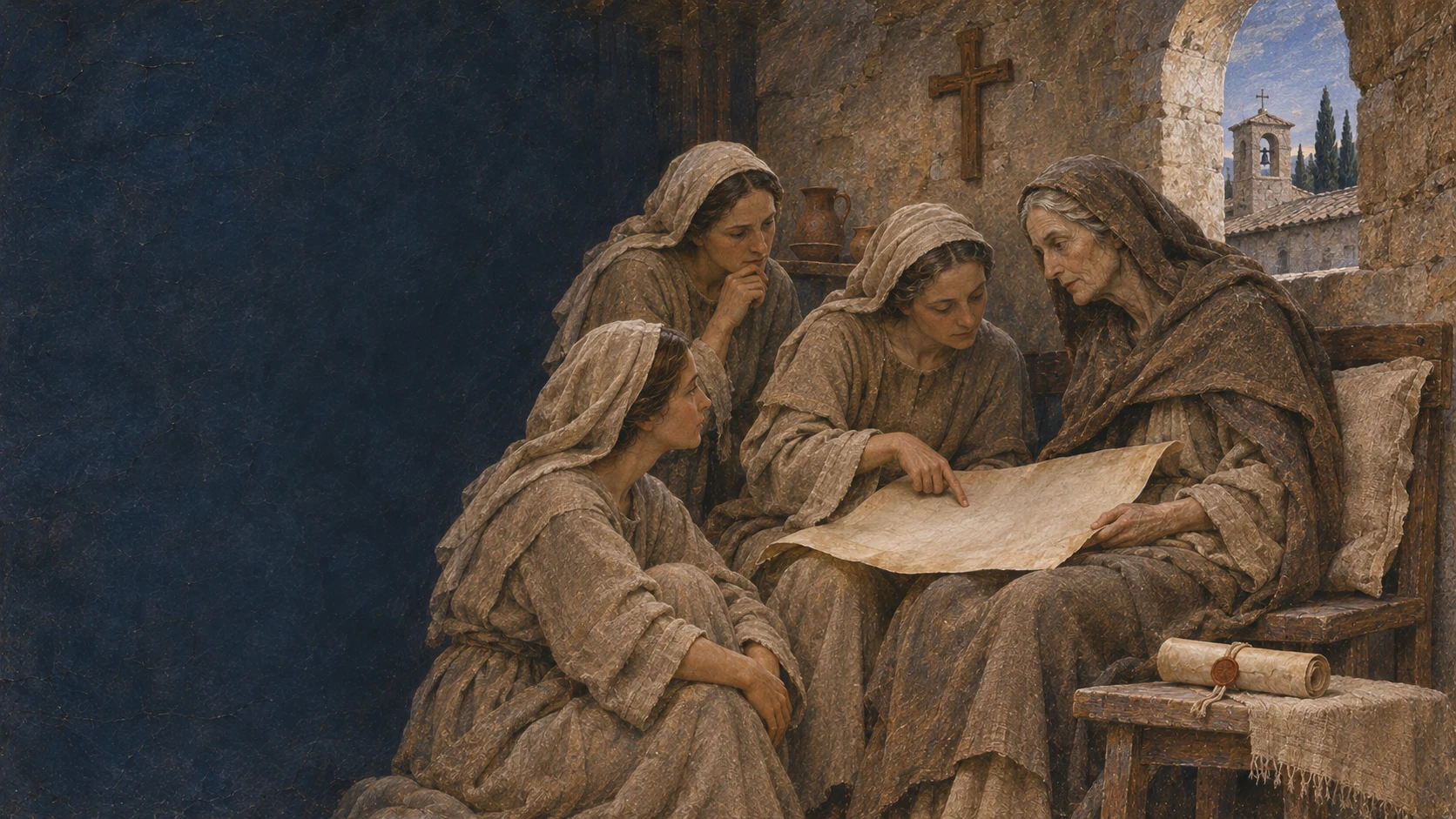
The image shows sisters gathered around the document of 1247. Clare does not appear alone receiving orders. One sister reads, another watches and a third holds the lamp.
The scene is a visual reconstruction. We do not know when the parchment arrived or who read it first. The composition emphasizes that rules affect communities of living people.
The painted text remains illegible. We do not want to invent handwriting that looks like a real document.
Illness did not end her government
Clare spent long periods ill. A superficial reading might imagine that decisions were made without her.
Her writings as a whole and the final approval show the opposite. Illness limited movement, but not necessarily discernment. An abbess could govern from bed, listen to sisters, receive messengers and work with advisers.
Her fragile body makes her activity more concrete, not miraculously easy. Writing and negotiating took energy.
The rule that did not prevail
Innocent IV’s form was not simply canceled for every community. The history of the Poor Clares would continue with different rules. Not all adopted Clare’s text.
This matters because it prevents a narrative of total victory. Clare obtained approval for San Damiano and houses following her form, but institutional diversity remained.
The name “Poor Clares” can hide this later complexity.
One document prompts another
In 1247, a papal rule arrived as an answer to real problems. By allowing property, it showed Clare that the core of her experience needed protection within a complete text.
Sometimes an insufficient proposal helps a community discover its own voice. Innocent IV’s Rule is more than an obstacle; it is part of the path that made Clare’s Rule possible.
Six years later, another parchment would arrive at San Damiano. This time, the confirmed text would carry the form built by the community itself.
A change that seemed small
Allowing assets in common could sound like a technical detail: no sister would own anything individually, and the community would have only what it needed. For Clare, however, the difference affected the entire architecture of life.
With common property, acquisitions, titles, income and management would need to be defined. Outsiders or designated sisters would handle these relationships. The house would have greater stability, but also new responsibilities and ties. Personal poverty would remain; the community’s poverty would change.
There is no reason to conclude that Innocent IV wanted to make the sisters rich. The solution followed a long monastic tradition and answered real needs. The conflict lay in the meaning of “necessary” and the kind of security compatible with Franciscan memory.
Many communities, one regulation
By the middle of the 13th century, women’s houses connected in some way to the Friars Minor existed in different regions. Not all had begun like San Damiano. Some had owned property since their foundation; others depended on noble families; others sought stricter poverty.
A common papal rule made inspection and recognition easier. At the same time, it treated diversity as an administrative problem. Clare did not need to deny the legitimacy of other houses to state that her community did not fit entirely within that solution.
The bond with the friars could shrink
The rule of 1247 gave the Friars Minor a role in assistance and inspection. Shortly afterward, however, Innocent IV allowed the minister general to free himself from responsibility for the women’s communities. This shift showed how a promise depending only on outside decisions could disappear.
Clare responded in her own Rule by asking the minister general for chaplains and serving brothers. She was not seeking to control the male Order; she was trying to ensure that the spiritual family created around Francis would not abandon the women when the founder could no longer defend them.
From objection to authorship
Clare’s response was more than a protest against 1247. She produced a complete alternative. She included poverty, but also elections, work, silence, care of the sick, government and external relations. This proves that her resistance was not a childish refusal of any regulation.
She knew the law well enough to write within it. Innocent IV’s Rule, although not her desired answer, helped make one question urgent: if the available models did not express San Damiano, who could write a text that did? Clare answered with forty years of experience.
Reading without making the pope a villain
A good reading maintains the tension without handing out simple masks. Innocent IV sought a workable organization for real communities. Clare defended the idea that practicality should not cancel the spiritual calling. Both dealt with survival; they measured different dangers.
The text of 1247 was not a useless failure. It made the point of disagreement visible and offered materials that could be accepted, adapted or refused. Clare’s response grew more precise because she had a concrete alternative before her.
A received rule
Sources with commentary
- OFS Australia — Clare and the rulesDocumentary overview. Summarizes the content and context of the Rule of 1247.
- Cambridge — a study of Saint ClareCritical history. Places the text among the women’s rules of the 13th century.
- The Medieval Review — Clare and the ChurchAuthorship and institution. Discusses the formation of Clare’s Rule in response to the papal environment.
- Epistolae — Innocent IVCorrespondence. Brings together papal letters connected to Clare and Agnes of Prague.
- Vatican — Rule and povertyInterpretation. Highlights the focus on Christ at the heart of Clare’s insistence.
- Oxford Academic — the struggle for a Franciscan RuleResearch. Places Clare and Agnes in the debate over property and identity.
How we read 1247: the date, text and permission for common assets are documented. The reading meeting shown in the artwork reconstructs the impact on the community.