
For many years, Clare lived under texts written by men. Popes and cardinals prepared regulations for women’s communities. Francis had left brief, precious words. Appointed visitors explained what was permitted. Even so, none of these voices knew San Damiano like the women who woke, prayed, worked, fell ill and made decisions there every day.
Then Clare wrote.
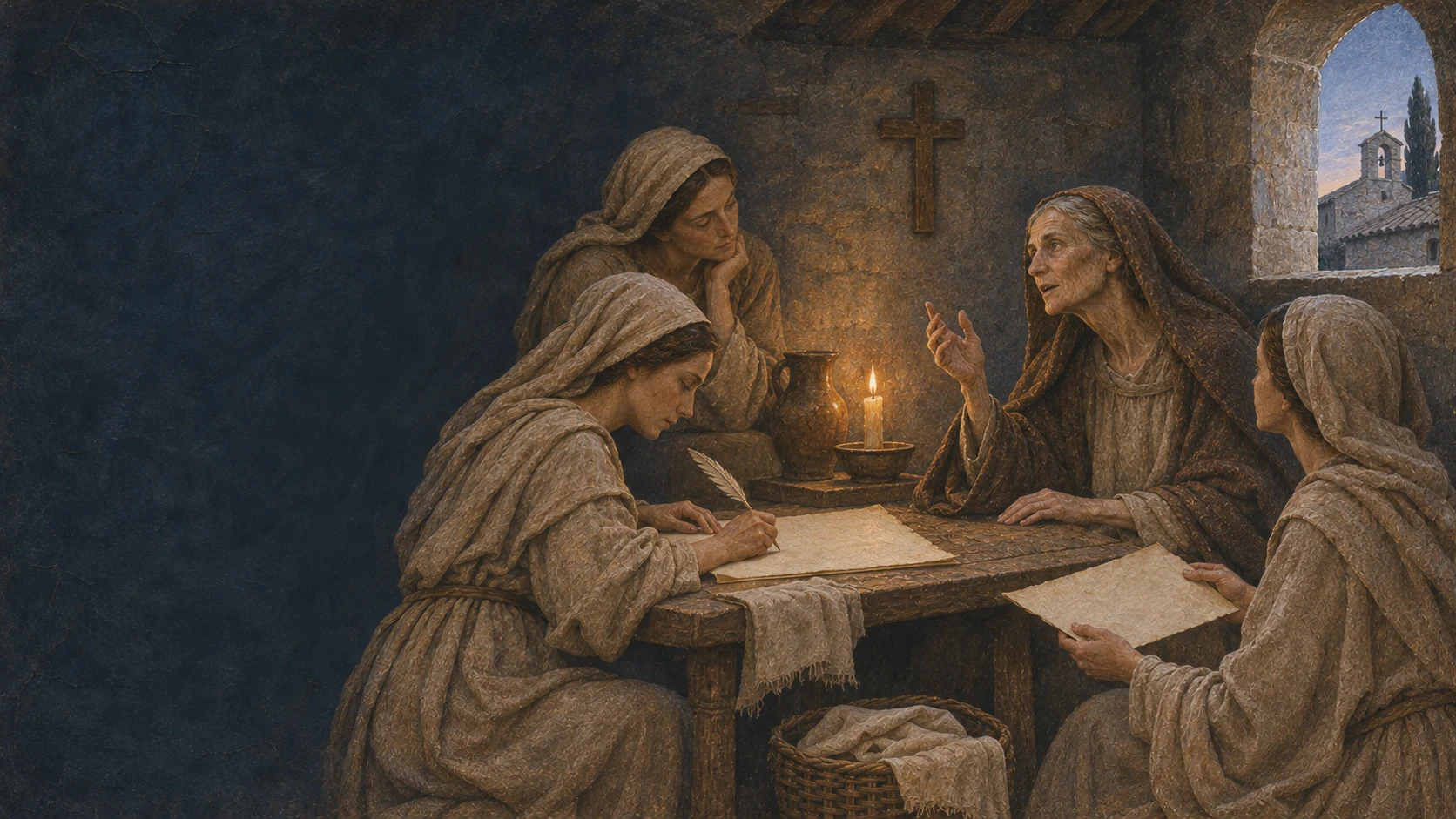
We do not know on which morning she asked for parchment, or which sister held the pen. Illness already forced her to remain lying down for long periods, so she probably dictated passages and listened to readings. That scene is a reconstruction, not a preserved memory. What we know from a document is stronger: the text has reached us and presents itself as the “Form of Life of the Order of Poor Sisters,” established by blessed Francis and confirmed by Pope Innocent IV.
Why this was extraordinary
In the 13th-century Church, women could found communities, teach by example, advise and govern monasteries. But final approval of a rule depended on male Church authority. Furthermore, the Fourth Lateran Council, in 1215, had restricted the creation of new religious rules. New communities were to adopt a recognized form.
Clare did not simply ignore this world. She learned to speak within it. She kept documents, wrote to popes, spoke with cardinals and accepted protections that did not destroy her purpose. Her Rule grew from this long practical intelligence.
It is generally recognized as the first rule for women composed by a woman to receive papal approval. That statement needs care: women had legislated and organized houses before her, and many texts grew from entire communities. What is distinctive here is the combination of Clare’s authorship, a surviving text, papal approval and an explicitly Franciscan identity.
Writing made of many voices
The Rule did not fall ready-made from heaven. Clare worked with earlier materials. She adopted the structure and several passages of Francis’s Rule confirmed in 1223. She used the short Form of Life Francis had given the sisters and preserved his last wish concerning poverty. She also engaged with regulations and customs practiced at San Damiano.
This does not diminish her authorship. A medieval builder did not need to invent stone to build a church. Authorship also means choosing, ordering, adapting and giving a new direction to what one has received.
When Clare takes words from the friars’ Rule, she does not pretend that sisters and brothers lived in exactly the same way. She transforms the material for a settled community, surrounded by enclosure, dependent on outsiders to seek alms and subject to particular risks. Faithfulness is not copying. It is translating inspiration into another way of life.
Poverty in the first chapter
Right at the beginning, the text declares that the form of life consists of observing the Gospel of Jesus Christ, living in obedience, without property and in chastity. The language draws the sisters close to the Friars Minor. But Clare adds her own community and its relationship with Francis.
Francis’s name does not appear as an affectionate decoration. It serves as a founding memory. Clare recalls her promise of obedience and the responsibility assumed by the saint and his successors. It was a way of saying that San Damiano was not just another women’s monastery placed under whichever model was available.
Poverty also receives concrete form. The sisters should not acquire or possess any house, place or thing, except the small space needed for dignity and seclusion, and a little land for a vegetable garden. This was not contempt for creation. It was a refusal to turn land, income and dependents into a power base.
The abbess does not govern alone
The Rule calls the superior an abbess, but prevents the title from becoming distance. She must be elected by all the sisters and remain a servant of unity. On important matters, she must gather the chapter and hear the community. Clare even says that the Lord often reveals what is best to the least.
That phrase comes from monastic tradition, especially Benedict’s Rule, but gains strength in a house of poor women. The youngest, least educated or socially lowest sister was not noise. Her voice could carry discernment.
The text does not create a modern democracy. There was authority, obedience, offices and differences in responsibility. Yet it draws spiritual limits around power: the abbess is accountable, consults, consoles and must not order anything against the soul or against the Rule.
Real bodies within the Rule
A law can imagine perfect people who never get sick. Clare knew real bodies.
The Rule speaks about food, fasting, clothing, work, silence and the sick. Strong sisters fasted, but sick sisters received exemptions. Those unable to observe the same abstinence were not treated as spiritual failures. The abbess should carefully ask what they needed and provide food, medicine and help.
Here the document meets the testimony of the Canonization Process. Sisters who had lived with Clare recalled her compassion and attention to the sick. The Process seeks to demonstrate holiness and therefore selects uplifting memories; even so, several independent witnesses describe a superior involved in bodily care.
Clare also deals with work. Each sister would do what was entrusted to her, so that idleness would not stifle the spirit, but without extinguishing prayer. The work did not belong individually to the person performing it. It was community service.
Doors, grilles and encounters
The monastery needed to relate to the outside. There were chaplains, serving friars, messengers, workers and people seeking advice. That is why the Rule defines doors, the doorkeeper, the parlor and visits.
Read quickly, this part may seem to be only about surveillance. In the 13th century, however, enclosure was also connected to safety, public reputation and the possibility for women to maintain a way of life not controlled by family alliances. At the same time, it could be imposed in a suffocating way. Clare writes within this tension, not outside it.
She regulates contact without imagining San Damiano as a tomb. The sisters remained connected to Assisi, the friars and the world’s needs. Enclosure protected a space of life; it did not remove every relationship.
The minister general and the serving brothers
In the final chapter, Clare asks that the community always have a Friar Minor as its appointed visitor and requests chaplains and lay brothers from the minister general to help them. It is one of the Rule’s most delicate points.
The sisters wanted to belong to Francis’s family. They also needed Mass, confession, preaching and outside service. Yet depending on the friars could make them vulnerable if the Order’s leaders refused this responsibility. The Rule seeks to turn a founding friendship into a lasting commitment.
We do not know whether all the friars welcomed this enthusiastically. Later documents show negotiations and limits. Claiming perfect harmony would therefore be idealized tradition, not demonstrable history.
Did Clare sign alone?
The text bears her mark, but arose within a community. The sisters heard, practiced and probably commented on the regulations. Some had known San Damiano since its first years; others brought different experiences. The papal approval mentions the petition of Clare and the sisters.
It is therefore better to imagine authorship without solitude. Clare had a decisive role — her Testament, letters and persistence confirm a voice of her own — but she wrote the life shared by many women.
The early hagiographic Legend presents the saint as a founder enlightened by God. That image expresses the religious meaning her contemporaries gave the work, but does not describe meetings, drafts or corrections. We do not have that behind-the-scenes record.
A Rule to remain at the beginning
Clare did not want to freeze 1212 as if nothing had changed. In forty years, the small fraternity had become a recognized community. There were elderly, sick and newly arrived sisters, and legal responsibilities. Remaining at the beginning meant carrying the original inspiration through time.
Her Rule does exactly that. It preserves poverty without ignoring the vegetable garden. Preserves sisterhood without erasing the abbess. Preserves prayer without forgetting soup, blankets and medicine. Preserves Francis without making the sisters a copy of the friars.
When she finally received confirmation, Clare was near death. The parchment did not give her an identity she had not possessed before. It recognized, in official language, what she and her companions had learned through the body, hunger, conflict, prayer and faithfulness.
Sources and paths for further reading
- Innocent IV — Solet annuere and Clare’s RulePrimary document. Provides the papal confirmation and the text of the Form of Life.
- Writings of Saint ClareClarean source. Brings together the Rule, Testament and letters to compare themes and vocabulary.
- Epistolae — Clare of AssisiDocumentary corpus. Places the Rule among the letters and privileges connected to Clare.
- Cambridge Companion — Francis, Clare and the Second OrderAcademic research. Analyzes the institutional emergence of the Poor Sisters.
- University of St Andrews — Clare and early Franciscan womenUniversity research. Helps explain authorship, authority and women’s religious identity.
- Benedict XVI — Saint Clare of AssisiChurch reading. Summarizes her life and highlights the Rule approved at its end.
- The Medieval Review — studies on ClareAcademic review. Points to modern debates about texts, government and context.
How we reconstruct the writing: the approved text is a document. Clare’s decisive participation is well supported; the sister who served as scribe, the dictation sessions and the exact order of drafts are plausible reconstructions, not witnessed scenes.