
Francis died on the afternoon of October 3, 1226. Clare would live for almost another twenty-seven years.
That difference changes the story. She did not spend her entire life walking in the shadow of a man who was present. She governed, wrote and negotiated for decades after his voice fell silent.
Grief opened a void. It also revealed Clare’s responsibility for what would survive.
The body before San Damiano
Early sources recount that the procession carrying Francis’s body passed San Damiano on its way to Assisi. The sisters were able to say farewell to the man who had accompanied the community’s beginnings.
The scene is deeply physical: a grille, an opening or a meeting space; enclosed women; a body being carried. Later narratives intensify the emotion and details.
We do not know every word spoken. We know that the death was public and that San Damiano was connected to the founder’s memory. The procession allowed a farewell within the boundaries of the sisters’ life.
Losing a friend and a protection
Francis was more than a spiritual inspiration. His relationship with the friars gave weight to the commitment to care for the sisters.
His death raised an institutional question: would his successors recognize the same responsibility? The Order of Friars Minor was growing and debating poverty, study and government.
Clare had the support of authorities, but knew that people change. That was why memory needed to be written down.
The preserved Form of Life
Clare’s Rule preserves brief words attributed to Francis for the sisters. He recognizes that they chose to live according to the Gospel and promises care from himself and the brothers.
It also preserves a last wish concerning poverty. These fragments are small. That is precisely why they are powerful: they serve as foundation stones built into Clare’s later text.
They do not make up a complete rule for the community. Clare would have to do the work of developing regulations on elections, work, fasting, government, silence and assistance.
Preserving Francis did not mean asking him to write everything for her.
Memory can become an argument
In negotiations with popes and cardinals, Clare could recall the beginning. Her Testament insists that the form of poverty was received at the start and confirmed through her relationship with Francis.
This memory is spiritual and political. By telling how everything began, Clare explains why future authorities should not turn San Damiano into something else.
All memory selects. The Testament is not a neutral camera; it is the voice of a founder near the end, wanting to protect the community. That does not make it false. It makes its purpose visible.
A woman facing her own authority
While Francis lived, it was possible to ask what he wanted. Afterward, various people could claim to know his intention.
Clare held a particular authority: she had lived the experience, received his words and led the community since its early years. Even so, as an enclosed woman, she did not hold offices in the male Order or occupy the places where many decisions were made.
Writing became a way to be present beyond the walls.
Almost three decades of change
Between 1226 and 1253, the Franciscan world changed. The basilica in Assisi was built. Francis was canonized. Biographies were written. Friars reached universities and courts. The movement became an international institution.
Clare did not watch everything from afar. She received news, letters and visitors. She corresponded with Agnes of Prague. Negotiated with popes. Her community was part of this transformation, although it occupied a different place.
That is why it is wrong to end her story at Francis’s death. Most of her surviving writings and her mature legal struggle belong to the period afterward.
The silence of our artwork
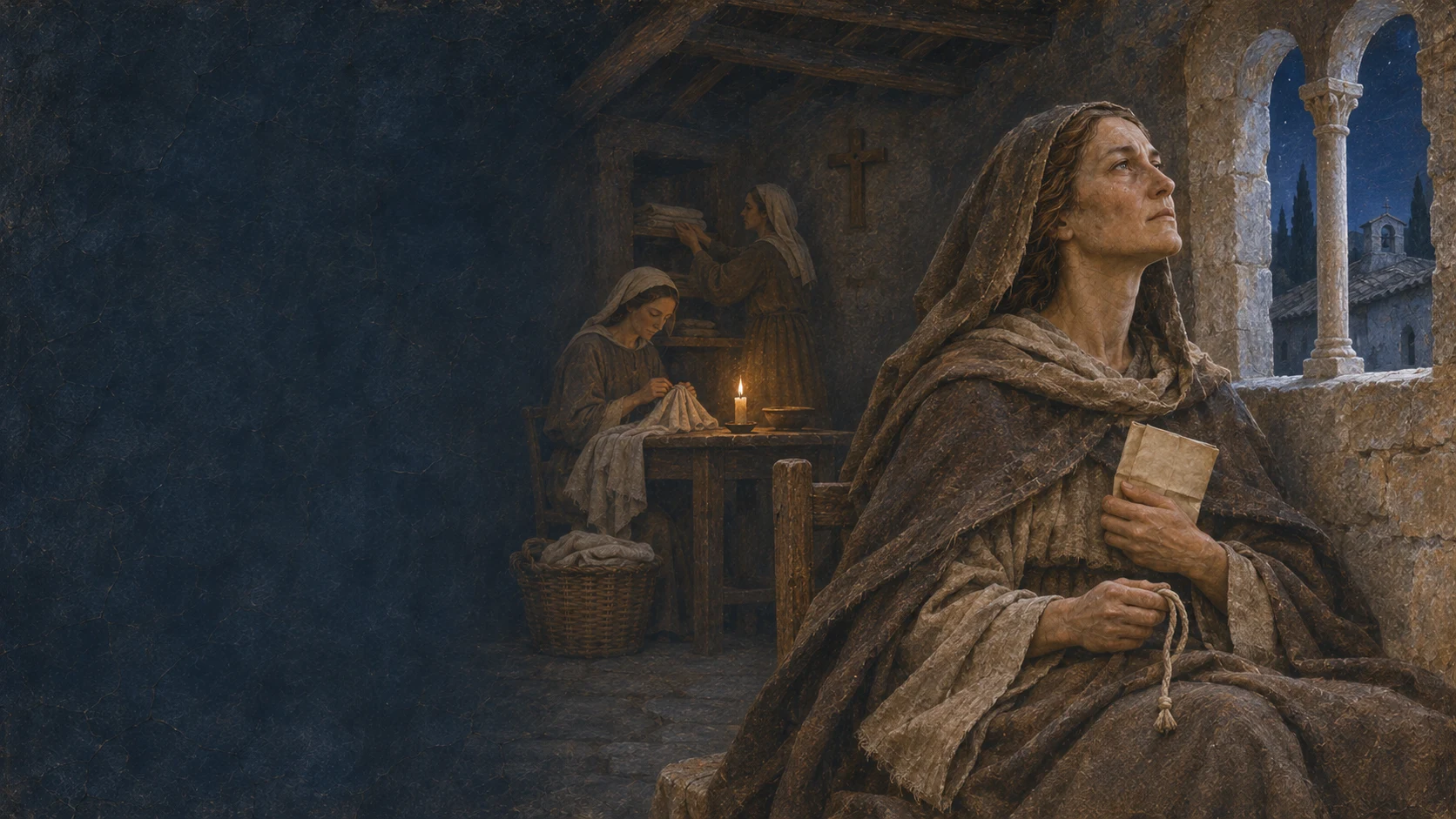
The image shows Clare beside the window, with a small sheet and a cord on the table. There is no vision of Francis or transparent memory in the background.
It is a contemplative reconstruction of grief. We know of no specific night. The sheet represents preserved words; the cord, Franciscan life. Absence is shown without fantasy.
Clare is no longer the young woman at the Porziuncola. Her face carries years. Visual continuity matters: the story does not freeze a saint at a single age.
Faithfulness is not standing still
After a loss, people may try to preserve everything exactly as it was. But living communities face new situations.
Clare had to distinguish the core from the form. The core was following the poor Christ in unity. The legal forms would need to be written and approved within a changing Church.
Her Rule would draw on Franciscan and monastic elements and on San Damiano’s experience. This composition does not betray the beginning; it shows a founder at work.
Friendship without erasing a person
Clare loved and respected Francis. The sources make his importance clear. But saying this does not require erasing her intelligence.
For almost twenty-seven years, there was no living Francis to guide San Damiano. There were Clare, sisters, friars, cardinals and popes. She listened, decided, insisted and wrote.
True friendship does not turn one person into the other’s echo. Francis helped Clare begin. His absence allowed the centuries to see what a hurried narrative might hide: she could hold the light in her own hands.
What an absence changes
While Francis lived, a visit, a message or a direct recollection could clarify the meaning of the beginning. After 1226, different people began speaking in his name. Friars debated how to interpret poverty. Authorities chose which promises had legal force. Memory became disputed ground.
Clare had an advantage and a burden: she had known him and received words from him addressed to the sisters. But personal experience does not automatically become a document accepted by everyone. She had to preserve, repeat and insert those words into texts the Church could recognize.
Her Testament recalls Francis’s Form of Life and last wish; her Rule incorporates these memories. Grief thus also produced archival work.
The community remembered too
Clare was not alone in preserving the past. Long-standing sisters had heard sermons, witnessed visits and shared decisions. When the Canonization Process opened, some offered testimony about the early years. They spoke decades later and in a religious context, so their memories need to be assessed, not copied like a recording.
Even so, the agreement among voices prevents the story from being reduced to the abbess’s solitary invention. San Damiano had a community memory. Clare gave it a particularly powerful form.
Twenty-seven years were not an epilogue
Almost three decades fit between Francis’s death and Clare’s. During that time she followed the sisters’ expansion, wrote to Agnes, received privileges, faced the Rule of 1247 and composed her own Form of Life. Calling all this “afterward” can hide a creative phase.
Francis remained a reference point, but Clare became an interpreter. Faithfulness no longer meant waiting for the founder’s voice; it meant discerning how his inspiration would live under conditions he had not known.
The procession and the city
The early narrative recounts that Francis’s body, carried from the Porziuncola to Assisi, passed before San Damiano so that Clare and the sisters could say farewell. The route is preserved in Franciscan hagiography and became a deep part of local memory. We have no independent logistical record listing every stop.
The meaning of the scene, however, corresponds to a documented relationship: these women were not distant spectators of the fraternity. The public farewell recognized a spiritual friendship that enclosure did not erase.
After the procession climbed the hill, San Damiano remained in the same place. The sound of footsteps disappeared, but the institutional questions stayed. The image of the community before the body is only complete when we see the years of work that followed that goodbye.
Grief became perseverance.
Memory after farewell
Sources with commentary
- Writings of Saint ClarePrimary voice. The Rule and Testament preserve the Form of Life, the last wish and the memory of the beginning.
- Cambridge Companion — Francis and ClareHistorical relationship. Analyzes their bond and the emergence of the women’s community.
- Vatican — Clare’s eighth centenarySpiritual reading. Presents her writings and autonomy within the Franciscan heritage.
- Franciscan Institute — early sourcesCorpus. Brings together writings and witnesses from the first generations.
- The Medieval Review — Clare and the ChurchAgency. Highlights the complex formation of the Rule after Francis’s death.
- Epistolae — Clare of AssisiDocumentary chronology. Shows the extensive correspondence and activity after 1226.
How we read the grief: the death, the passage of the procession and the preserved words have early sources. The silent night in the artwork and Clare’s exact thoughts are a contemplative reconstruction.