
Privileges usually gave something: land, protection, exemption, income or authority. Clare asked for a privilege that allowed her not to receive.
The document of September 17, 1228 states that she and the sisters could not be forced to accept property. Pope Gregory IX was recognizing, in solemn language, a choice that seemed economically dangerous.
They called it the Privilege of Poverty.
The document we can read
Gregory IX’s letter survives in the documentary record and has a precise date. It is addressed to Clare and the other servants of Christ gathered at San Damiano.
The text recognizes that they sold and distributed their possessions and wished to own nothing. It then grants that nobody may force them to accept property. Its language connects their choice to the poor Christ and to trust in divine care.
For the historian, this letter is firm ground. It does not prove every later story about spoken negotiations, but it shows that in 1228 the issue was already clear and important enough to receive papal confirmation.
What about Innocent III’s letter?
Clare’s Testament recalls that she asked Pope Innocent III, who died in 1216, for the privilege. A version of a text attributed to him circulated in the tradition.
Here a debate begins. Some scholars and Clarean memory accept an initial grant by Innocent, later confirmed by Gregory. Others note problems with its transmission, wording and the absence of the original.
We do not need to settle the controversy by pretending certainty. We can say two things together: Clare bears witness to a very early initiative; the securely preserved document is the one from 1228.
This distinction does not diminish the Testament. It shows how personal memory, archives and copies have different histories.
A privilege against whom?
The text does not accuse a specific person. It protects against any authority or benefactor who might wish to impose property.
A family might offer land out of generosity. A bishop might consider it necessary. A pope might want to guarantee food. Pressure could come from good intentions.
That is why the protection needed to be broad. Clare did not want to depend on someone’s temporary goodwill. A successor might think differently. The parchment would outlast the conversation.
The power to say no to a donation
In medieval culture, refusing a powerful gift was no simple gesture. Donations created ties of gratitude, remembrance and influence. A monastery prayed for its benefactors and might house family tombs.
Without property, San Damiano limited noble families’ ability to shape the house through wealth. The privilege protected poverty and also a form of freedom.
Yet that freedom remained dependent on alms. The sisters did not stop receiving food or necessary objects. The difference lay between use and ownership, immediate help and permanent income.
Gregory knew the risk
Gregory IX was the former Cardinal Hugolino. He knew Francis, Clare and the difficulties of organizing women’s communities. He did not grant the text out of ignorance.
The document itself recognizes bodily weakness and the need for support. Spiritual trust does not erase the body. The pope accepts that the community will walk without the normal kind of guarantee.
This makes the grant more impressive: it is not youthful enthusiasm, but an institutional decision in the face of a known risk.
The scene with the seal
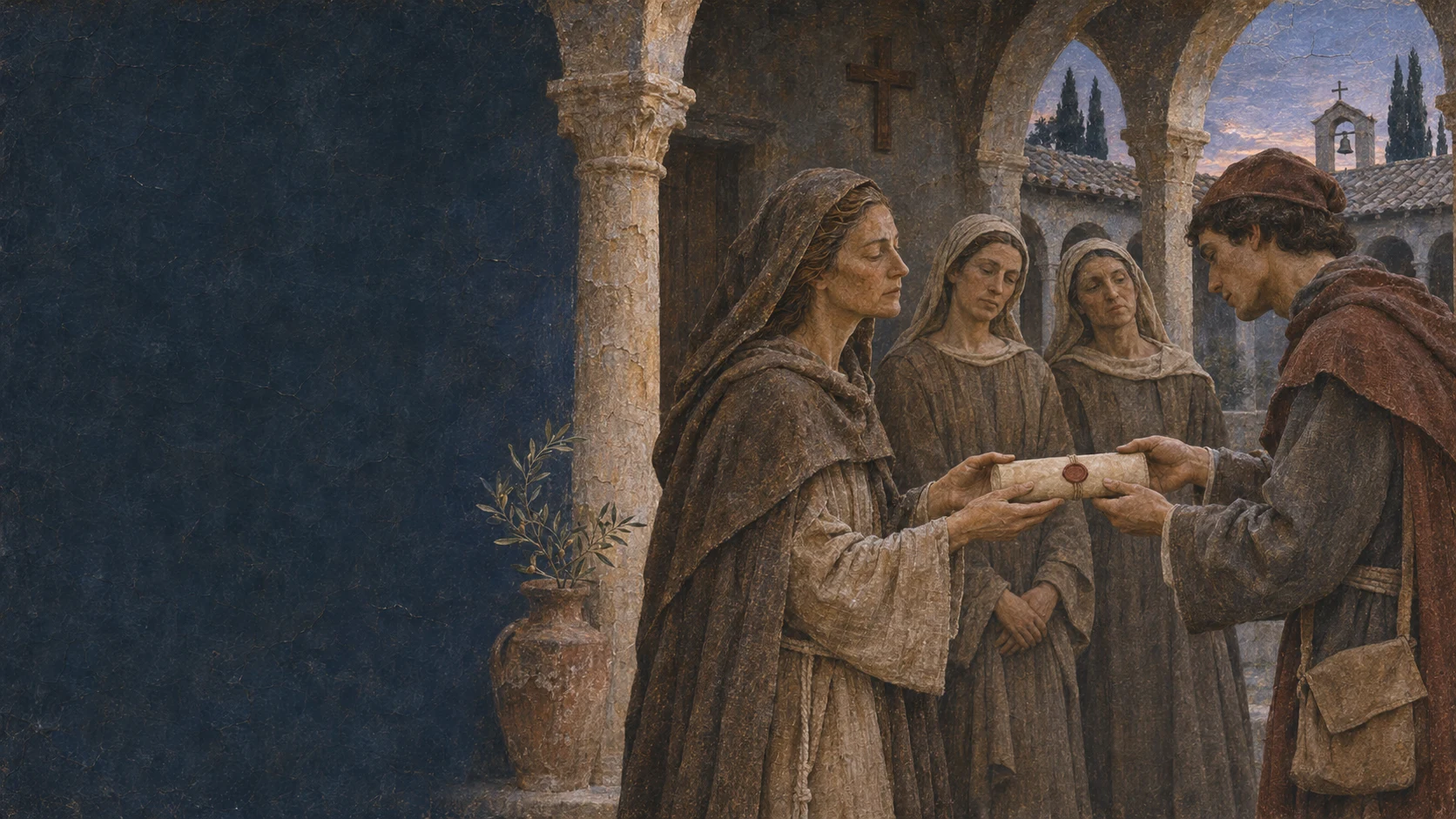
Our artwork shows a messenger handing the parchment to Clare before the sisters. The seal is visible, but there is no legible writing.
We do not know how the document arrived, who carried it or where Clare first read it. This is a visual reconstruction. The scene gives material form to something documented: a decision from Rome had to travel to Assisi and be received by women who may never have imagined that it would still be read eight centuries later.
Clare holds the sheet, but the sisters surround the gesture. The privilege was no personal prize; it protected the community and its successors.
Poverty chosen and poverty suffered
One point requires care. Clare chose to give up wealth from a position of nobility. Many poor people in Assisi did not choose hunger, debt or lack of land.
Her proposal should not turn involuntary misery into beauty. Gospel poverty sought to bring the sisters closer to the stripped Christ and prevent domination. To be faithful, it needed to create solidarity, not indifference toward those suffering need without a choice.
Medieval texts do not always develop this difference in our current words, but the reader should see it.
A right that needed renewal
Receiving a privilege did not end the struggle. New rules and new popes created other tensions. Agnes of Prague would seek similar protection for her community. Clare would keep working for a Rule that placed poverty at its center, rather than adding it as an attached exception.
The document of 1228 served as a legal shelter. But a shelter can be removed or interpreted narrowly. Lasting security would only come when Clare’s own form of life was confirmed in 1253.
The sheet and the choice
The parchment did not create San Damiano’s poverty. The community was already living it. The document did something else: it recognized that this experience had legal dignity.
This is one of the strongest images of Clare. She did not leave the institution to preserve her insight. She learned to ask, argue and obtain unusual protection within it.
The privilege reveals a contemplative woman who understood archives. A mystic who knew that future generations would need text, seal and memory.
On the sheet of 1228, the absence of property ceased to be only a weakness. It became a freedom nobody should take away.
A short document with long consequences
The privilege does not describe how to obtain bread, repair the roof or care for an elderly sister. Its purpose is narrower: to prevent property from being imposed as the solution to these problems. It creates a boundary within which the community must invent answers.
This difference matters. A legal document does not tell the whole of Clare’s spirituality, just as a key does not describe a house. To understand the meaning of poverty, we need to read it alongside the Rule, Testament and letters. To understand its risks, we need to remember the medieval economic world.
The privilege’s strength lay precisely in being negative: nobody could force them. It did not turn every Christian woman into a Poor Clare or condemn monasteries with assets. It protected a specific community decision against future pressure.
Why the date matters
Gregory IX’s letter is dated September 17, 1228. This firm point allows us to organize other events. Gregory had visited Assisi and knew Clare; Francis had died less than two years earlier; the identity of the friars and sisters was still being defined.
The grant attributed to Innocent III, by contrast, raises questions about transmission. Clare’s Testament recalls that she obtained a privilege from him, and that memory deserves attention because it comes from the founder herself. But the text that circulated under the pope’s name does not have the same certainty as the document of 1228.
Separating these levels does not mean distrusting Clare. Memory and archives answer different questions. Clare could correctly remember an authorization, even if the preserved written form had been reworked or copied later.
A privilege for her successors
Clare might have tried to live her poverty through personal strength. The document shows that she thought beyond her own lifetime. A future abbess would receive donations, pressures and advice that Clare would not be there to answer.
By turning refusal into a right, she gave her successors protection. They could still fail, interpret it differently or face new regulations; but they would not begin without a voice. The papal seal said that the absence of property was not tolerated disorder. It was a recognized choice.
And recognized in writing.
Parchment and memory
Sources with commentary
- Gregory IX — letter of September 17, 1228Primary document. Latin text, translation and context of the Privilege of Poverty.
- Oxford Academic — The Privilege of PovertySpecialist research. Discusses Clare, Agnes of Prague and the legal formation of poverty.
- University of St Andrews — academic reviewHistoriography. Places Joan Mueller’s study of the dispute in context.
- Cambridge — Saint Clare and papal documentsHistorical criticism. Presents the transmission and the different rules and privileges.
- Vatican — Saint Clare of AssisiChurch overview. Acknowledges the attribution to Gregory IX or possibly to Innocent III.
- Writings of Saint ClareClare’s voice. The Testament offers the memory of the initial grant and the commitment to poverty.
How we read the privilege: the letter of 1228 is secure. The grant attributed to Innocent III is an important part of Clare’s memory, but its documentary form is debated. The delivery shown in the artwork is a reconstruction.