
“If you fear breaking your vow, I release you from it.”
“Holy Father, I do not wish to be released from following Christ.”
The dialogue between Gregory IX and Clare has crossed centuries. It is brief, powerful and too perfect to repeat without asking: who heard it? When was it written down? What does it preserve?
The former protector became pope
Before becoming Gregory IX, Hugolino of Ostia had followed the Franciscan movement. He knew Francis and had protected women’s communities. When elected pope in 1227, he did not become a stranger to San Damiano.
His new position, however, widened his responsibility. A cardinal could admire a small community; a pope needed to think about the survival of many houses.
To Gregory, property was not necessarily a betrayal. It could prevent enclosed women from going hungry or being left abandoned when the friars could not help them.
The offer of release
The Legend of Clare, written after her canonization, recounts that Gregory suggested releasing her from the vow if it prevented her from accepting property.
Clare’s reply shifts the question. She does not treat poverty as an obligation she would like to escape. She considers it part of following Christ. A legal release would not change the spiritual experience she had chosen.
The episode fits perfectly with secure documents, such as the privilege of 1228. Yet we have no record of the dialogue itself. We should cite it as early hagiographic tradition, not as a guaranteed literal transcript.
What a pope could release
In the medieval Church, vows and rules belonged to the sphere of authority. The pope had the power to grant exemptions under certain conditions.
Gregory might imagine that freeing Clare from an obligation would resolve her problem of conscience. She replies that the center is not the isolated obligation, but the person she follows.
This reasoning shows inner strength and intelligence too. Clare does not deny the pope’s authority; she explains that permission to own would not create a desire to own.
Security for whom?
Gregory could think of future sisters. Clare had begun young and could bear austerity, but what would happen when the community included elderly, sick and familyless women?
The question was legitimate. A way of life should not depend only on its founder’s heroism. The pope sought a lasting institution.
Clare was thinking of the future too. That was precisely why she wanted a text preserving poverty when she was no longer there. Both were concerned about continuity, but they defined security differently.
For Gregory, security could mean property. For Clare, it meant faithfulness protected by law.
Affection does not remove conflict
Papal texts use warm language for Clare and Agnes of Prague. Gregory admired their decision. The confirmation of 1228 shows that he accepted protecting the absence of property at San Damiano.
At the same time, other letters reveal concern about the resources of women’s monasteries. In Agnes’s case, he tried to connect a hospital’s income to the Prague community. The tension did not disappear.
We do not need to choose between a friendly pope and a controlling pope. He could be both: a sincere protector and an authority convinced that certain guarantees were necessary.
Clare was not alone at the table
Although tradition focuses the dialogue on two people, decisions affected many sisters. Clare spoke as the person responsible for a community.
Her firmness was not a personal taste for suffering. The Testament and Rule present poverty as a common vocation received at the beginning. Changing the foundation would mean changing the identity of the other women, including those yet to come.
When reading the famous reply, we should hear an entire house behind it.
The painted conversation
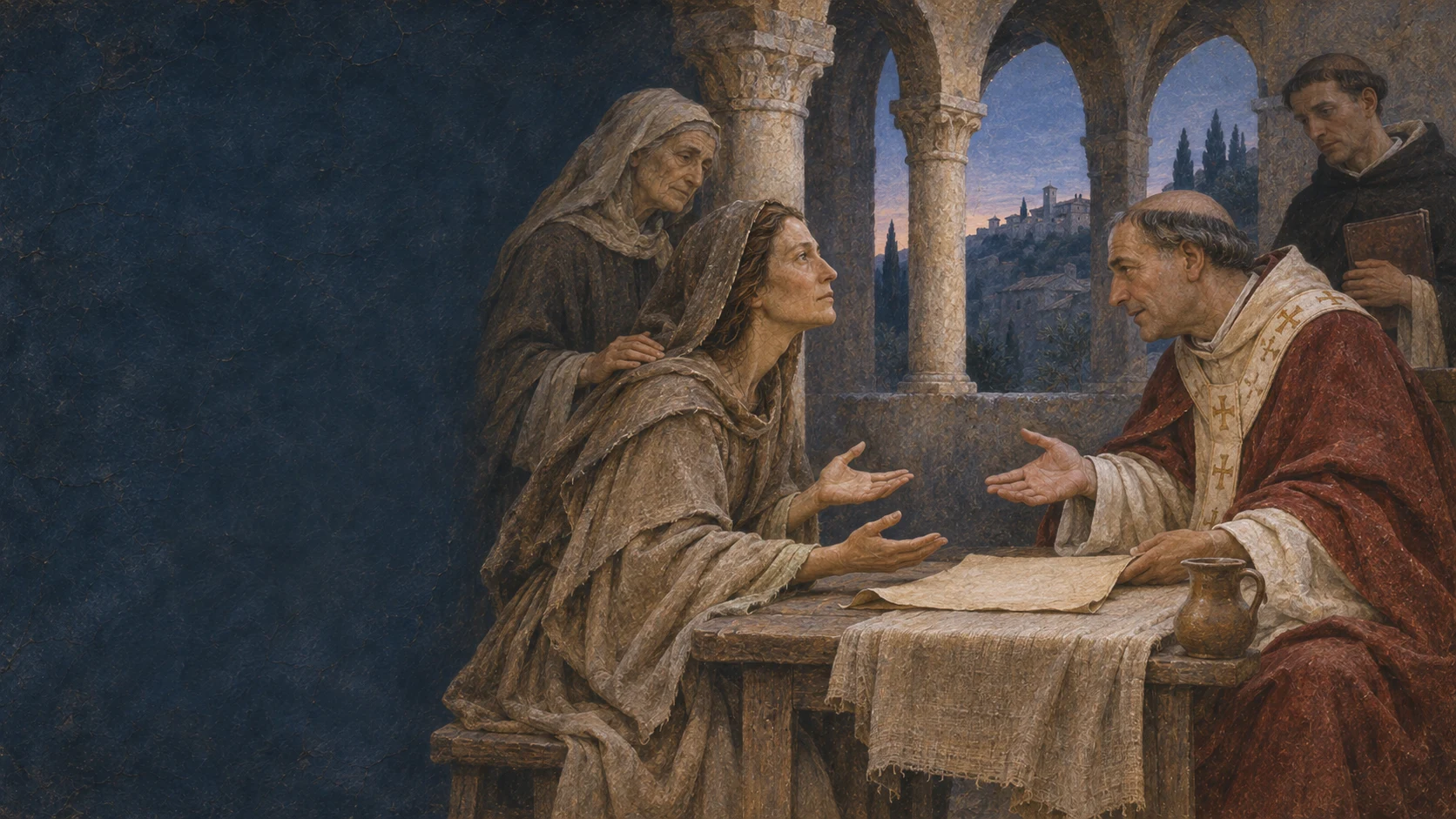
Our artwork places Clare and Gregory beneath the cloister arcade, without a throne or a gesture of confrontation. Sisters appear in the background. Between the two there is no document: there is space.
It is a visual reconstruction. We do not know whether the conversation took place at San Damiano, on which visit or before whom. The composition preserves the Legend’s meaning without pretending to know the details.
We avoided representing Clare as a modern rebel pointing at the pope. Her resistance used respect, persistence and a shared language of faith.
The phrase that grew
Perfect phrases take on a life of their own. Repeated in sermons and biographies, they seem to sum up a whole person. But Clare cannot fit into one reply.
She negotiated for decades. She received documents, accepted some structures, refused others and wrote a Rule. Her firmness did not happen only in one dramatic instant.
The dialogue matters when it opens the story, not when it replaces it.
Obedience without disappearing
Clare offers a complex way of being within an institution. She neither places herself above the Church nor erases her conscience before authority.
She stays in relationship. She asks for approval. Uses arguments. Preserves memory. Her obedience is not passivity; her resistance is not a break.
For a young reader, perhaps this matters more than the famous phrase. There are moments when respecting someone does not mean agreeing. And defending a conviction does not require turning the other person into an enemy.
Gregory offered security. Clare replied with another idea of security: not being drawn away from what gave her life meaning.
The pope and his old friend
Hugolino had known the Franciscan movement before becoming Gregory IX. As cardinal protector, he had accompanied Francis, Clare and new women’s communities. When he became pope, however, he carried broader responsibilities: he needed to think about stability, public scandal, discipline and the survival of houses spread across different cities.
Clare was therefore not speaking with an indifferent stranger. She was in dialogue with someone who understood her origins and, precisely for that reason, believed he had the authority to offer a solution. Their closeness makes the conflict more human. People who care for one another can see different risks.
The weight of a generous offer
Land given by the pope could seem a blessing impossible to refuse. An offer from the Church’s highest authority created gratitude and pressure at once. Saying no required explaining that the problem was not the donor’s bad intentions, but the effect of the donation.
The Legend dramatizes this moment in a memorable exchange of phrases. The text may preserve the heart of the negotiation, but it was written to reveal Clare’s holiness and firmness. We do not know the conversation’s tone, how long it lasted or who was present.
The document of 1228 does, however, show the result: Gregory confirmed that nobody should force the sisters to accept property. Thus the pope who offered security also protected the right to refuse it.
Governing without owning another’s conscience
This episode does not teach that every authority must always give way. It shows that governing requires recognizing experiences an office cannot replace. Gregory could assess institutional risks; Clare knew the daily texture of San Damiano and what ownership would mean for her community.
The solution did not erase the relationship. Clare remained within the Church, and Gregory remained an important part of her history. The conflict produced a legal limit, not a break.
The community behind the reply
Tradition focuses the scene on two strong figures: pope and abbess. But the decision affected all the sisters. They would eat the uncertain bread, work and grow old under that way of life. Clare spoke with authority, but she was not defending a private adventure.
Her later Rule requires important matters to be discussed in chapter. We cannot prove that a specific vote on Gregory’s offer took place, but community government makes it unlikely that the sisters were merely silent scenery.
The artwork represents an encounter; history must remember the whole house. Even a phrase spoken by Clare carried years of collective experience.
This perspective also changes the idea of courage. Clare was not risking only her own comfort. She had to answer for the future of younger women, the sick and those yet to arrive. Her firmness was no romantic impulse: it was a decision of government, made under responsibility.
Document and dialogue
Sources with commentary
- Gregory IX — Privilege of PovertyPrimary document. Proves the negotiation and the legal protection granted in 1228.
- Vatican — Saint ClareInterpreted tradition. Summarizes Clare’s firmness and Gregory IX’s role.
- Cambridge — historical study of ClareDocumentary criticism. Places privileges and rules in the context of her relationship with the papacy.
- The Medieval Review — Clare and the ChurchAcademic reading. Avoids reducing decades of negotiation to a simple confrontation.
- Clare’s Second Letter to AgnesClare’s voice. Shows firmness in the face of similar legal pressures in Prague.
- Oxford Academic — Privilege of PovertyResearch. Presents a study centered on the struggle for a Franciscan form of life for women.
How we read the dialogue: the relationship and dispute are documented. The offer of release and the reply belong to the early Legend of Clare. They may preserve a real memory, but they are not a literal record.