
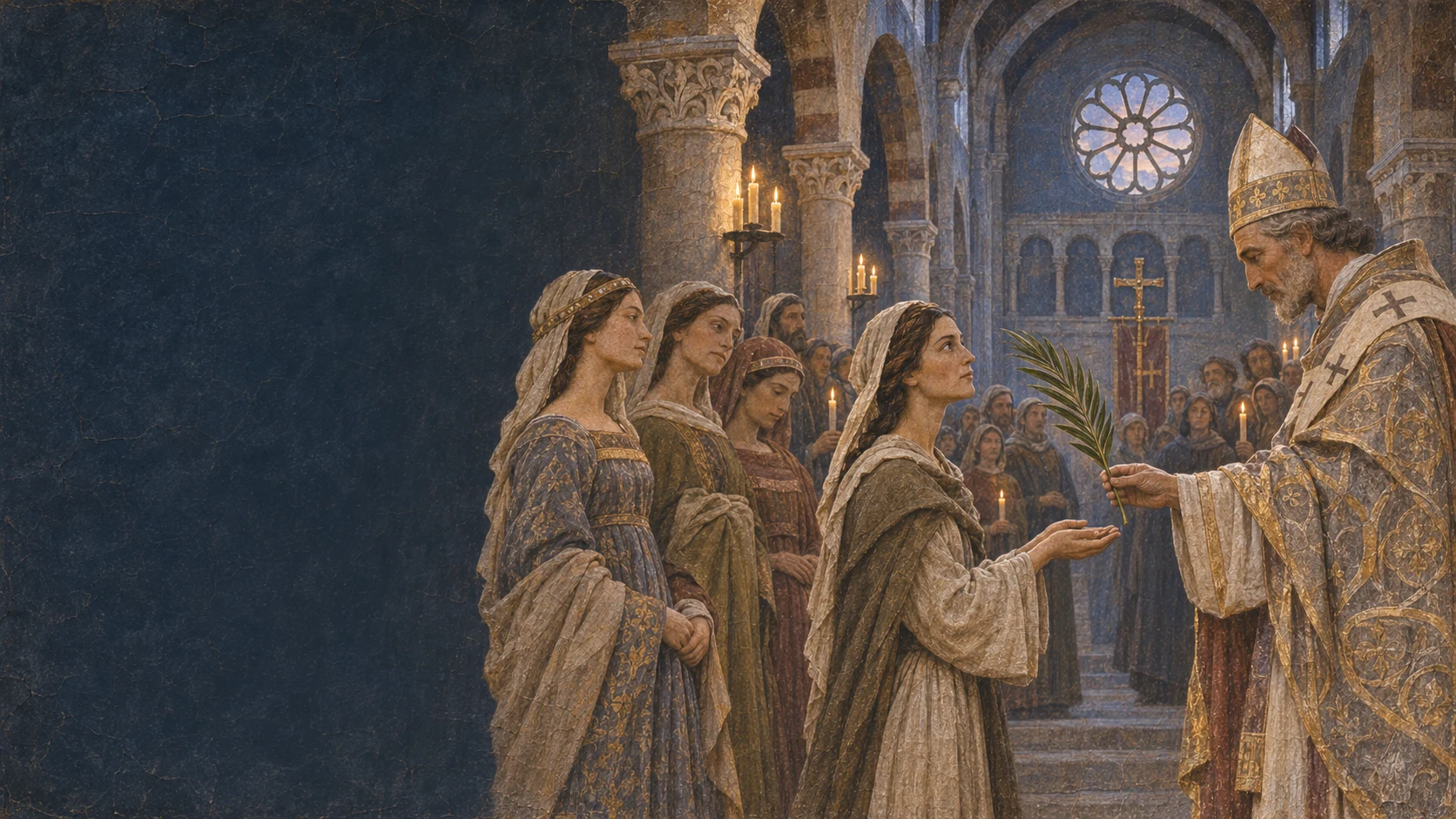
On Palm Sunday morning, Clare still seemed to occupy the place that Assisi expected of her. She entered the cathedral dressed as a young noblewoman and stayed among other women of her position. Before the night was over, she would have left the family home.
The ancient Legend says that when the faithful advanced to receive the branches, Clare remained still, perhaps out of shyness. Bishop Guido went down the steps and placed the palm in her hands. A short gesture passed through centuries.
The feast before the night
Palm Sunday recalls the entry of Jesus into Jerusalem and opens Holy Week. The liturgy unites acclamation and suffering: the people carry branches and listen to the Passion. For Clare, the date offered language for a passage. She would leave a form of honor and enter a path of vulnerability.
It is not appropriate to imagine the celebration exactly like a Mass today. Medieval rites varied by region and community. There were processions, blessing of branches, chants and organization according to social positions. Saint Rufinus was the episcopal center of Assisi and also the church linked to the baptism of the city.
The Legend points out that Clare presented herself richly dressed, as usual. This creates literary contrast with the poor clothing she would receive at night. The rich fabric does not prove vanity. It was the expected costume of her class and perhaps a way not to reveal the plan before the hour.
Bishop Guido
Guido, Bishop of Assisi, appears both in the history of Francis and Clare. He knew the local tensions and offered some kind of protection and discernment. Franciscan sources show him present in the rupture of Francis with his father. The Clarian Legend puts him on the threshold of Clare’s decision.
How much did he know that Sunday? Some authors understand the palm as a sign of prior approval. It is possible that the plan was communicated. But the narrative does not offer minutes of a meeting or record a sentence: “I authorize”. We must distinguish plausible interpretation from proof.
The gesture, however, prevents the departure from being counted only as rebellion against the whole Church. Clare broke family expectations, but sought a religious path accompanied by Francis, his brothers and episcopal authority. This alliance gave her some protection at a dangerous time.
Why did she stand still
The Legend explains immobility as shame or modesty. It can be a hagiographic trait: the humble young woman does not throw herself ahead and the bishop recognizes her uniqueness. It can also preserve a real incident that impressed those present.
We do not know if Clare hesitated because of emotion, if the social position determined another movement or if the author built the pause to intensify the scene. A responsible narrative does not choose a certainty where the source offers a symbol.
What matters is the inversion. He who occupies the high descends. The young woman who does not advance receives. Authority, for a moment, becomes service. This image combines with the way Clare would later describe leadership: whoever presides should take care of the sisters.
The palm wasn’t a magic password
Sometimes the story is told as if the branch was a secret code perfectly known to all involved. The source does not say that. The branch was delivered to many faithful and belonged to the feast. The special gesture was the bishop taking it to her personally.
It may have confirmed Clare inwardly. It may have communicated support. It may have acquired greater meaning when the story was later narrated. These possibilities coexist.
In Christian tradition, the palm is also associated with the victory of the martyrs. Clare would not walk to physical death that night, but would let a social future die prepared for her. The Legend reads her change with the language of the Passion: to go through loss for a new life.
A body still dressed in nobility
Clare’s clothes deserve attention because, for a medieval woman, dressing was social language. Fabrics, adornments and veils informed position, age and situation. In the cathedral, everyone could recognize her as a daughter of that household.
Hours later, in the Porziuncola, she would receive penitential clothing. The passage did not mean that the noble body was evil and the poor body, pure by magic. It meant exchanging belonging: from one network defined by blood and patrimony to another defined by promise and evangelical life.
This exchange would have material consequences. Poor clothing protects less from the cold, announces dependence and can provoke contempt. It was not a festive costume. Clare would choose to remain in this form when the enthusiasm of the first night ended.
The date that doesn’t close
Many books give 1212 as the year of escape. Other studies defend 1211. Ancient sources allow us to discuss chronology, but do not eliminate every doubt. Clare’s age also depends on the year of birth adopted.
So the frontmatter of this chapter does not pretend absolute precision. Knowing whether it was 1211 or 1212 matters for research; recognizing doubt matters for honesty. The force of decision does not depend on forcing a calendar.
The liturgical day is firmer in tradition than the calendar year: Palm Sunday. The memory chose to keep the feast because it interpreted the event.
Document, testimony and hagiography
No administrative document from San Rufino records: “Today we gave a palm to Clare”. The Process of Canonization focuses on other aspects and does not offer a detailed testimony of the scene. The Legend is our main narrative source.
Hagiography does not mean falsehood. It is a saint’s life written to edify, selecting facts and organizing symbols. It can keep true memory, but it does not work as a camera. The historian asks when it was written, where the information came from and how the literary form produces meaning.
Local traditions and later images have made the palm even more solemn. Our art dialogues with that memory, but avoids halo and impossible light. There are people, stone, candle and a green branch.
The silence between morning and night
After the celebration, Clare returned home. We do not know what the meal was like, if she kept her palm, who noticed her restlessness or where she waited for the night. No source authorizes us to write dialogues.
This silent interval may be the most human part. A decision can be right and still bring fear. Clare knew that relatives would react. She knew that leaving was not enough: she needed to find shelter, endure pressure and learn a life that did not yet exist fully.
The branch did not remove the risk, it gave the memory a way to say that she didn’t go through everything without blessing.
The gesture that remained
In art, the bishop and Clare look at each other without theatricality. Other women wait. The palm is small. This size matters. Christian history often clings to simple objects because the object carries a greater decision than it does.
Clare did not take a crown from the cathedral. She received a branch that dried up. The authority that gave it to her could not live for her. Francis could not decide for her. Bona could not bear every consequence.
By nightfall, the public gesture had already been left behind. It remained to open a passage and walk. The palm pointed; Clare’s feet would have to answer.
Palms dry; commitments remain
A cut palm branch loses green. Perhaps Clare’s branch was kept, perhaps discarded with others; we do not know. Tradition does not depend on possessing the object. It kept the gesture because it brought together three worlds: the common liturgy of the city, the authority of the bishop and the secret decision of a young woman.
In the morning, Clare received as everyone and in a singular way. At night, no one could walk for her. That is how a religious sign works when it does not become superstition: it does not replace the choice, it just illuminates it.
Between Rite and Memory
Sources for this chapter
- Legend of Saint Clare in the Clarian SourcesMain source. Narrates the liturgy, immobility and gesture of the bishop.
- Process of CanonizationTestimonial control. Helps to verify which aspects do not appear in the preserved testimonies.
- Guide to St. ClareCorpus. Gathers old texts and chronology notes.
- Basilica of Saint Clare — historical profileLocal synthesis. Presents Palm Sunday and date discussion.
- Letter for the Year of ClareOfficial reception. Interprets the gesture on Clare's vocational path.
- A Companion to Clare of AssisiAcademic research. Discusses chronology, hagiographic genre and context.
Level of certainty: Palm and Palm Sunday belong to the ancient Legend; words, exact intention of the bishop and visual details are not recoverable.