
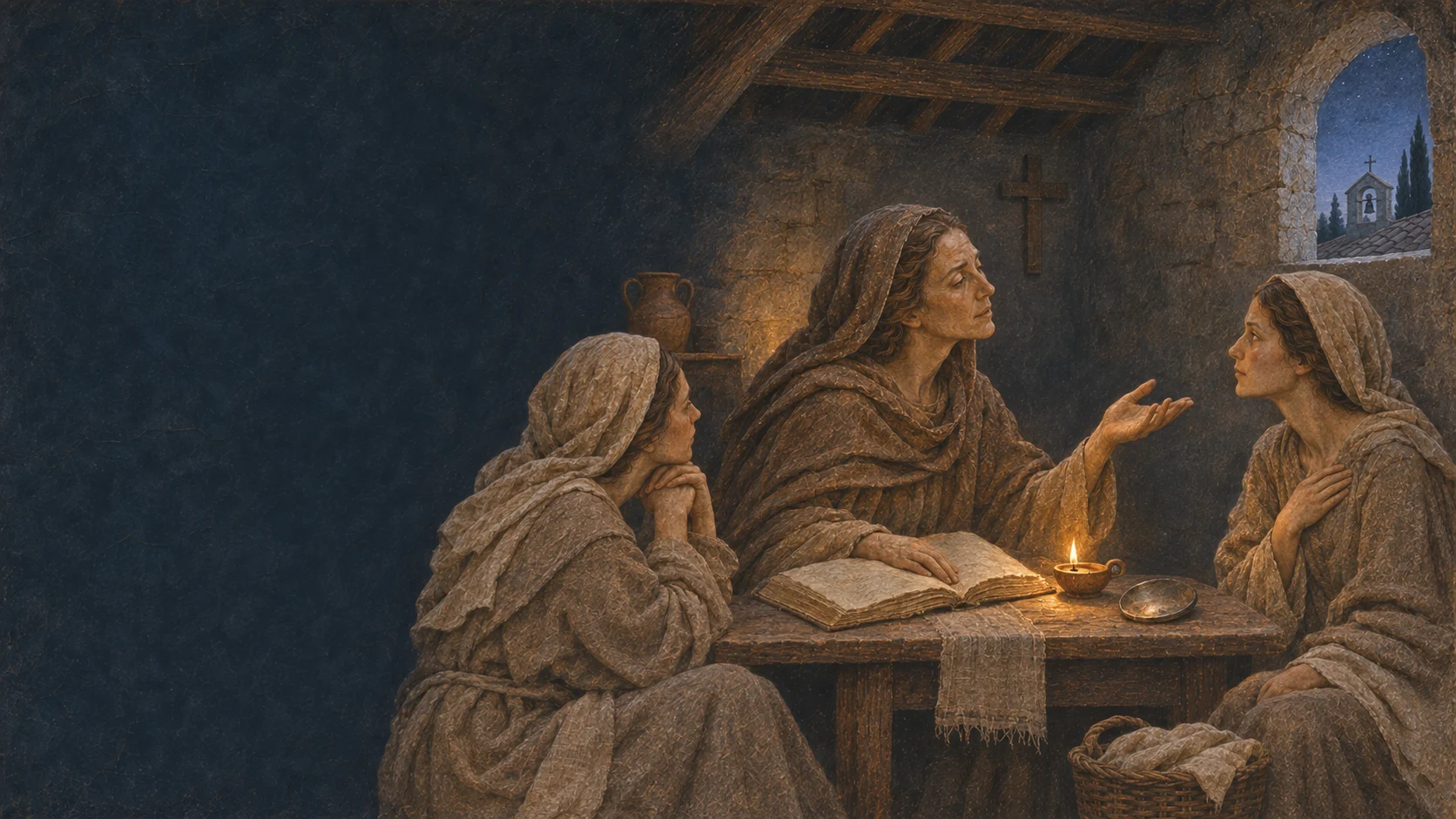
Before a mirror, we almost always look for something in ourselves. A face, a hair out of place, a mark that has appeared. Clare uses this word differently. She asks Agnes of Prague to look into a mirror and find there a life that can change her own.
This mirror is Christ. The image appears strongly in the letters, especially the third and fourth. We need not imagine that Clare held an object as she wrote. The writing offers a metaphor: it uses something familiar to bring us close to an experience we cannot point to with a finger.
The gesture is simple to understand and difficult to carry out. The person looking learns to recognize what she considers beautiful and worthy. Then she must ask whether her decisions match what she has seen. For Clare, contemplation does not end when the eyes turn away from the image.
One object and many meanings
In the Middle Ages, the word mirror could mean an object and also a book of teachings. A work could be called a mirror because it presented models through which readers would examine their own lives. Clare belongs to a world in which material images helped people think about spiritual questions.
We do not know what mirrors existed at San Damiano, or whether there was one where a letter was prepared. Adding a precise object to the scene would be reconstruction. What matters here lies in the surviving words, rather than a supposed item discovered on the abbess’s table.
The metaphor also has biblical roots. Christian language linked image, knowledge, and transformation. Clare does not create this vocabulary from nothing. She gives it her own direction when writing to another woman within the concrete choices of their communities.
Attention is more than a moment
In the Second Letter, Clare invites her friend to gaze, consider, and contemplate. These verbs need not become three rigid steps in a technique. They point toward deepening attention. First we recognize a presence; then we think about its meaning; finally, we let it reach our desires and choices.
A comparison helps. We can see someone offering their seat to a tired person and immediately forget it. We can also notice the need, think about the gesture, and learn to act in a similar way. This comparison is ours, used to explain the movement; it is not a story told by Clare.
Christian contemplation has specific content. Its center is not a vague pleasant feeling. It is Jesus, whose life both women knew through Scripture, liturgy, and preaching. Returning to him meant returning to a standard by which to judge their own path.
The mirror begins in the manger
In the Fourth Letter, Clare moves through the mirror, beginning with the poverty of the newborn Christ. The birth reverses appearances: the one faith recognizes as Lord receives shelter in a humble place and depends on care.
The image has consequences for those living in community. If divine dignity can be contemplated in a dependent child, fragility does not take away a person’s value. A sick sister does not become less important because she has stopped producing or needs to be fed.
That consequence is an interpretation of the writings as a whole, rather than a sentence we can put in quotation marks in Clare’s mouth. The Rule helps support it because it commands merciful treatment of the sick. The reading gains strength when placed beside another document, without pretending the two texts are the same.
The middle spans a lifetime
Clare moves from the birth to the way Christ lived. She highlights humility, work, and hardship. Between the beginning and the end lies a stretch of time. This matters because the sisters’ faithfulness also depended on repeated days, rather than extraordinary decisions alone.
A radical choice could happen in one night. Continuing it required sharing food, caring for the space, asking for help, hearing complaints, and organizing responsibilities. Clare’s writings that set out rules address these tasks. The mirror in the letters offers the horizon within which they gain meaning.
We do not know how each sister connected a prayer with a task. It would be wrong to narrate a woman’s private thoughts as she sewed or washed a bowl. We can, however, recognize that the contemplative life described in the sources did not exclude work. Attention to God was meant to run through the way they lived together.
The hardest part to look at
The journey reaches the cross. Clare presents it as the utmost expression of charity, meaning love that gives itself. The passage requires care. It does not authorize anyone to cause herself suffering or demand that another person endure violence in silence.
The text belongs to Christian faith in Jesus’s Passion. Its center is Christ’s love, rather than admiration for pain as though it were good in every circumstance. Clare herself asks for caution in fasting and provides care for fragile bodies.
Reading the writings together prevents an image from being torn out to justify cruelty. A community that humiliated a sick sister in the name of the cross would clash with the concrete instructions for mercy. Contemplation does not remove responsibility for what we do to others.
Transformation is not erasure
In the Third Letter, Clare speaks of transformation through contemplation. The recipient remains Agnes: someone with her own history, intelligence, and decisions. She is not ordered to disappear so that another personality can take her place.
The desired change touches what a person loves and chooses. Someone may stop seeking prestige at any cost, learn to share, or recognize a need previously ignored. These are explanatory examples. We cannot present each as a specific event in Agnes’s life without documentation.
Nor is there a promise of immediate results. The letter does not say that looking once makes someone perfect. The repeated gaze suggests learning. Life together remained subject to failures, the need for forgiveness, and difficult decisions. The Rule recognizes conflicts precisely because its author knew real people.
A dream is not the same thing
The Canonization Process preserves another set of images. Some sisters reported a vision Clare had described involving Francis, food, and a mirror. The account belongs to the memory of a visionary experience. It should not automatically be mixed with the metaphor in the letters.
There is a difference between writing that Christ is a mirror and testifying that someone said she had seen a mirror in a vision. In the first case, we study a device of language in a written work. In the second, we study testimony about an experience passed on to others. The origin of each claim must remain visible.
The Legend selects and organizes memories to present Clare’s holiness. Later tradition may gather all these images into a single artistic composition. That gathering has its own history and interest, but it does not turn different images into one proven scene. Readers deserve to know which layer we are discussing.
The beholder is also beheld
An ordinary mirror seems to depend only on the person approaching it. In Clare’s use, the encounter involves an earlier initiative: Christ has already given himself in love. The person contemplates a relationship in which she recognizes herself as welcomed and called to respond.
For that reason, the image can make demands without becoming mere accusation. Clare writes to a friend she values, desires her joy, and worries about her body. She is not offering a tool for endlessly finding faults. Correction takes place within a bond of trust.
This aspect helps us understand the beauty of her language. Poverty, humility, and charity do not appear as a cold list of prohibitions. They are ways of sharing in a life considered worthy of love. The desire to change comes from something seen as good, rather than fear of punishment alone.
The face of the sister beside you
One possible reading of the mirror begins when a person stops seeking only her own improvement and notices those nearby. The humility she contemplates must find a voice that has not been heard; charity must find someone asking for help. This link between prayer and conduct is an interpretation supported by the writings as a whole.
It prevents the mirror from becoming a private prize for someone who believes she prays better. The community could not inspect each sister’s inner life, but it felt the effect of her actions. A harsh word, a shared task, or an act of care reached others with real consequences.
After closing the parchment
The letters are documents; the Process accounts are testimonies recorded for a religious purpose; the Legend is hagiography; later devotional and artistic uses belong to tradition. Explanations of how these images affected the daily routine are interpretations or reconstructions, depending on the case. None of these distinctions weakens the mirror’s power.
They allow us to recognize where that power lies. It does not depend on a marvelous object hidden in the monastery, but on words linking attention and conduct. A person looks at Christ’s poverty and must think about her possessions; she contemplates his care and must consider the sister beside her.
The parchment can be put away. The kitchen, infirmary, and community chapter still await decisions. In these places the gaze, if it has changed anything, will take a form that other people can recognize.
Sources and paths for further reading
- Clare — Second Letter to Agnes of PraguePrimary document. The invitation to gaze, consider, and contemplate allows us to follow the language of attention.
- Clare — Third Letter to Agnes of PraguePrimary document. Places transformation and the mirror within the relationship between God, soul, and body.
- Clare — Fourth Letter to Agnes of PraguePrimary document. Develops the journey through poverty, humility, and charity in Christ’s life.
- Clare’s writings — Stary Sącz monasteryBody of writings. The Rule offers a necessary comparison for interpreting care, work, and prayer.
- Fonti Clariane — writings, Process, and documentsTestimonies and other genres. The Process preserves the vision narrated by Clare; it must be distinguished from the metaphor in the letters.
- Regis J. Armstrong — Clare of Assisi: The LadySpecialist edition. Keeps the writings and biographical accounts identified as different genres.
- Studying the Life of Saint Clare of Assisi — source guideAcademic guide. Guides readers toward editions and translations rather than devotional quotations without a location.
Reading the images: the mirror in the letters is a theological metaphor. The vision reported in the Process is testimony about an experience attributed to Clare; everyday scenes used here to explain the meaning are not new biographical facts.