
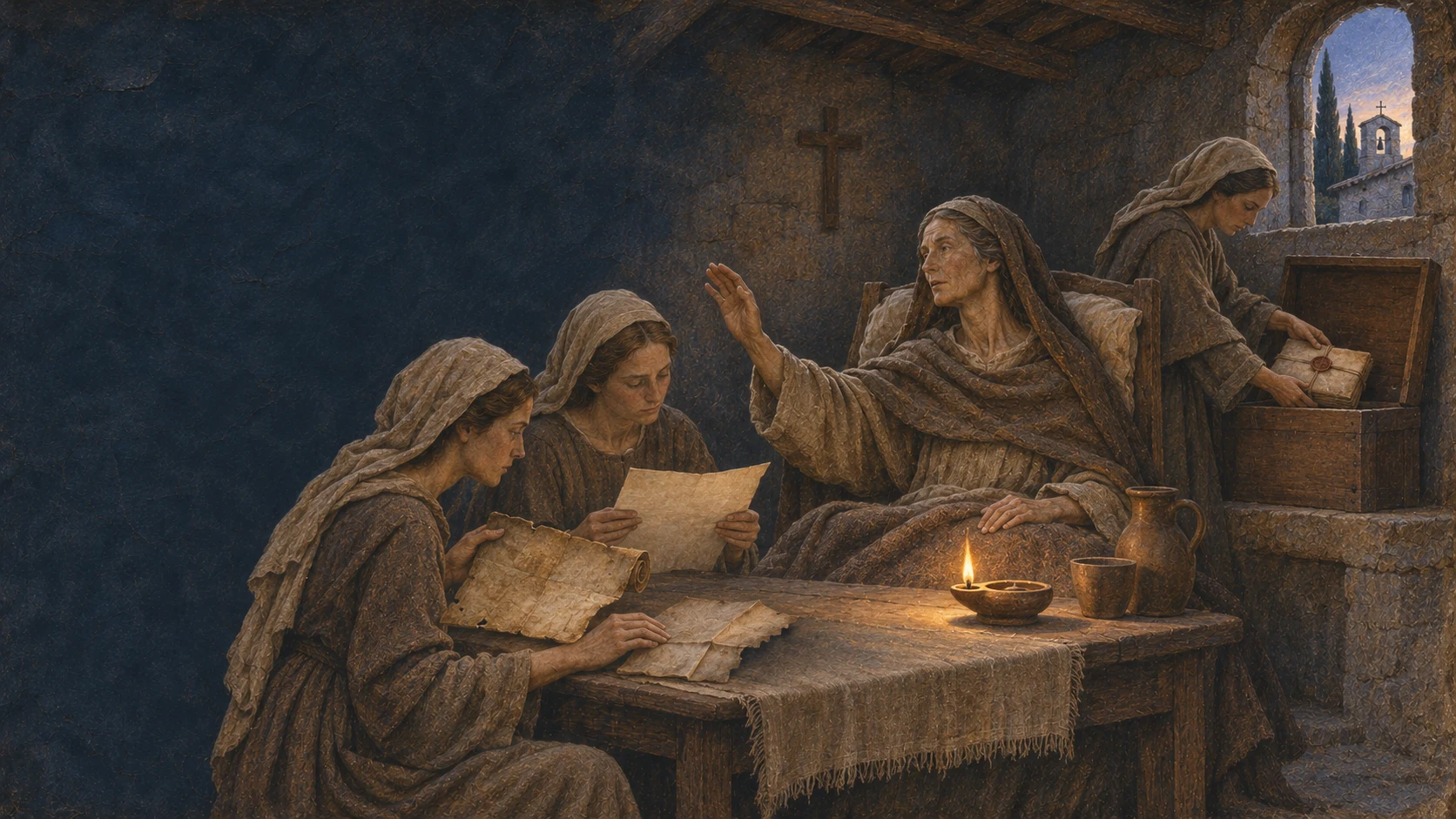
A voice can cross centuries without the paper that first recorded it surviving. Another can acquire sentences it never spoke. Those who study ancient writings work between these two possibilities. Clare’s name at the beginning of a text is an important clue, but it does not end the investigation.
After the letters and the Rule, we encounter the Testament, the Blessing, and a letter attributed to Clare and addressed to Ermentrude of Bruges. These texts carry different weight in the history of transmission. It would be wrong to present them all as though we had before us three parchments signed by her on the same day.
The question is delicate because it involves much-loved words. The Testament recalls the community’s beginning; the Blessing reaches present and future sisters. Examining their origin does not require abandoning that beauty. It requires stating clearly what kind of trust we can place in each passage.
What a testament can preserve
The Testament attributed to Clare does not resemble a division of houses, coins, and land among heirs. Its inheritance is a form of life. The text begins by giving thanks for the calling, recalls Francis, and presents poverty as a commitment the sisters should preserve.
The narrative’s movement matters. The beginning does not appear only as a glorious past. It should guide those who will go on living when the foundress is no longer present. Remembering becomes a way of accepting responsibility for the future.
Read this way, the text holds very concrete questions: who will protect a vulnerable community? What kind of security can be accepted? How can they remain faithful without turning Francis’s memory into an empty image? We need not invent a final gathering at which every line was dictated to recognize the urgency of these questions.
The memory of the first house
The writing presents Francis as the one who recognized and supported the women’s calling. It recalls the first sisters’ willingness to face work, poverty, and contempt. The group would not have begun because everything was organized and safe.
These statements speak to other sources, but that closeness needs examination. A text resembling another may preserve a shared memory; it may also have used an earlier writing. Similarity alone does not prove that both were written by the same person.
The Rule of 1253 offers an especially important point of comparison. Its papal confirmation firmly places the document in time, and its sixth chapter preserves words attributed to Francis. When studying the Testament, researchers compare vocabulary, structure, concerns, and the circulation of manuscripts. The discussion thus rests on evidence that can be examined.
Why there is debate
We do not possess an autograph original of the Testament, meaning one written in Clare’s own hand. Its manuscript transmission, the dating of copies, and the absence of certain references in the earliest sources have fueled doubts. There are also discussions about style and possible relationships between passages.
These objections have not produced a single answer among scholars. Some defend its authenticity; others question it or allow for a core linked to Clare with later interventions. The assessment and dating of manuscripts, including the Messina manuscript, form part of this debate.
It would be hasty to declare it a proven forgery. It would also be hasty to say that all doubt has disappeared. In this chapter, the text is treated as the Testament attributed to Clare, included in important editions and debated by researchers. That wording allows us to read it without hiding the problem from readers.
A question does not destroy a person
Sometimes it seems that Clare’s life would lose value if an admired phrase could not be guaranteed as hers. But her existence does not depend on the certainty of every attribution. There are surviving letters, a confirmed Rule, papal documents, and testimony from people close to her.
If a later community gathered words to preserve what it understood as Clare’s legacy, that too has a history. We simply need to distinguish a person’s voice from the voice of those who received it. One must not take the other’s place without notice.
We should also avoid the opposite movement: using doubt about the Testament to cast equal suspicion on all the writings. The strength of the documentation varies. Historical criticism compares those differences; it does not distribute certainty or suspicion in equal amounts to every source in a collection.
The Blessing reaches across absence
The Blessing attributed to Clare begins within biblical language of protection and peace. It then addresses the sisters, including those who would come in the future. The voice presented as the foundress’s wishes the community to remain united in God’s love and in love among its members.
That reach is moving. The writer does not know the faces of all the recipients. A blessing can reach someone born much later. The foundress’s presence is imagined as care extending beyond her life, without requiring her to keep making every decision in the house.
But we must not confuse this writing with every gesture of blessing mentioned in the Process or the Legend. A woman may have blessed her sisters, while the surviving textual form still requires its own study. A remembered event and a transmitted document are different objects of investigation.
The name of Ermentrude
The letter to Ermentrude of Bruges presents still greater problems of attribution. Its transmission is linked to late compilations, especially the work of Luke Wadding in the seventeenth century, rather than a body of manuscripts comparable to that of the four letters to Agnes of Prague.
There is a report of two letters joined or summarized into the known form. This requires us to ask what came from an old text, what was condensed, and what was reworded. The transmitted version cannot be used as a transparent record of Clare’s words.
Its content may resemble themes associated with Clare: perseverance, prayer, and detachment. That closeness, however, does not settle authorship. A later person familiar with her spirituality could also write in a similar way. For that reason, critical editions and studies often present the text with reservations or in a supplementary section.
What was lost
We know that medieval communication was greater than what the archives preserved. The four letters to Agnes imply questions, news, and bearers. Not all the replies survived. Other contacts are known indirectly.
We cannot conclude from this that any phrase attributed to Clare belongs to a lost letter. A lost text is a gap, rather than permission to fill the archive with convenient words. Investigation needs clues: early mentions, copies, quotations, dates, or demonstrable relationships.
Nor do we know how many messages Clare may have dictated or had written. Saying that we have no number is more precise than turning four surviving letters into her complete output. The silence of the archives calls for humility both from those who doubt everything and from those who wish to believe everything.
The sisters after the foundress
The texts in this chapter share a concern: what will happen to the women after Clare’s death? Later history shows changes in rules, places, and structures. The future was not a perfect repetition of the beginning.
This helps explain why a written legacy could become so important. In remembering the foundress, different communities also defended their own choices. Tradition was not simply repetition without a stake; it could take part in debates over authority, property, and identity.
Recognizing this use does not mean accusing all the sisters of manipulation. Memory lives within real needs. A community seeking guidance could preserve, copy, and interpret what it had received. The historian’s task is to study that work without erasing the women who did it and without automatically attributing their words to Clare.
A copyist’s work
Copying a text was a way of keeping it alive. A religious woman who transferred words from one manuscript to another took part in that survival, even when her own name went unrecorded. The work could preserve an old form and also introduce errors, adjustments, or choices of language.
We do not know the identities of everyone involved in transmitting these writings. Even so, recognizing their presence changes our reading. Between Clare and today’s book there were hands and communities. Studying the copies brings us closer to this material journey, seeking to distinguish what one generation received from what it added when passing on its inheritance.
Preserving without closing the question
We call the materially transmitted text a document; its authorship remains a separate question. We call someone’s declared memory testimony, a narrative presenting holiness hagiography, and continued reception tradition. When we imagine a scene to connect fragments, we are making a reconstruction and must say so.
These distinctions allow a closer reading because they do not require any weakness to be hidden. The Testament can be read as an attributed legacy; the Blessing as a transmitted form of care; the letter to Ermentrude as an especially uncertain attribution.
Different texts lie on the reader’s table, each with its own history. The task is not to force them to speak with the same voice. It is to listen to what they preserve, check what we can, and leave visible the part where we still need to ask questions.
Sources and paths for further reading
- Clare’s writings — Stary Sącz monasteryTransmitted texts. Offers the Testament and Blessing for reading; inclusion in the collection does not end debates about authorship.
- Catherine M. Mooney — Clare of Assisi and the Thirteenth-Century ChurchAcademic research. Catherine Mooney presents arguments and doubts about the Testament and Blessing in the context of the final writings.
- Studying the Life of Saint Clare of Assisi — source guideGuide to critical editions. Identifies editions and highlights the doubtful attribution of the letter to Ermentrude.
- Regis J. Armstrong — Clare of Assisi: The LadySpecialist edition. Gathers the texts within the body of sources and provides introductions for critical reading.
- Fonti Clariane — writings, Process, and documentsDocumentary collection. Allows comparison of the Rule, attributed texts, and witness memories without confusing them.
- Clare — Fourth Letter to Agnes of PragueDocument for comparison. A securely attributed letter helps in studying language and themes, without proving the authorship of other texts on its own.
- Miles Pattenden — The Canonisation of Clare of Assisi and Early Franciscan HistoryAcademic study. Places the shaping of Clare’s memory within the institutional relationships of early Franciscan history.
Reservation about authorship: the Testament and Blessing are read with the debate indicated; the letter to Ermentrude is not quoted as Clare’s certain words. Lost texts are not reconstructed as though they had survived.