
The door of a noble house protected and separated.
Inside there were stored provisions, textiles, metal objects, animals, family members, and people who worked for them. Outside, the same city held smaller workshops, travelers, poor people, soldiers, and rival families.
Clare grew up inside that difference.
The sources call her father Favarone of Offreduccio and present the family as belonging to the old nobility of Assisi. This does not mean that we have a perfect family tree, or that “Offreduccio” worked exactly like a modern surname. Medieval names could indicate a father, an ancestor, a place, or a bond, and their use changed.
Where the house stood
Local tradition places the family home near the cathedral of San Rufino. Studies of medieval Assisi connect the Offreduccio with this upper part of the city. Present buildings preserve layers from many centuries, and devotional plaques are not property deeds from the year 1200.
It is reasonable to place Clare in a noble district near the cathedral. It is not safe to point to every wall and say that she touched that particular stone.
The city itself changed through wars, renovations, and new construction. A medieval house might incorporate older structures and later disappear inside another building. Memory chooses places; archaeology requires greater caution.
The courtyard that organized the day
We do not possess a floor plan of Clare’s house. To imagine it, we use what is known about urban residences of wealthy families: several rooms arranged around shared circulation, storerooms, sleeping chambers, a place to prepare food, perhaps a tower or fortified section.
Women supervised domestic labor, yarn, cloth, and supplies. Men might be absent because of war, business, or the management of land. Servants and dependents crossed the same spaces without sharing the same power.
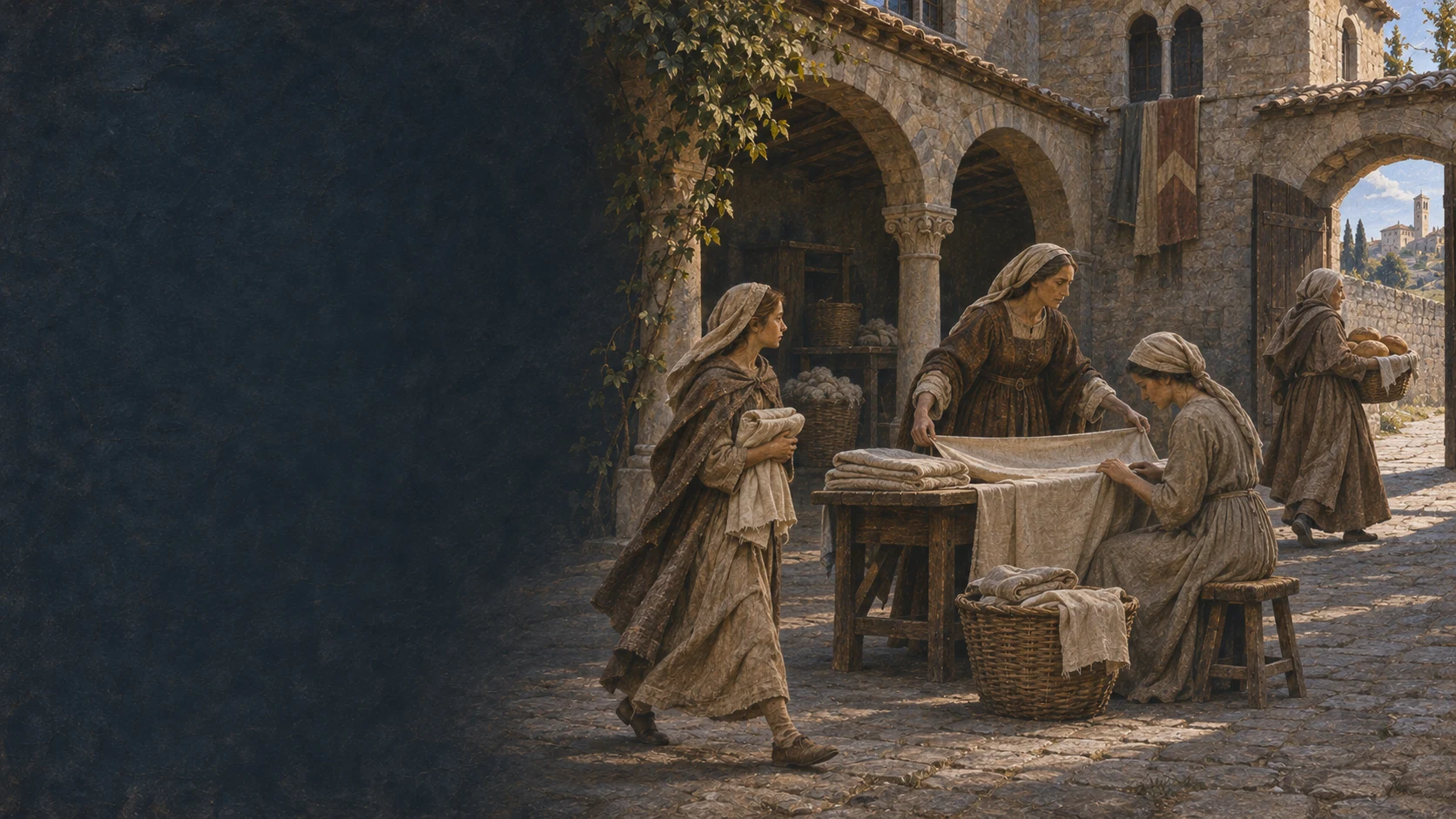
The artwork shows the adolescent Clare in a courtyard among cloth and bread. It is a reconstruction. The cloth recalls the skill that would reappear when she made altar linens for churches; the bread recalls the accounts of charity. We are not claiming that both actions occurred together on one morning.
Nobility was more than wealth
To be noble meant belonging to a culture of honor, defense, and mutual obligation. Families owned weapons and could fight on horseback. The city knew private towers and clashes between groups.
A daughter’s marriage helped build alliances. Witnesses in the Process said that Clare’s relatives wished her to marry and that she refused. We do not have a contract, a securely named suitor, or a date of betrothal.
Later accounts sometimes turn the suitors into a procession of enchanted young men. That increases the drama but adds no evidence. The historically firm point is that a woman of her rank was expected to take her place within a marital and property strategy.
Honor guarded through a woman’s body
In Clare’s world, women’s choices affected everyone’s reputation. Leaving the house without permission, cutting one’s hair, and putting on penitential clothing were not private gestures. They could look like flight, disobedience, and the loss of an alliance.
That is why her relatives reacted. We need not describe them as monsters. They were defending a social order they believed necessary. Clare, however, understood her life in relation to an authority greater than family expectation.
Her conflict was real precisely because love, dependence, and duty were involved. A caricature of a cruel family would make her courage smaller.
The people the house hid from the documents
Large households depended on the work of people whose names seldom appear: women who cooked, men who tended animals, young people who carried water, and laborers tied to the family’s lands.
The Process names Giovanni di Ventura, who had served in the household and later testified about Clare. His presence opens a narrow window. He saw a domestic life that noble documents almost never describe.
When we read that Clare set food aside for poor people, we should also imagine those who prepared and stored it. Charity passed through an unequal economy.
What Clare learned there
She learned ways of speaking and receiving guests, the value of cloth, the organization of resources, and the language of honor. Later she would lead a community for decades. Her authority did not appear from nowhere on the night she left.
San Damiano was radically poor, but it still had to organize food, work, care for the sick, and relations with outsiders. Clare transformed abilities learned in a noble world into service to a community.
This does not mean that her father’s house was a secret school for abbesses. It means that a person carries skills with her even when she rejects the system in which she learned them.
Wealth and compassion
The ancient sources insist that Clare cared for poor people before her conversion. The Legend presents discreet acts. Witnesses remember her good reputation.
A young woman could give food without questioning the whole structure that produced inequality. Conversion was not simply an increase in the amount of alms. Clare chose to live without the security that had allowed her to distribute gifts from above.
That movement is profound. Instead of remaining a generous lady, she chose to become a poor sister.
It did not happen in a single, simple instant. The choice was matured, discussed, and prepared.
The house as later memory
After Clare became a saint, Assisi began to reread its geography. The house became a place of origin; the door, a sign of rupture; the cathedral, the setting where she received the palm on Palm Sunday.
Pilgrims need to know when they stand before a preserved structure and when they stand before a tradition. Prayer does not lose its value because of that distinction.
A later wall can hold centuries of affection. It simply should not be used as evidence it does not possess.
The price of crossing the door
Clare did not leave a wretched house. She left protection, position, and relatives. She continued to love people who belonged to that world; some later joined her.
Her act was not contempt for her family. It was a change in the center of her belonging.
Years later, when she wrote about poverty, Clare did not speak as someone who had never known security. She knew the weight of a strong house and the frightening freedom of not owning one.
Before the door opened at night, however, she still crossed the courtyard by day. She watched deliveries, heard decisions, and learned gestures. The house prepared the future it wanted for her.
Without knowing it, it also prepared some of the abilities with which Clare would build another kind of house.
A house made possible by invisible labor
When we say “noble house,” we may picture only a family in front of the hearth. In fact, such a residence depended on many people. Someone fetched water, kept the fire, tended animals, prepared food, mended cloth, and welcomed visitors. There were servants and workers whose names almost never entered the sources.
Clare grew up within this inequality. The food she shared with poor people did not simply appear in her hands: it was produced by labor and controlled by a household with resources. Acknowledging this does not diminish her act. It reveals the world she began to question and the forgotten people who sustained it.
Later, at San Damiano, work and service would carry another meaning. The sisters spun, sewed, and cared for one another. Clare wrote that the woman responsible for the community should serve, advise, and console. We cannot prove that she framed this while remembering the corridors of her childhood; we can see the contrast between inherited authority and authority chosen as care.
What property did to the future
A house was also a set of rights: land, income, dowries, and alliances. A daughter’s marriage took part in this organization. Clare’s decision therefore concerned more than private devotion. By refusing a marital future, she altered economic and political expectations.
At this point the ancient stone ceases to be decoration. The house protected, but it also wrote every person into an order. Clare did not leave because all domestic life was evil. She left because the form of belonging she desired could not fit into the plan prepared for her.
Stones and documents
Sources for this chapter
- Basilica of Saint Clare — Chiara d'AssisiFamily and place. Critically examines Offreduccio, Favarone, and the tradition of the house near San Rufino.
- Process of CanonizationLocal voices. Preserves testimony from relatives, neighbors, and a former household servant.
- Le recrutement social des Clarisses d’AssiseSocial history. Reconstructs kinship and the urban setting from the witnesses.
- Women, Art, and SpiritualityWomen's context. Places Clare within the nobility and medieval religious possibilities.
- Cambridge Companion — Francis, Clare, and the Second OrderSocial structure. Discusses the limits placed on mixed groups and the formation of the women's community.
- Internet Guide to St. ClareDocument map. Brings together papal sources, the Process, and the Legend.
How we read the house: noble origin and the marriage plan are firm; the approximate location has both research and tradition behind it; the interior architecture and routine are reconstructed from social context. The artwork does not represent a documented episode.