
Before Portuguese books called her Clara, she was called Chiara.
The Italian name seems to carry light within it. Medieval sources noticed this and repeated plays on words: Chiara would be clear, luminous, able to illuminate other women. But a child is not born knowing what biographers will one day write about her name. She is born small and dependent, surrounded by voices she cannot yet understand.
Clare was born in Assisi at the end of the twelfth century, probably in 1193 or 1194. That one-year difference already teaches us something important. Even for a famous person, medieval documents do not always allow us to mark an exact birthday on a calendar. Modern chronologies usually offer both possibilities.
There is no certificate preserved in a drawer with her date of birth, her height, and the name of the person who attended the delivery. What we have are later writings, memories gathered during the Process of Canonization, and documents that together form an image.
The Assisi where she opened her eyes
Assisi climbed the slope of Mount Subasio. Narrow streets connected houses, churches, workshops, fountains, and towers. Roman remains stood among medieval buildings. From above, one could see the plain and the roads leading to Perugia, Spoleto, and other places.
The city was not a silent backdrop. Noble families defended their prestige and lands. Merchants and craftspeople were gaining strength within the commune. Political disputes could turn into armed conflict. Clare was born into a world in which family position defined almost everything: clothing, marriage, education, protection, and danger.
Her family belonged to the nobility. Her father is named as Favarone, or Favorone, of Offreduccio. Her mother was Ortolana. The sources mention sisters and relatives who would later appear at San Damiano. This places the girl within an extended family network, not in a house occupied only by father, mother, and daughters like an isolated modern family.
There were relatives, dependents, servants, and alliances. A noble house was also a place of administration and power.
What the witnesses remembered
Clare died in 1253. A few months later, an inquiry heard women who had lived with her and people of Assisi who had known her before religious life. They spoke under oath.
Pacifica of Guelfuccio said that she had known Clare while Clare still lived in her father’s house. She was both a neighbor and a relative. Other residents remembered Clare’s youth, her reputation, and her family’s intention that she should marry.
These testimonies are precious, but they were given when the girl was already remembered as a holy woman. A witness did not simply return to the past as if opening an untouched box. Forty or fifty years of shared life, devotion, and change stood between the memory and the event.
The Process also followed questions connected with holiness. That is why we hear much about prayer, charity, fasting, and miracles, and little about games, everyday fears, or domestic lessons.
The silence of the sources does not mean that Clare never laughed, made mistakes, or became annoyed. It means that the investigators were not trying to write a complete diary of her childhood.
A childhood interpreted afterward
The ancient Legend of Saint Clare organizes her earliest years as preparation for holiness. It says that she hid food so that it could be given to the poor and that she used small stones as prayer beads when she did not yet have a cord.
These episodes belong to hagiography. They may preserve old memories, but they also follow a familiar way of telling saints’ lives: the adult virtue appears as a seed already present in the child.
We do not need to mock these stories. We can ask what they were meant to teach. The hidden food suggests that the wealth of her house did not blind Clare to poverty. The little stones suggest that prayer did not depend on expensive objects.
But we cannot claim that someone counted every stone or watched every meal. Historical honesty protects Clare’s story from becoming a collection of fragile certainties.
A noble girl was not necessarily a free girl
Belonging to the nobility brought material security and obligations as well. Marriage could create alliances between families. A young woman was prepared to manage a household, protect family honor, and bear heirs.
Clare probably learned tasks connected with cloth, household organization, and religious practice. We do not know the curriculum of her mornings. Noblewomen might know prayers, chants, sacred stories, and some degree of reading, but it would be unwise to turn general possibilities into an exact list of lessons.
We know that the adult Clare wrote or dictated texts of great power. Her letters use biblical images and refined spiritual language. That shows education and intelligence; it does not by itself reveal when she learned each thing.
Her future decision would be radical precisely because an expected future already existed. She did not escape from a life with no possibilities. She abandoned real privileges, a likely marriage, and the protection of a powerful family to seek another kind of freedom.
Her mother and the first language of faith
Ortolana is remembered as a religious woman and a pilgrim. She went to Rome, to the sanctuary of the archangel Michael on Mount Gargano, and to the Holy Land. Pacifica said that she had taken part in some of these journeys.
A medieval pilgrimage was long, costly, and dangerous. The information reveals initiative, resources, and a faith that crossed roads. The young Clare grew up near a woman for whom biblical places and shrines were not merely names.
We cannot say that Clare’s entire vocation came from her mother. Daughters are not copies. Later, however, Ortolana would enter San Damiano. Their story is not a simple line of influence: mother and daughter eventually learned a new form of kinship within the same community.
The father who almost disappears
Favarone appears less often in the memories than we might expect. One witness said that she knew Ortolana but had never seen the father. Other sources confirm his position and the family’s marriage plans, yet his voice did not reach us.
This allows several hypotheses: absence because of war, a relatively early death, domestic distance, or simply a lack of interest on the investigators’ part. None should be presented as certain without evidence.
When Clare breaks with the family plan, it is her uncle Monaldo who appears strongly in the accounts. The group of male relatives defended a collective decision. Reducing everything to “a cruel father against a holy daughter” would invent a story simpler than the sources.
The art and what we do not know
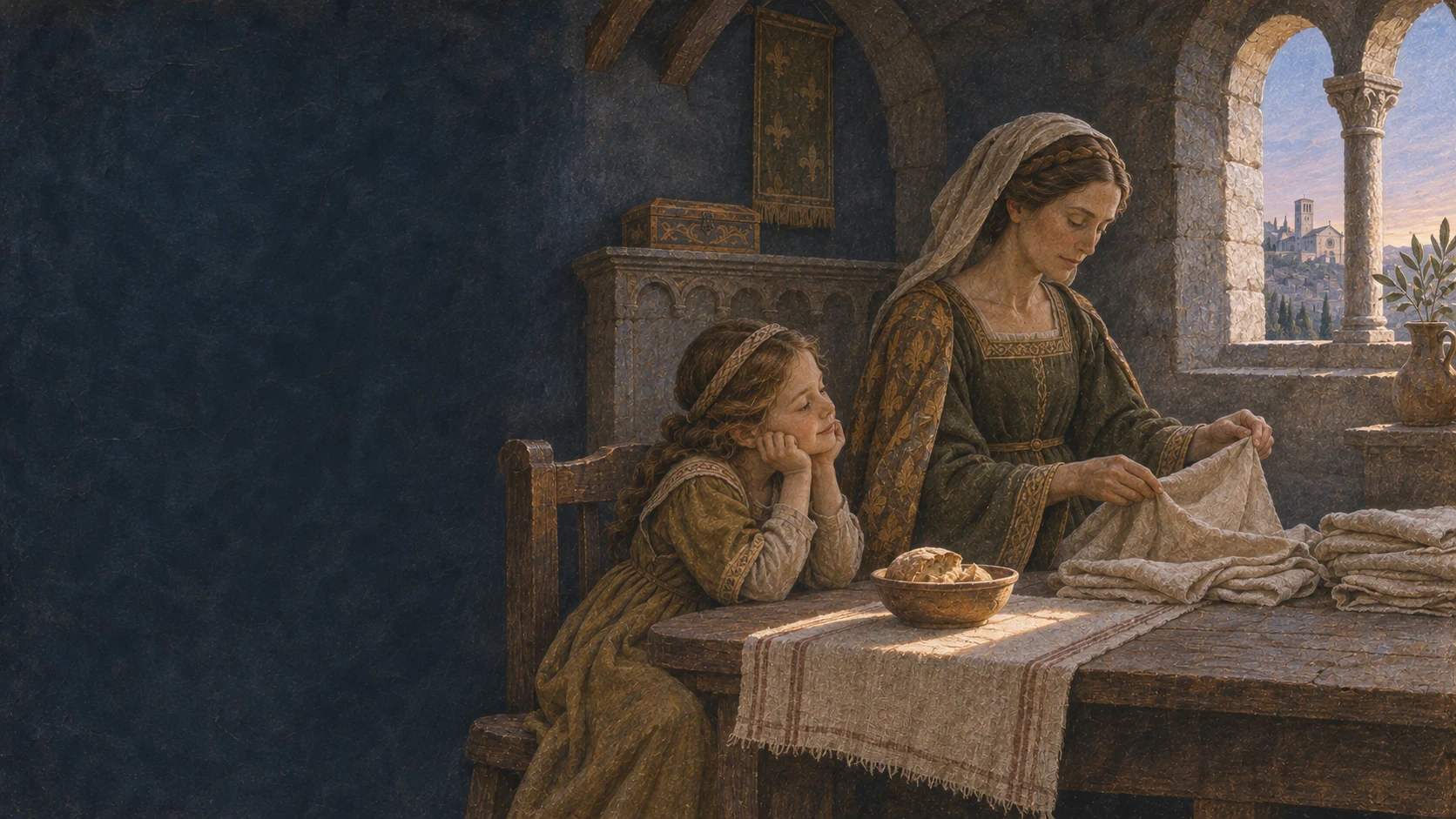
The artwork for this chapter shows a girl beside Ortolana in a stone room. There is cloth, a bowl, and morning light. We do not know of one particular morning like this. The scene brings together plausible elements of a noble household and two people who were historically connected.
We have not placed a halo over the child. Clare is not yet a statue. Her future holiness does not need to erase her childhood.
The girl’s face will be kept coherent as she grows in the later artworks. This is a visual choice made by the portal, not a reconstruction of her appearance. No portrait made from life has survived.
Where the story begins
Perhaps Clare’s story does not begin with supernatural light. Perhaps it begins with a child watching adults, hearing news of war, and noticing that some people had abundance while others begged at the door.
It begins in a house that offered protection and designed her future. It begins with a mother who knew the roads. It begins in a divided city.
The sources see signs from birth because they know the ending. We will travel in the opposite direction. We will not place the finished woman inside the girl. We will watch each choice come into being in its own time.
Chiara has not yet crossed the night. She does not yet know San Damiano as home. She has not yet written to Agnes of Prague. For now, her name is only being spoken by those who call her near.
And the light is beginning.
Memory examined
Sources for this chapter
- Basilica of Saint Clare — Ugolino Nicolini's historical profileCritical synthesis. Discusses birth, family, and dependence on the Process of Canonization.
- Cambridge Companion to Francis of Assisi — chronologyDating. Gives 1193/1194 as the range for her birth.
- Historical Documents of the Franciscan OrdersDocuments. Brings together the Process, the canonization bull, and papal texts in several languages.
- Process of Canonization of Saint ClareTestimonies. Allows us to identify the voices that remembered Clare in the world and at San Damiano.
- Cambridge University Press — Clare and the early Poor ClaresContext. Places her family, departure, refuges, and the nature of the Process in context.
- Benedict XVI — Letter for the Year of ClareEcclesial reception. Summarizes Clare's conversion from her own writings and the ancient sources.
How we read this beginning: her name, family, noble origin, and birth around 1193–1194 are historically supported. The promise of brightness and the detailed childhood scenes belong to the Legend and should be read as hagiography. The artwork is a responsible reconstruction.