
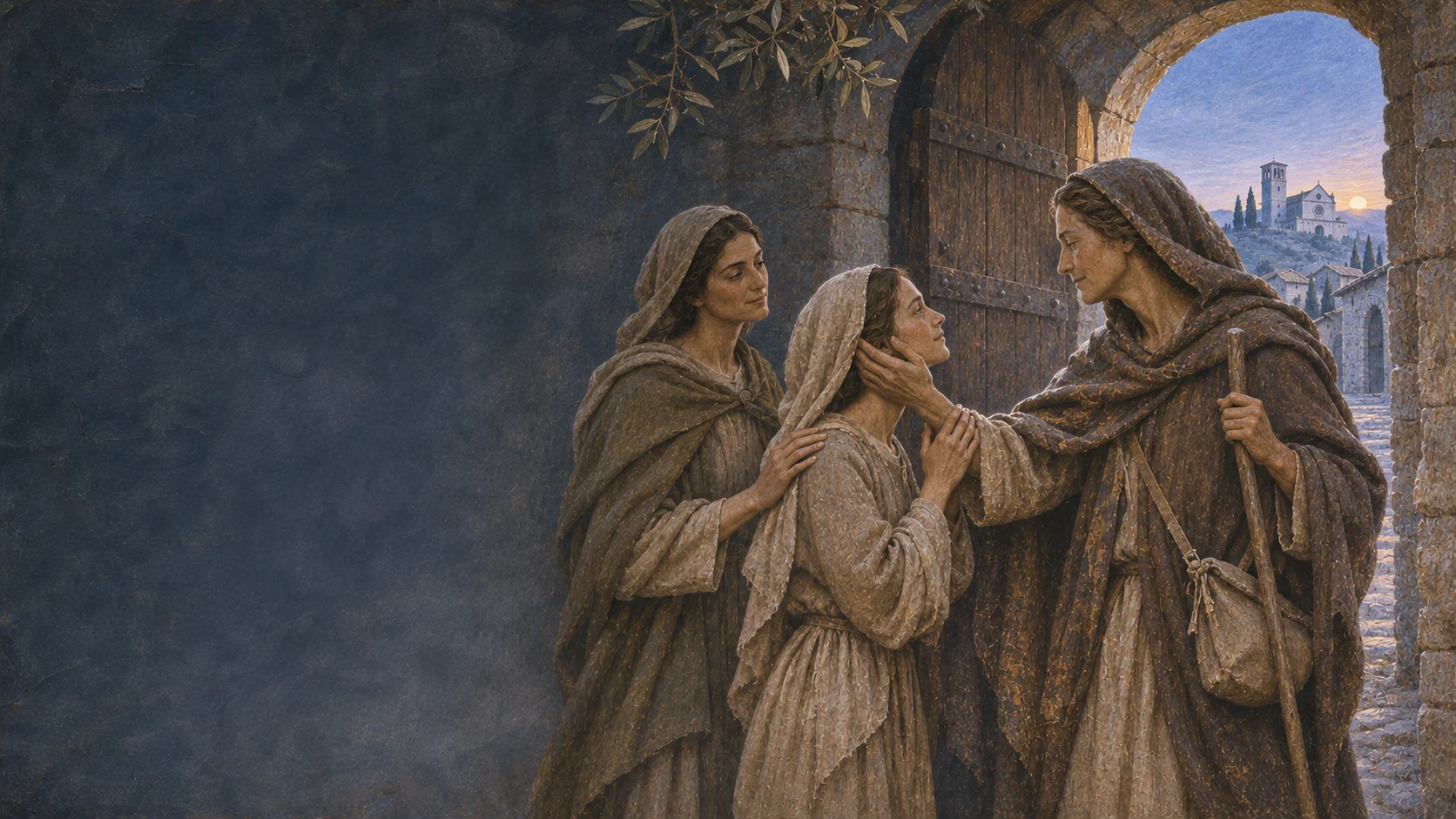
Ortolana knew the sound of a long road.
Pacifica of Guelfuccio declared in the Process of Canonization that she had traveled with Clare’s mother to Rome, to the shrine of St. Michael on Mount Gargano and beyond, to the Holy Land. For a woman of the late 12th century, these were not excursions. They were crossings that required resources, protection, endurance and resolve.
This news changes the image of Ortolana. She was not only the mother who stayed at home while her daughter became a saint. Before Clare crossed the night to Porciuncula, her mother had already crossed mountains and seas because of faith.
Rome, Gargano and Holy Land
Rome kept apostolic graves and great basilicas. Mount Gargano attracted pilgrims to the shrine of Michael in a cave in southern Italy. The Holy Land placed the traveler before the places linked to the life of Jesus.
Each trip had risks: bad roads, disease, assaults, uncertain lodging and sea crossings. Ortolana probably traveled in group. A noble woman had means that most did not have, but privilege did not eliminate danger.
Pacifica is an important witness because she says to have been with her. Still, the testimony was collected decades later and interested in the holiness of Clare. She does not tell us what year each pilgrimage took place or how long it lasted.
The world was bigger than Assisi
Clare grew up near a mother who could describe landscapes beyond the valley. Maybe she heard about the sea, pilgrims from other languages and the rocky road of Gargano. It is possible, but not documented, to imagine these conversations.
The safe fact is simpler: the Offreduccio house was not closed to the world. People, news and devotions circulated.
Years later, Clare would build a friendship with Agnes of Prague without traveling to Bohemia. Letters would do what Ortolana’s feet had done: unite distant places for a common search.
A mother doesn’t explain a whole daughter
It is tempting to say that Ortolana “taught everything” to Clare. Sources do not allow it. Vocation is not automatic inheritance. The daughter made decisions that surprised and hurt family expectations.
It would also be unfair to oppose a godly mother only concerned with power. We know Ortolana better because the witnesses spoke of her and because she later entered San Damiano. Silence about Favarone does not prove lack of faith.
We can say that Clare saw an adult woman exercise religious initiative, which broadened the horizon of what was possible.
When the daughter chose another road
On the night of the escape, Ortolana does not appear with her own speech in the sources. We do not know when she understood the plan, if she tried to prevent or suffered in silence. The collective reaction of the family is narrated with more force than individual feelings.
The Process is interested in Clare’s conflict and firmness. It does not offer a letter from her mother.
We don’t have to fill it with an ortolana secretly complicit or with an angry mother, both of which would be invented characters.
The mother comes to her daughter’s house
Later Ortolana entered the community of San Damiano. The family order reversed. The noble mother became a sister in a place led by the daughter.
We don’t know exactly when the entrance took place. Traditions bring it closer to the last years of Francis, but chronologies vary. The important thing is that the Process and the Clarian memory recognize her presence.
There was no lady’s room. There was common poverty, prayer and service. Ortolana did not stop being a mother, but needed to learn a brotherhood in which blood did not give precedence.
Faith and social position
Holy journeys cost. Ortolana could pilgrim because she belonged to a family with resources. This does not diminish sincerity; it reveals the material conditions that made the journey possible.
A responsible story does not call privilege poverty. Nor does it reduce all religious experience to money. It holds together economic possibility and spiritual desire.
Clare would take this tension to the extreme: how to live without property and still care for sick women, get food and keep a home? The future struggle for the Privilege of Poverty was born in a world she knew inside.
What art has chosen
We show Ortolana returning through a door, with worn robe and simple bag. Clare receives it. We do not claim that Pacifica was at that moment, even if the city looked exactly that way.
The scene avoids exoticism. Ortolana does not bring bright relics. The center is her tired body and the encounter.
In the middle age, pilgrimage could be penance, supplication, gratitude or desire for closeness to the sacred. We do not know which motive dominated each journey. Silence prevents us from turning the mother into a unique symbol.
Two ways to travel
Ortolana crossed distances. Clare would live almost all religious life within San Damiano. That does not make the mother adventurous and the daughter immobile.
Clare sent words away, received news, faced popes and sustained a community. Her cloister was linked to cities and kingdoms.
One woman walked to the holy places, the other made a small house a place sought after by distant women, and in the end Ortolana entered this house.
The mother’s road led her out of Assisi. The daughter’s road brought her mother back another way.
The sea that the sources do not describe
Arriving in the Holy Land required more than walking. In some port, Ortolana and her companions embarked. Medieval ships depended on wind, season, sailors and war routes. Space was tight; illness and seasickness accompanied pilgrims. Pacifica did not describe the crossing, so we do not know port, ship or duration.
Still, the simple expression “beyond the sea” contains an enormous experience. Ortolana left the known land and agreed not to control the course. For a woman of position, traveling could require leave, male protection and money, but also personal decision. Her pilgrimage shows that female piety was not only inside the room.
In the Holy Land, pilgrims sought places associated with Bethlehem, Jerusalem and the tomb of Jesus. Political control of the region changed, and the itineraries depended on the conditions of the moment. We do not know which Ortolana shrines reached. To name a complete itinerary would be to invent.
Pacifica walked next door
The most concrete detail of the testimony is the companionship of Pacifica of Guelfuccio. She did not hear the story of third parties: she claimed to have traveled with Ortolana. Decades later, Pacifica would enter San Damiano and testify about Clare.
This continuity is extraordinary. A companion of the mother became a companion of the daughter. The circle of women before the foundation did not disappear when Clare left home; part of she was transformed by the new community.
Here too we must be prudent. The Process wanted to demonstrate holiness and could condense memories. “I went with it” does not tell us if they remained together at each stage. But it offers a named relationship, something rare at a time when so many travelers were without a registered voice.
What a pilgrim brought back
Pilgrims could return with objects, accounts, new devotions and another measure of the world. We do not know whether Ortolana brought relic, shell, fabric or just memory. Art chose a small bag and no brilliant treasure not to turn possibility into affirmation.
The most important thing was perhaps not what was in the luggage. A woman who had crossed borders could look at her own city differently. Clare grew up close to that experience. When she later wrote to Agnes of Prague, she would speak to a distant woman as a sister, without reducing her faith to the limits of Assisi.
Mother and daughter, different choices
Ortolana expressed devotion traveling to holy places. Clare chose to stay for decades in a poor house. One way does not correct the other. Medieval Christianity contained pilgrimage, cloister, penance, liturgy and service; women found different paths within real restrictions.
When entering San Damiano, Ortolana did not cease to be the pilgrim she had been. Perhaps the monastery was her last great journey: not the longest in miles, but the one that changed her place in the world more deeply. The mother entered the spiritual house founded by the daughter and accepted to call her also abbess.
Verified footprints
Sources for this chapter
- Process of CanonizationMain source. Preserves Pacifica testimony about pilgrimages.
- Basilica of Saint Clare — historical profileFamily. Summarizes what is safely known about Ortolana.
- A Companion to Clare of AssisiContext. Examines the cultural importance of Ortolana and Pacifica travel.
- Cambridge — Poor Clares of Early Modern ItalySynthesis. Situa mother, daughters and community.
- Guide to St. ClareCorpus. Gathers Process, Legend and Documents.
- Letter for the Year of ClareReception. Presents family and community in ecclesial tradition.
How we read Ortolana: her pilgrimages and subsequent life in San Damiano belong to ancient memory; dates, dialogues and the reunion shown in the artwork are reconstructions.