
When the sun rose after her escape, Clare still had no new home.
At the Portiuncula, her hair had been cut and her noble clothing replaced with a simple habit. The gesture made public a decision prepared in secret. But the friars’ little chapel could not become a young woman’s home. Francis and his companions lived differently, traveling and preaching. A safe place had to be found quickly for Clare.
She was taken to the monastery of San Paolo of the Abbesses, near Bastia, on the plain below Assisi. The name almost disappears in very short accounts of her life, as though it were merely a bridge between the Portiuncula and San Damiano. It was more than that. There, for the first time, Clare had to stand by her nighttime choice before her own family.
Why not San Damiano straight away?
Today, the story seems to follow a straight line: her father’s house, the Portiuncula, San Damiano. The early sources show a more careful path. Before forming her community, Clare stayed in two existing religious houses: San Paolo and Sant’Angelo di Panzo.
This reveals caution. Francis did not improvise a women’s community in the middle of the night. An established monastery could offer walls, religious authority, and legal protection. It also gave them time to discover what shape Clare’s vocation would take.
San Paolo belonged to the Benedictine tradition. Its women knew a settled life, liturgical prayer, and the leadership of an abbess. Clare, however, was not simply exchanging a noble household for a wealthy convent. Her choice of poverty would create tensions with the monastic models available to women.
At that first moment, the main concern was more urgent: remaining free from her relatives’ pressure.
The family arrives
The Process of Canonization, held a few months after Clare’s death, preserves statements by people who knew her. The Legend of Saint Clare, written later, arranges these memories into a fuller narrative. Both recount that her relatives tried to make her return.
For a noble family, a young woman’s escape was more than a private sorrow. Marriages created alliances, protected property, and defined everyone’s social position. Clare had made a decision that, according to custom, should have depended on the men of the family.
The sources describe relatives using promises and force. We do not know each person’s exact words or how many entered the church. The scene was handed down as a confrontation between two wills: on one side, the family trying to restore the familiar order; on the other, Clare declaring that she already belonged to a different life.
Hands on the altar
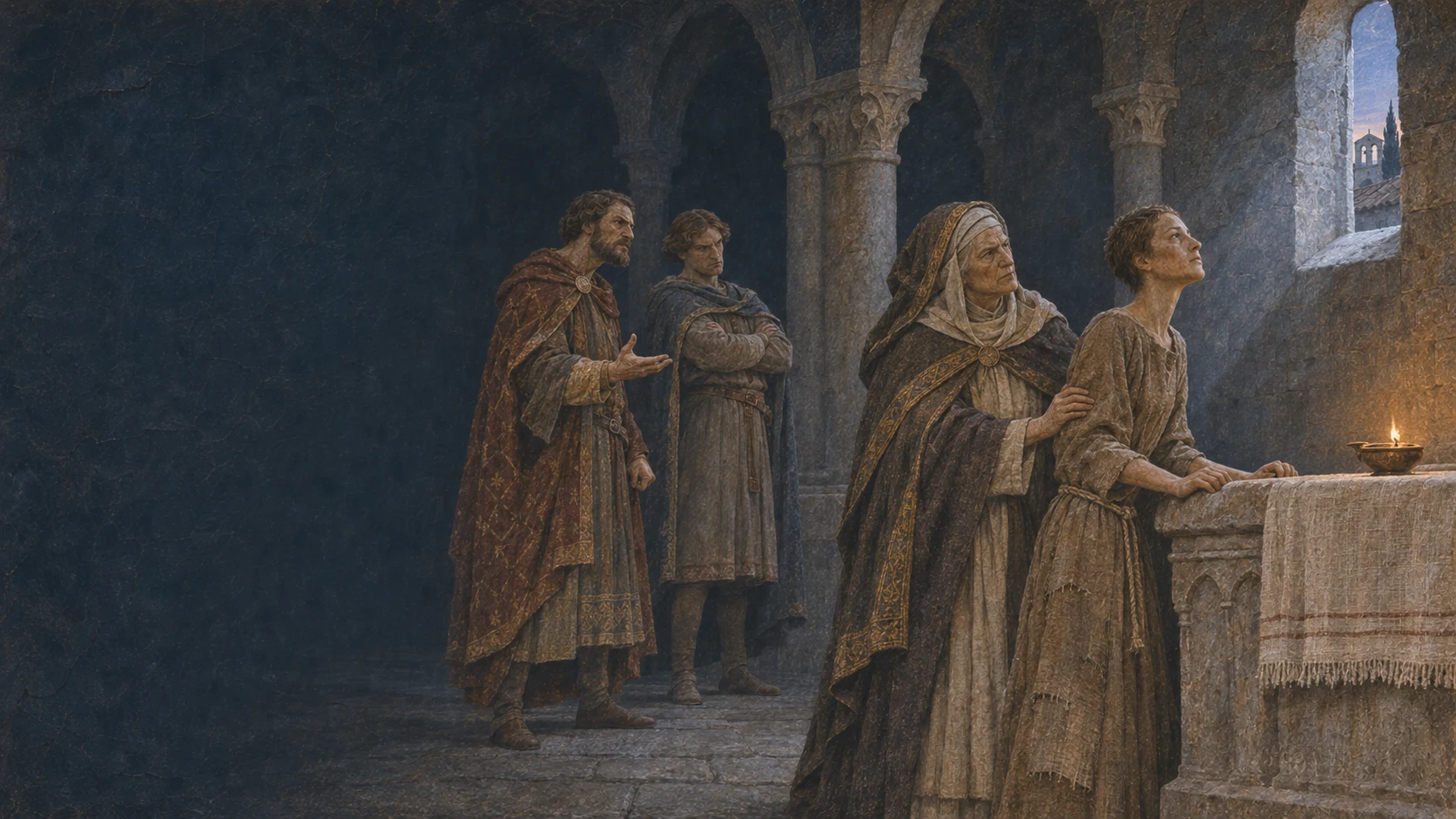
According to the early tradition, Clare ran to the altar, clung to it, and uncovered her shorn head. The gesture showed that her change was no passing whim. Her hair, an important sign of beauty and social standing, had already been given up. The altar signaled sacred protection.
In the medieval world, seeking shelter beside an altar carried a weight that is difficult to feel today. A church was more than a room. Violating it could be understood as both a religious and a legal offense. Clare used the space available to defend a decision that her voice alone might not have been able to protect.
Her cut hair does not prove every detail of the Portiuncula ceremony, but it appears early in the memory of Clare. Uncovering her head before her relatives said: the former possibility of marriage had been left behind.
We do not need to imagine Clare shouting. The sources emphasize her firmness. Her resistance may have been silent and still absolute.
A young woman surrounded by women
It is easy to picture this scene with only Clare, Francis, and the men of her family. But it happened inside a women’s house. The abbess and nuns of San Paolo were there. They opened the door and allowed the fugitive to remain.
Their names do not appear clearly in the account. This silence is common in medieval sources: women’s institutions are mentioned, but many individual women disappear. Even so, the protection they offered was essential.
Perhaps they understood Clare’s courage. Perhaps they also feared conflict with a powerful family. We do not know their conversations. The artwork for this chapter shows a few quiet figures in the background, not to invent specific witnesses, but to remind us that Clare did not resist in an empty building.
Their presence changes how we tell the escape. Francis had helped Clare take the decisive step, but religious women gave her a roof when her family reacted. They knew from experience the weight of a woman’s choice within structures largely governed by men. We do not know whether they approved of the plan for poverty that Clare was still forming. We know only that they received her and that the monastery provided real protection.
Nor should we call that shelter a prison. Monastic life had limits and rules, but at that moment the walls kept Clare from being forced to return. The same wall could mean separation to someone looking from outside and safety to someone who needed to stand by a decision. This ambiguity would run through the whole history of the women of San Damiano: an enclosed space could restrict movement while also protecting a way of life they defended.
A monastery different from Clare’s dream
San Paolo owned lands and had an economic organization that ensured its survival. This was normal. A women’s community could not go out each day to preach and ask for food as the friars did. Properties provided harvests, income, and protection.
Clare, however, wanted to follow the poor Christ without the community owning sources of steady income. It would take decades for this choice to receive a legal form. At San Paolo she saw, close at hand, a respected monastic solution that did not fully match the path she sought.
We should not turn the Benedictines into enemies. They offered safety. The contrast lay between ways of life, not between good women and bad women.
This distinction will matter throughout the book. Clare learned from earlier monastic traditions while also insisting on a Franciscan innovation.
How long did she stay?
Chronologies usually speak of a few days. The likely sequence places the escape at the beginning of Holy Week in 1212, followed by the brief stay at San Paolo and then the move to Sant’Angelo di Panzo. But the exact date of the escape remains debated between 1211 and 1212, and the sources are not travel diaries.
So “a few days” is a plausible reconstruction, not a number preserved in an official record. What matters is the order of places: the Portiuncula, San Paolo, Sant’Angelo, and finally San Damiano.
Each move answered a need. The first offered protection against the family. The second brought Clare closer to an experience of women penitents. The third made possible a community with its own identity.
Resistance did not mean an absence of love
Clare did not need to hate her family to refuse the future they had planned for her. Years later, her sister Beatrice and her mother Ortolana would also enter San Damiano. Catherine, who became Agnes, would follow Clare much earlier.
This makes the confrontation at San Paolo even more human. People who would one day live close together were then divided by fear and misunderstanding. Conversion does not erase bonds; it changes their shape and can wound them before reshaping them.
We do not know how Clare remembered that day. Her own writings speak more about the gift received from God and faithfulness to her path than about family violence. She did not build her identity by feeding resentment.
The first boundary crossed
At her father’s house, Clare had crossed a doorway. At San Paolo, she had to stop others from forcing her back through it.
That is the power of this place. It was not yet her lifelong home, but it was the first space where her decision survived the morning. Escaping at night might have seemed brave while everyone slept. Before her relatives, it became a choice she stood by.
The stones standing today do not give us the exact room or an unchanged altar. The monastery changed, and its later history covered part of the medieval setting. Even so, its name survived in the sources because something essential happened there: a young woman with no wealth of her own found enough protection to say no.
Afterward, she would leave again. Clare’s vocation still had no permanent walls. But it already had a firmness that no arm could carry back home.
That is why San Paolo is more than a stop on the map. It is where the freedom chosen during one night found human shelter, religious memory, and enough time to survive the first confrontation at dawn.
Preserved voices
Sources for this chapter
- Ugolino Nicolini — “Chiara d’Assisi”, Dizionario Biografico degli ItalianiHistorical synthesis. Reconstructs family, chronology, and sources with particular attention to the Process of Canonization.
- Cambridge University Press — study of Clare and medieval cultureContext. Places the escape of 1212 and the brief stays at San Paolo and Sant’Angelo before San Damiano in context.
- Clare of Assisi: The Lady — Early DocumentsCritical corpus. Collects writings, the Process, the Legend, and papal documents in a scholarly edition.
- Benedict XVI — audience on Saint ClareTradition and synthesis. Presents the escape, the cutting of her hair, and family resistance according to the sources on Clare.
- Franciscan Archive — documentary guide to Saint ClareDocuments. Provides guided access to the Process, the Legend, and papal texts.
- Clare of Assisi and the Thirteenth-Century ChurchHistorical research. Examines religious women, rules, and resistance within the institutional context of the thirteenth century.
- Marian University — chronology of ClareTimeline. Records the sequence of the Portiuncula, San Paolo, Sant’Angelo, and San Damiano in 1212.
How we read this episode: the stay at San Paolo and the family's attempt to reclaim her belong to the early documentary tradition. The exact duration, words spoken, and arrangement of people are unknown. The artwork reconstructs the confrontation without claiming to record a preserved moment.