
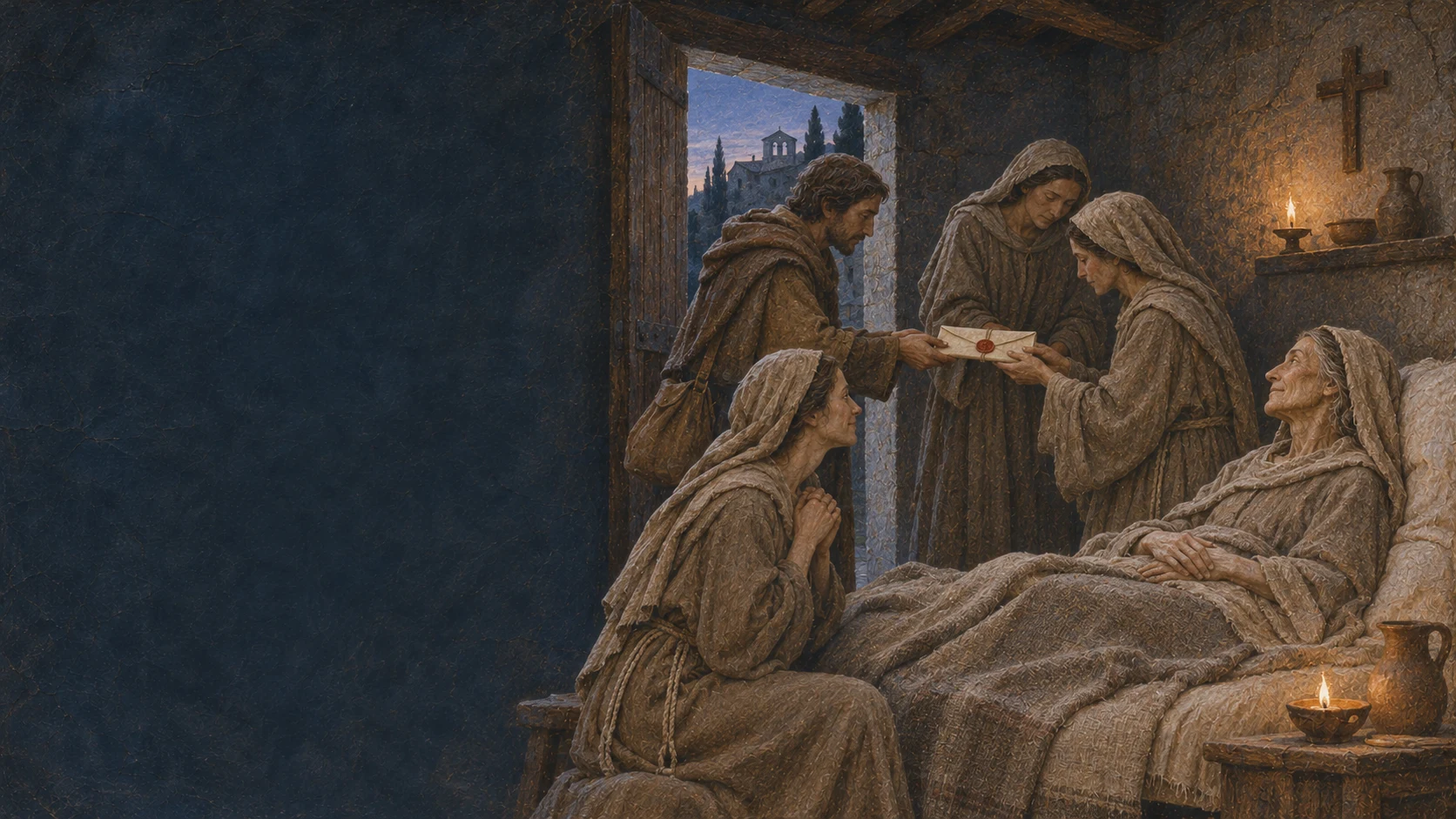
In the summer of 1253, the road between Assisi and San Damiano was dry. Inside the monastery, Clare could no longer travel it. For many years her body had alternated between periods of great weakness and some improvement. Now the sisters sensed that the illness was nearing its end.
Then the document she had waited for over decades arrived.
San Damiano’s tradition preserves August 9 as the day when the bull of confirmation was brought to the monastery. Two days later, on August 11, Clare died. The original of the Rule preserves Innocent IV’s confirmation, given in Assisi on August 9, 1253. The date is a documented fact. Exactly how the parchment passed through the door, who opened it and at what moment Clare touched it was not recorded in an official account; those images belong to reconstruction and devout memory.
The pope was nearby
Innocent IV was staying in Assisi at that time. He was not a distant figure sitting in Rome. He visited the sick Clare and knew San Damiano’s situation. Cardinal Protector Rainaldo had already approved the Form of Life in Perugia on September 16, 1252; on August 9, 1253, the pope confirmed it through the bull beginning with the words Solet annuere.
These dates show the final stage of a process that lasted almost a year—and was not an improvised decision. The text resulted from decades of practice, earlier attempts and negotiation. Rainaldo’s approval and the papal confirmation were the final legal steps.
The bull addresses Clare, abbess, and the other sisters of the monastery of San Damiano. It confirms the form of life “according to which you must live in common, in unity of spirit and in the vow of highest poverty.” That phrase joins two things sometimes separated: communion and poverty.
The parchment that survived
The document associated with the Rule is preserved in the protomonastery of Saint Clare, in Assisi. Seeing an ancient manuscript can feel like touching the past directly. But the historian needs to examine seals, writing, transmission and preservation.
What we call “Clare’s Rule” includes the letter of confirmation and the text of the Form of Life. It has twelve chapters. They cover receiving new sisters, prayer, fasting, clothing, election of the abbess, work, care of the sick, poverty, silence, correction and relations with the Friars Minor.
It was not a private keepsake to be buried with Clare. It was an instrument for the future.
A victory without simple enemies
It is tempting to tell this story as a battle between good Clare and bad popes. The reality is harder and more interesting.
Cardinals and popes feared that communities without income would go hungry, depend on uncertain donations or be abandoned. They also sought to organize numerous women’s groups emerging in different cities. Economic security, discipline and protection had real reasons behind them.
Clare, however, knew another danger. Owning land could require managers, rents, disputes and power over workers. The house would begin living from property instead of sharing and alms. For San Damiano, this struck at the heart of its vocation.
The two sides were not debating an abstract word. They were asking how real women would eat tomorrow and who would guarantee their freedom fifty years from now.
What Clare might have heard
We have no transcript of the moment of arrival. Perhaps a sister read the bull aloud. Perhaps Clare held the parchment. Perhaps her weakness allowed her only to listen.
The Legend of Saint Clare, a hagiographic text written after canonization, presents the confirmation as a great consolation in her final days. Later tradition added tenderness to the scene. All this may preserve a core of community memory, but it does not authorize us to invent phrases and present them as quotations.
That is why, when we imagine the rustle of parchment or the sisters’ tears, we should say: this is a contemplative reconstruction. The document gives us the date; the Process and the Legend bring us closer to the setting; art completes what the archives did not see, without turning imagination into proof.
Forty years within a seal
Clare had left her family home around 1212. She had spent brief periods in other communities before reaching San Damiano. There she had received sisters, faced illness, hunger and war, corresponded with Agnes of Prague and spoken with authorities.
The seal of 1253 enclosed this history in a few formal lines. Legal documents are like that: they seem dry because they need to produce clear effects. Behind expressions such as “we confirm by apostolic authority” lay nights of not knowing whether there would be bread, chapter meetings, cardinals’ visits and Francis’s memory.
The confirmation also recognized authorship. It did not merely say that San Damiano could use a regulation created for another order. The Poor Sisters’ form of life had its own text.
Clare’s body and the body of the community
As the Rule gained legal permanence, Clare was losing strength. This closeness makes the scene powerful, but should not turn illness into a holy decoration.
The Canonization Process gathers testimonies from sisters present during the final days. They speak of the long illness, visits, prayer and farewell. Their memories were recorded to demonstrate holiness; they are not neutral recordings. Even so, they come from women who shared the house and offer details no papal document would have reason to preserve.
One of them, Sister Benvenuta, recalled serving the sick woman. Others described Clare’s serenity and her blessing. The accounts agree in showing a community gathered around someone loved and recognized as a spiritual mother.
But the Rule prevented everything from depending on one personality. It described elections, counsel, offices and practices. Clare’s body would die; the community’s body would need to continue.
“Go safely, for you have a good escort”
The Legend and the testimonies preserve words attributed to Clare in her final moments. The best known seem addressed to her own soul: “Go safely, for you have a good escort for the journey.” She then praises God for having created her.
These words belong to hagiographic and witness memory, not to the bull. They were transmitted in a canonization context and given literary form. We do not need to dismiss them for that reason. We simply need to read them according to the right genre.
They show how the sisters understood the death: not as the disappearance of an administrator, but as the passage of a woman who had learned to receive her own existence as a gift.
The visit that eyes could not prove
There is also the narrative of a great procession of virgins dressed in white, with a luminous figure resembling the Virgin Mary, entering to visit Clare. One sister is said to have seen the scene while the others perceived nothing.
This is hagiography and religious vision, not an occurrence that historical methods can confirm. Its meaning is clear: the community interpreted Clare’s death as a welcome by Christ’s mother and the communion of holy women. The image also gives back to the founder what she had sought to offer the sisters: presence in a moment of weakness.
We can contemplate this tradition without placing it in the same column as the date of a bull.
August eleventh
Clare died on August 11, 1253. The liturgical day of her feast was later fixed on August 11. The funeral brought together authorities and ordinary people; according to the Legend, the pope wanted immediately to celebrate a Mass of a holy virgin, but Cardinal Rainaldo advised following the usual procedure.
This hagiographic passage seeks to show that her holiness already seemed evident. The formal canonization process began shortly afterward, and Alexander IV canonized her in 1255.
The Rule continued its journey. Other communities of Poor Clares would receive it under very different conditions. Not every house lived its poverty in the same way; reforms and interpretations emerged over the centuries. An approved text does not end history. It gives it a form capable of passing through conflicts.
What the 9th teaches us
The day of confirmation was not a simple happy ending. Clare was dying. The sisters would have to live without her presence. The institutional future remained uncertain.
Even so, something had been secured: women could name precisely the life they had learned together. Their experience would not remain only in oral memory or depend on the next appointed visitor’s goodwill.
The parchment was fragile, made of skin, ink and seal. But it carried an enduring promise: nobody should erase from San Damiano the form of poverty Clare had received, examined and freely chosen.
Sources and paths for further reading
- Innocent IV — confirmation of Clare’s RulePrimary document. Presents the date, recipients, papal letter and confirmed text.
- Writings of Saint ClareClarean source. Allows the Rule to be read alongside the Testament and letters.
- Epistolae — Clare of AssisiDocumentary chronology. Brings together correspondence and privileges connected to the final years.
- Benedict XVI — Saint Clare of AssisiChurch reading. Summarizes the approval close to her death and the saint’s spiritual legacy.
- Cambridge — St ClareAcademic research. Places the texts and San Damiano’s institutional development in context.
- University of St Andrews — studies on ClareUniversity research. Examines the sources of women’s Franciscan religious experience.
- Franciscan Institute — Early Franciscan SourcesAcademic portal. Explains critical work with early Franciscan sources.
How we read the final days: the confirmation and its date are documents. The bedside memories are testimonies collected for canonization; the heavenly procession is hagiography. Exact gestures when the parchment arrived are reconstruction.