
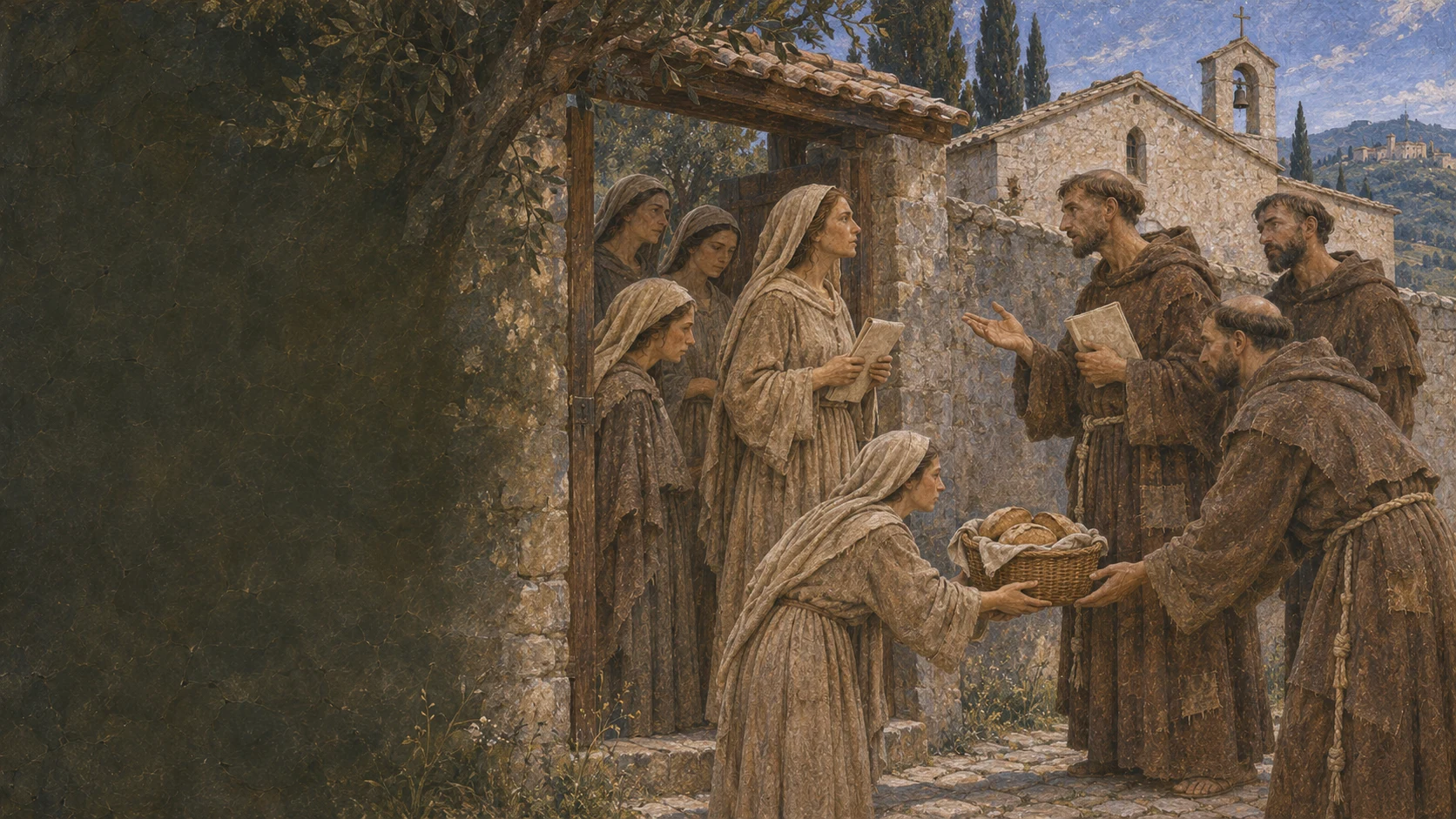
A young woman from a noble family seeks out a man who preaches poverty in the streets. She wants to change her life; he speaks to her about following Christ. The situation could easily be given a movie script: secret meetings, hidden attraction, renouncing an impossible marriage. But that script is not what the documentation has preserved.
Clare and Francis had an important, affectionate, and lasting relationship. It need not be cooled down to fit into history. Nor must it become a romance to attract interest. What we can know involves trust, spiritual authority, shared choices, and differences that grew as each community followed its path.
In the Canonization Process, Bona of Guelfuccio recalled accompanying Clare to meetings with Francis. The witness gives us a relationship accompanied by other people. She does not give us access to secret thoughts, declarations of romantic love, or promises that were never recorded.
The beginning involved more than two people
Clare’s choice took place in a world of relatives, companions, churches, and friars. Francis was decisive, but he was not the only presence. Bona accompanied their contacts; other women helped form the community. Reducing everything to an isolated pair would erase the network that made the change possible.
Clare recognized in Francis a way of following the Gospel. He recognized the seriousness of her decision. In the first sisters’ memory, the women’s courage in the face of difficulty led Francis to promise care. This history receives written expression in the sixth chapter of Clare’s Rule.
The Rule, confirmed in 1253, is an especially important document because the community itself presented it as its standard. In it, the relationship with Francis appears as part of the origin and commitment of a house of women, rather than the abbess’s personal secret.
A promise meant to last
The sixth chapter preserves a brief form of life attributed to Francis. Its language is Christian and communal. It speaks to the women who chose the Gospel and promises care from him and his brothers. Its recipient is a group, rather than Clare alone.
This detail changes the question. The relationship cannot be measured only by how often two people met. It also mattered whether there would be chaplains, counsel, assistance, and a lasting connection between friars and sisters. Trust needed to take some concrete form.
We have no grounds for saying that everything worked without tension. Over the course of the century, care for women’s monasteries became a difficult issue among authorities and friars. The written promise could be recalled precisely when practice fell short of expectations. A cherished bond also needed defending.
He traveled, she stayed
Francis lived an itinerant life: he traveled, preached, and met people in many places. Clare settled at San Damiano with her sisters. This difference did not arise from temperament alone. The possibilities offered to religious men and women were deeply unequal.
Clare’s remaining there, however, should not be treated as waiting for visits. For many years, she welcomed women, led community life, negotiated with authorities, and built her own way of living in poverty. Her monastery had problems that a traveling preacher could not solve for her.
It would also be too simple to imagine that both freely chose between identical options. Enclosure and women’s safety formed part of institutional expectations. History asks us to recognize these limits and, within them, the power to decide that Clare exercised.
Francis also wrote to the sisters
Among the Franciscan texts linked to the women of San Damiano is the exhortation known by its Italian opening, Audite, poverelle. It speaks of unity, obedience, and hardships endured in religious life. The textual tradition places it in Francis’s final years.
The existence of this writing shows that the sisters had a place in his spiritual attention. It does not prove daily contact or allow us to imagine that they all received the text in the same way. The document has its own voice and purpose, and should be read within the body of writings.
Francis’s last will for the sisters, preserved in Clare’s Rule, insists on poverty. After his death, these words became a reference for decisions he could no longer follow. Spiritual friendship also took the form of a demanding legacy, which Clare interpreted and upheld.
Two bodies needed care
Both knew illness. The sources about Francis place him near San Damiano during a period of great physical suffering. Testimony about Clare recalls her long illness and the need to moderate her penances. They were not figures above human limits.
This point allows us to understand a concrete closeness without inventing intimacy. There was care, concern, and people entrusted with helping. We do not know who served Francis each meal, who was present at every moment, or what conversations took place outside the record.
Modern scenes of Clare alone as Francis’s only nurse can be moving, but they need to be recognized as reconstruction when specific sources are lacking. The community of women and Francis’s companions should not disappear to produce a more beautiful encounter. Their lives depended on those other presences.
What a dream allows us to say
The Process preserves a vision described by Clare in which Francis appears offering food, in an image of spiritual motherhood. The bodily language can be surprising. For those who passed it on, it expressed nourishment and spiritual relationship, rather than a physical episode lived between the two.
It is important neither to hide the image because it seems strange nor to use it as proof of romance. We are dealing with testimony about a visionary account attributed to Clare. Interpretation requires attention to medieval religious symbolism and the questions asked in the investigation.
The Legend does not incorporate every memory from the Process. Its selection shows that memory was organized. What an author chose to tell or omit interests researchers, but it does not justify turning a symbolic experience into a declaration of romantic love that the sources never made.
A meal surrounded by fire
In the Fioretti, a later collection of Franciscan stories, Clare and Francis share a meal at the Porziuncola, and the place seems to burn in the eyes of those watching from outside. It is a famous and beautiful narrative, shaped to communicate the fervor of a spiritual conversation.
Its genre is hagiographic and its transmission comes after the events. It should not be treated as contemporary minutes of a dinner. Nor can the story’s light automatically be translated into disguised romantic passion. That would add an interpretation without documentary support.
Tradition deserves to be known as tradition. It tells us how generations imagined the two saints’ friendship. When art depicts the meal, it represents that reception. The problem begins when readers receive the scene without any indication of its period and come to confuse it with direct testimony.
A farewell that did not end Clare’s story
Francis died in 1226. Franciscan accounts describe his body passing by San Damiano, where Clare and the sisters could see him. The scene brings loss and connection together: a community that owed so much to this man received him already dead.
We do not know every word of the farewell. Tears and lamentation belong to the transmitted account; invented dialogues between the two at that moment would not have been possible. Even so, the memory helps us recognize the intensity of a separation that affected all the sisters.
Clare lived another twenty-seven years. During that period, her correspondence with Prague matured and she obtained confirmation of her own Rule. Telling her life as though it ended beside Francis’s body would take away precisely the stage when her written voice becomes most visible.
A name that could be called
Grief for Francis was not limited to an idea of poverty that remained available in the writings. A person to whom Clare could turn had died, someone whose presence was part of the beginning. After 1226, a new question would no longer receive his direct reply.
This absence helps explain the importance of preserving words, but it does not allow us to invent conversations with the dead. Clare had to live with the difference between remembering advice and receiving more. Her later decisions belong to this difficult adult condition: remaining faithful to a relationship without being able to hand the absent person responsibility for what still needed to be chosen.
Remaining connected and making decisions
Clare could recognize Francis as a spiritual father and exercise authority of her own. These two things coexisted. Her autonomy does not require erasing the debt she herself affirmed; that debt does not require denying her intelligence, her negotiations, or her authorship.
The letters and Rule are documents. The Process gathers testimony from people close to her. The Legend and Fioretti belong to different forms of hagiography; later tradition continued to interpret the bond. Our reconstruction begins when we try to join these fragments into a continuous life, and it must keep its limits visible.
At the end, we see a friendship rooted in two communities. There is enough affection to explain concern, grief, and faithfulness. There are enough differences to recognize two lives. Clare remains before her sisters, with decisions no one can make in her place.
Sources and paths for further reading
- Fonti Clariane — writings, Process, and documentsPrimary sources. Process, especially Bona’s testimony and the vision narrated by Clare; includes Franciscan writings and later receptions.
- Clare’s writings — Stary Sącz monasteryDocument setting out rules. The Rule, chapter VI, preserves the form of life and last will attributed to Francis.
- Regis J. Armstrong — Clare of Assisi: The LadySpecialist edition. Allows comparison of writings, testimonies, and biographies without assigning them all the same documentary value.
- Catherine M. Mooney — Clare of Assisi and the Thirteenth-Century ChurchAcademic research. Examines the women’s identity and the institutional limits of their bond with the friars.
- La voce di Chiara e delle compagne — study of the Process and LegendResearch on memory. Analyzes episodes from the Process omitted in the Legend, showing the work of hagiographic selection.
- Legend of Saint Clare — Italian textEarly hagiography. Should be compared with the testimonies, without turning it into a complete record of their shared life.
- Miles Pattenden — The Canonisation of Clare of Assisi and Early Franciscan HistoryAcademic study. Places Clare’s memory within tensions among the papacy, friars, and women’s communities.
Documentary limit: the sources support spiritual friendship, affection, and community commitments. They do not document courtship, hidden passion, or a renounced romance; those plots have not been added.