
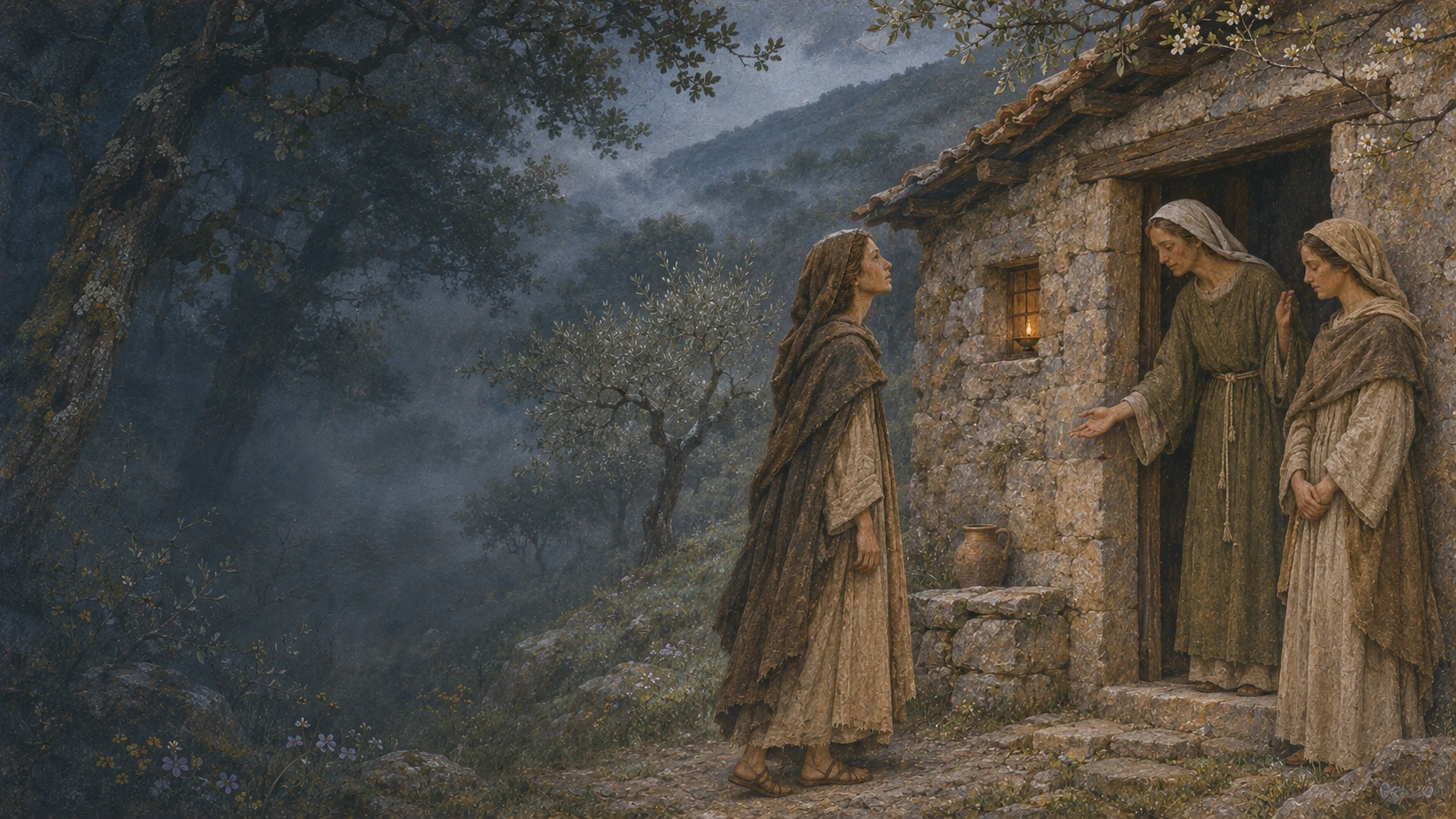
Clare had to leave one shelter before she had a home.
At San Paolo of the Abbesses, she had resisted relatives who wanted to take her back. The religious women’s protection had allowed her to stand by her choice. But remaining in that monastery was not necessarily the destination she sought. Her decision to follow the Gospel in poverty still needed to find a way of life and a place where it could grow.
The name of the next stop has reached us: Sant’Angelo di Panzo, near Assisi, on the slope of Mount Subasio. The Portuguese form of its name translates as Saint Angel of Panzo. The name seems small among larger events. Yet without this passage, the story becomes too easy, as though Clare had found San Damiano ready on the morning after her escape.
She did not. There were moves, temporary welcomes, and people whose part we know only incompletely. A firm choice could exist alongside a future still open.
Beatrice’s memory
In the Process of Canonization, Clare’s sister Beatrice gives a sequence of places. After the Portiuncula and San Paolo, Francis, Brother Philip, and Brother Bernard led Clare to Sant’Angelo di Panzo. She stayed there a short time before moving to San Damiano.
This is important information because it preserves names and an order. It also has a limit stated by the witness herself: Beatrice explains that she saw some things and heard others from Clare and other people. We should not place her walking beside the group simply because she recounted the route decades later.
Historical inquiry begins by listening to this caution. Direct testimony and information received from others can appear in the same statement. Knowing who told the story does not settle everything; we must also ask how that person knew.
Beatrice was speaking in 1253. About four decades had passed between the move and her testimony. She preserved a family and religious memory without providing the equivalent of a daily travel log.
Climbing without knowing the ending
We can imagine the effort of a hillside path, the changing light on stone, and the weight of simple clothing. These elements belong to a possible narrative reconstruction. No witness described that day’s weather, the sound of footsteps, or the words spoken during the climb.
What this passage reveals goes deeper than a description of the weather. Clare was doing more than escaping a family. She was trying to enter a life that did not yet have a stable place for her. Each stay therefore required trust in other people.
For a young woman separated from her family’s protection, being welcomed by religious women had practical importance. There was food, rest, guidance, and some public recognition that her choice deserved respect. Courage needed this support to survive the days ahead.
We do not know who opened Panzo’s door. That unnamed woman also belongs to the story, even though we cannot write her biography.
What kind of community was it?
Books and guides often call Panzo a Benedictine monastery. Other studies associate its residents with groups of women penitents, whose organization did not exactly match that of a large abbey. The documents do not allow us to settle the question with an absolute statement.
Penitents were people who sought a more intense religious life through prayer, simplicity, and changed conduct. Some women lived together, attached to a church, before their experience received a fully monastic organization. This does not mean they were outside the Church or without any discipline.
Medieval categories do not always fit divisions that seem obvious today. A house could change its status over time. A later name could cover an earlier, different experience. Calling all these women Benedictines without qualification may therefore hide the very diversity Clare encountered.
It would also be unwise to turn Panzo into a modern community of completely independent women. Protection, guidance, and religious ties remained necessary.
A poverty without a finished rulebook
Clare arrived with a decision, not with the approved Rule we know from 1253. More than forty years would separate those two moments. Ways of working, organizing prayer, and supporting a community would be learned and discussed during that time.
It is tempting to imagine the young woman already explaining all the principles of her future house at Panzo. We have no such conversation. Her mature writings help us understand the path she recognized as her own, but they are not a recording of her first weeks.
The desire to follow the poor Christ appears as a lasting center of her life. Its expression in rules, relationships, and economic choices had a history. Panzo belongs to the beginning of that history, when the intention needed protection before it could be organized.
This difference brings Clare closer to us. Having a conviction does not mean knowing in advance how to face every problem. Sometimes the possible next step is to find somewhere to spend the night without abandoning what one has chosen.
Those who accompanied her, those who stayed
Francis and the friars appear as companions in Beatrice’s account. Their presence indicates a support network. It does not mean they managed the women’s lives alone, or that we can assign each one a specific task during the move.
The welcome also depended on Panzo’s residents. They would remain when the companions left. In stories centered on famous figures, this work easily disappears: preparing a place, sharing provisions, accepting the risks of receiving someone in conflict with powerful relatives.
No document lists these tasks for that day. They are the general needs of hospitality, not individually proven facts. Even so, they help us see why a change of address is never merely one person’s movement between two points.
Clare learned to live within a network of women before leading her own community. We do not know the content of that learning at Panzo. We can recognize its possibility without filling it with invented lessons.
The arrival that would change the shelter
The early Legend places at Panzo Clare’s meeting with the sister whom tradition calls Catherine and who would become known as Agnes. The narrative develops the relatives’ resistance and the defense of a new religious choice. It is one of the most intense scenes in the memory of Clare.
We must, however, distinguish the layers. The Process preserves Clare’s stay at Panzo. The Legend offers the most extensive narrative account of her sister’s arrival. Later traditions add explanations about names and family details. These texts do not have the same closeness to the events or the same purpose.
The meeting matters because it changes the meaning of being alone. Another woman, linked to Clare by birth, also wants to choose a religious future. The experience begins to take a shared form.
There is no need to imagine Panzo as Clare’s monastery already founded. The shelter belonged to other women. What was beginning between the sisters would still need to find its own space.
The short time recorded by the sources
How long did the stay last? Beatrice says it was brief. Chronologies try to combine this information with the sequence of Clare’s conversion and Agnes’s arrival. Their results depend on debated dates, including the choice between 1211 and 1212 for the beginning of Clare’s religious path.
A precise number may make a timeline easier, but it may also create certainty the documents do not offer. Here, the most honest course is to preserve the brevity without counting days no one securely recorded.
The same applies to the exact reason for leaving. We can recognize that San Damiano would become the lasting home. We cannot claim that an argument, an order, or a particular difficulty caused the departure from Panzo if the source does not describe it.
History is not an obligation to explain everything. Sometimes its responsibility is to show where an explanation stops being known and starts being imagined.
A passage that was not empty
When Clare left Panzo, she took more than the memory of a roof. The episode shows that her path passed through women’s communities older than her own. The new beginning did not arise in an empty space: it needed the hospitality of women already seeking to live their faith.
We do not know whether there was a long farewell. We do not know who watched the group leave. These images may serve a painting or a narrative, provided they are recognized as reconstructions.
We know that Panzo’s name remained when many details disappeared. Between the protection of San Paolo and the permanence of San Damiano, it holds the time when Clare was still a guest.
Before offering other women a home, she had to receive a place in someone else’s house. This dependence does not diminish her decision. It shows how many hands were needed for a personal choice to become, little by little, a shared life.
Preserved voices
Sources for this chapter
- Clare of Assisi: The Lady — Early DocumentsCritical corpus. Regis J. Armstrong's edition collects the writings and early sources, allowing comparison of genres and versions.
- Process of Canonization — testimony of Beatrice, XII, 5Testimony. Preserves Panzo, the companions, and the short stay; Beatrice distinguishes what she saw from what she heard.
- Legend of Saint ClareHagiography. Arranges the moves and associates Panzo with her sister's arrival; its composition is not equivalent to a contemporary official record.
- Catherine M. Mooney — The Early San Damiano: A House of PenitentsAcademic research. Questions the projection of later monastic structures onto the early years.
- Jeryldene M. Wood — Women, Art, and SpiritualityAcademic context. The introduction records the sequence of shelters; its description of Panzo should be read alongside the historical debate.
- Ugolino Nicolini — Chiara d’Assisi, on Assisi Santa ChiaraHistorical reference. A biographical synthesis useful for comparing chronology and documents; the portal does not replace reading the testimonies.
- Benedict XVI — audience of September 15, 2010Ecclesial reception. Presents the religious meaning of Clare's choice without resolving the uncertainties about Panzo's location and layout.
How we read this episode: the stay and sequence come from testimony; the fuller account of Agnes's arrival belongs to hagiography. The house's status, the precise duration, and the setting remain open questions. The path, light, and visual welcome are reconstructions, not preserved observations.