
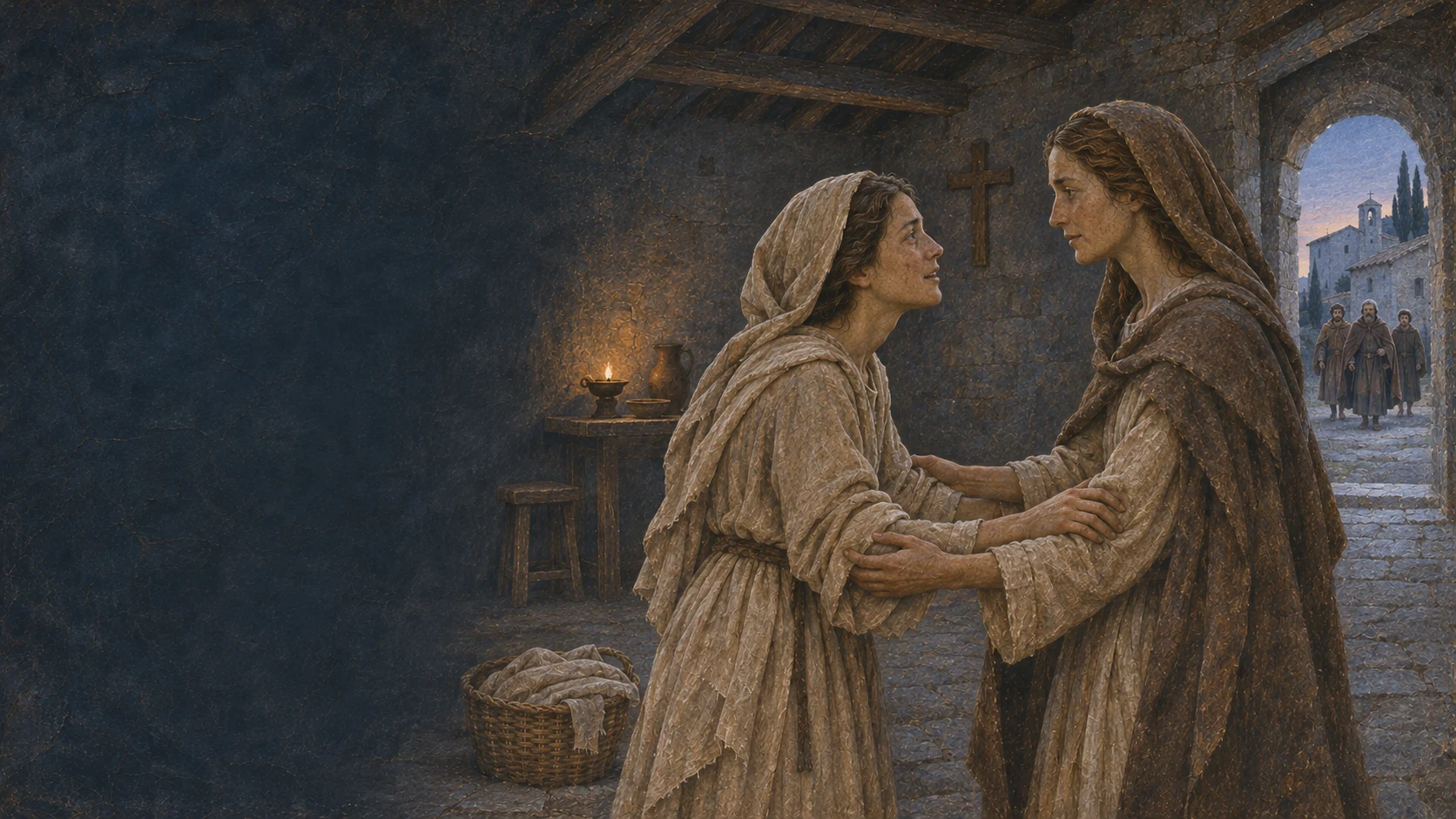
The first departure did not end the unrest in Clare’s household.
One of her sisters also decided to leave. Tradition calls her Catherine before religious life; the sources recounting her vocation present her as Agnes. This difference deserves attention. In the closest sources, the earlier name is less certain than the name by which she became known.
We can keep Catherine in the title, as the received tradition does, without pretending that every document records a change of name. The woman we will meet is Agnes of Assisi, Clare’s sister. She should not be confused with Agnes of Prague, the distant princess to whom Clare would write years later.
Her arrival was more than a family visit. Another young woman was claiming the right to answer a vocation for herself. The conflict the relatives thought they could contain by bringing Clare back now involved another daughter of the household.
A meeting recounted later
The early Legend of Saint Clare says that Clare wanted her sister beside her and prayed for her. It places Agnes’s arrival shortly after her sister’s conversion, at an interval traditionally given as about two weeks. The two were bound by affection and, according to the author, came to share the same religious choice.
This is a hagiographic narrative, written to show God’s action in a saint’s life. It is not a letter the young women wrote on the day they met. The joy, prayer, and dialogue reach us arranged by an author who knows the story’s outcome.
Recognizing this does not require us to dismiss the episode. It helps us read without treating every sentence as recorded speech. The Legend wants readers to recognize a spiritual choice protected despite opposition. Its concern is not to measure the distance between two houses or describe a complete family conversation.
The sister who also wanted to choose
In many noble families, daughters’ futures involved marriage agreements and protection of property. Entry into a religious community could be accepted, provided it met conditions considered suitable. Leaving by one’s own decision and seeking an unusual poverty changed that balance.
Agnes was leaving more than personal belongings. She was moving away from expectations that tied her body and future to family alliances. This helps explain the intensity of the reaction, though it does not justify it.
We do not know everything she thought before leaving. It would be easy to invent a sleepless night, a conversation with her mother, or the memory of an old promise. None of these scenes is needed to recognize her initiative.
A person can receive support and still be the author of her decision. Clare offered a possible path; Agnes had to want to follow it. Their meeting is powerful precisely because it brings together two wills, rather than one will and its copy.
The relatives come to Panzo
The Legend places the confrontation at Sant’Angelo di Panzo. It recounts that a group of relatives came to fetch Agnes and tried to remove her by force. The violence is described in concrete terms: she is seized, struck, and dragged while calling for help.
The text presents a large group and singles out an uncle as the scene unfolds. These details belong to the way hagiography shaped the episode’s memory. We have no separate statements from each participant against which to check the sequence.
Even so, the central conflict is historically understandable. A young woman’s religious independence could clash with family authority. What relatives might call protection or duty could become coercion for a woman who refused to return.
This chapter’s title speaks of the same doorway in a narrative sense. It does not identify a physical door both crossed or claim that Agnes repeated Clare’s exact nighttime route. Sharing a choice does not mean repeating every step.
The weight that halts force
In the Legend, when the men try to carry Agnes, her body becomes so heavy that they cannot move it. The story also says that the arm of the relative who meant to strike her is prevented from acting. Clare prays, and the violence is stopped by protection attributed to God.
These elements should be presented for what they are: miraculous events recounted by hagiography. They are not verified measurements of a body’s weight or a diagnosis of someone’s arm. Historical inquiry can study the text, its connections, and its meaning; it has no means of repeating that experience.
For the medieval author, the body that cannot be carried shows that the family could not own this young woman as it owned an object. Physical force met a greater limit. The name Agnes could also evoke the Christian martyr whose choice had resisted coercion.
This reading of meaning does not dissolve readers’ faith. It simply distinguishes religious interpretation from historical demonstration.
Clare at her side, without filling the whole scene
Clare appears praying and defending her sister. Her involvement gives unity to the Legend’s narrative, which centers on her holiness. But the scene can also be read from Agnes’s perspective: it is her body the relatives try to control, her right to stay that is at stake.
When we say only that Clare gained a companion, we lose something essential. Agnes was not a gift handed to the main character. She was a woman who faced the consequences of her own choice.
Nor should we turn Panzo’s religious women into motionless figures. The house sheltering Clare became the site of the confrontation. We do not know which residents witnessed the violence or how they acted. Their institutional presence, however, was part of the shelter without which the sisters would have been more exposed.
The future community was taking shape through supportive relationships. Blood family did not disappear, but it ceased to be the only network able to offer belonging.
Clothing and hair
According to the Legend, Francis welcomed Agnes’s decision and cut her hair. The change expressed a new religious condition. As with Clare, visible signs made public a choice the relatives could no longer treat as a temporary departure.
It is important to avoid picturing a complete modern ceremony, with rules and clothing identical to those of present communities. These women’s first religious experiences would still pass through changes in organization, legislation, and customs.
Cut hair carried social force in a world where appearance, marriage, and family position were closely linked. Simple clothing also marked a departure from earlier privileges. But neither gesture allows us to infer all the young woman’s feelings.
Courage can accompany fear. Joy can coexist with longing. We do not know how these emotions mingled in Agnes, so we need not choose a single expression for her face.
What the Process allows us to confirm
The Process of Canonization preserves Agnes’s existence, her bond with Clare, and her place in the community’s memory. Beatrice, another sister, also testified. This family network is firmly grounded in the early documents.
The developed account of the heavy body and the halted attack, however, comes from the Legend. We should not say that every sister questioned confirmed the entire scene under oath. Different sources can support one another while preserving information of unequal reach.
Memories were also selected. The Process investigated Clare’s holiness. Agnes’s life appeared when it helped explain her sister, not because the investigators were writing her complete biography.
This explains some of the silences. Later, Agnes would have responsibilities and relationships beyond that first meeting. Her entry into religious life is a beginning, not a summary of her whole existence.
A family that would still change
At that moment, the sisters’ choice seemed to open a division that would be hard to repair. Over the years, Beatrice and Ortolana would also become part of the San Damiano community. We should not use this future to minimize the earlier violence, as though everyone knew they would someday reach an understanding.
People lived through the conflict without knowing its ending. Bonds could be rebuilt, but this required time and change. Religious memory brought these paths together; it did not erase the cost of the first decisions.
At Panzo, Agnes ceased to be simply the sister who had remained in the family home. She became a companion in a search that still had no permanent dwelling. There was temporary protection, opposition, and hope.
The two would move toward a life that needed work, food, rules, and patience. The extraordinary events told by the Legend retain their message; the everyday life that followed would show how long the choice lasted. Staying together would require more than crossing a doorway once.
Preserved voices
Sources for this chapter
- Clare of Assisi: The Lady — Early DocumentsCritical corpus. Allows us to distinguish early family information from the development of Agnes's life in texts of different kinds.
- Legend of Saint Clare, 24–26Hagiography. Main source for the meeting, family violence, and miraculous protection recounted for Agnes.
- Process of Canonization — testimonies of Pacifica and BeatriceTestimony. Preserves the family and religious network; it should not be presented as independent confirmation of every detail of the Legend.
- Catherine M. Mooney — Clare’s Childhood and Conversion to Religious LifeAcademic research. Examines the limits of later narratives about the early years.
- Assisi Santa Chiara — Chiara d’AssisiBiographical reference. A reference portal for the family setting and Clare's chronology; it does not give every tradition the same antiquity.
- Benedict XVI — Saint Clare of AssisiEcclesial reception. Places resistance and the Gospel choice within a contemporary spiritual synthesis.
- Chronicle of the Twenty-Four Generals — translation in Franciscan StudiesLater tradition. The fourteenth-century chronicle develops the memory of Agnes; its distance in time requires distinguishing it from the documents of 1253.
How we read this episode: Agnes and her family relationship are historical; Catherine is the earlier name passed down by tradition. The confrontation and extraordinary signs are recounted by the Legend. Emotions, a specific doorway, and unpreserved conversations have not been turned into facts.