
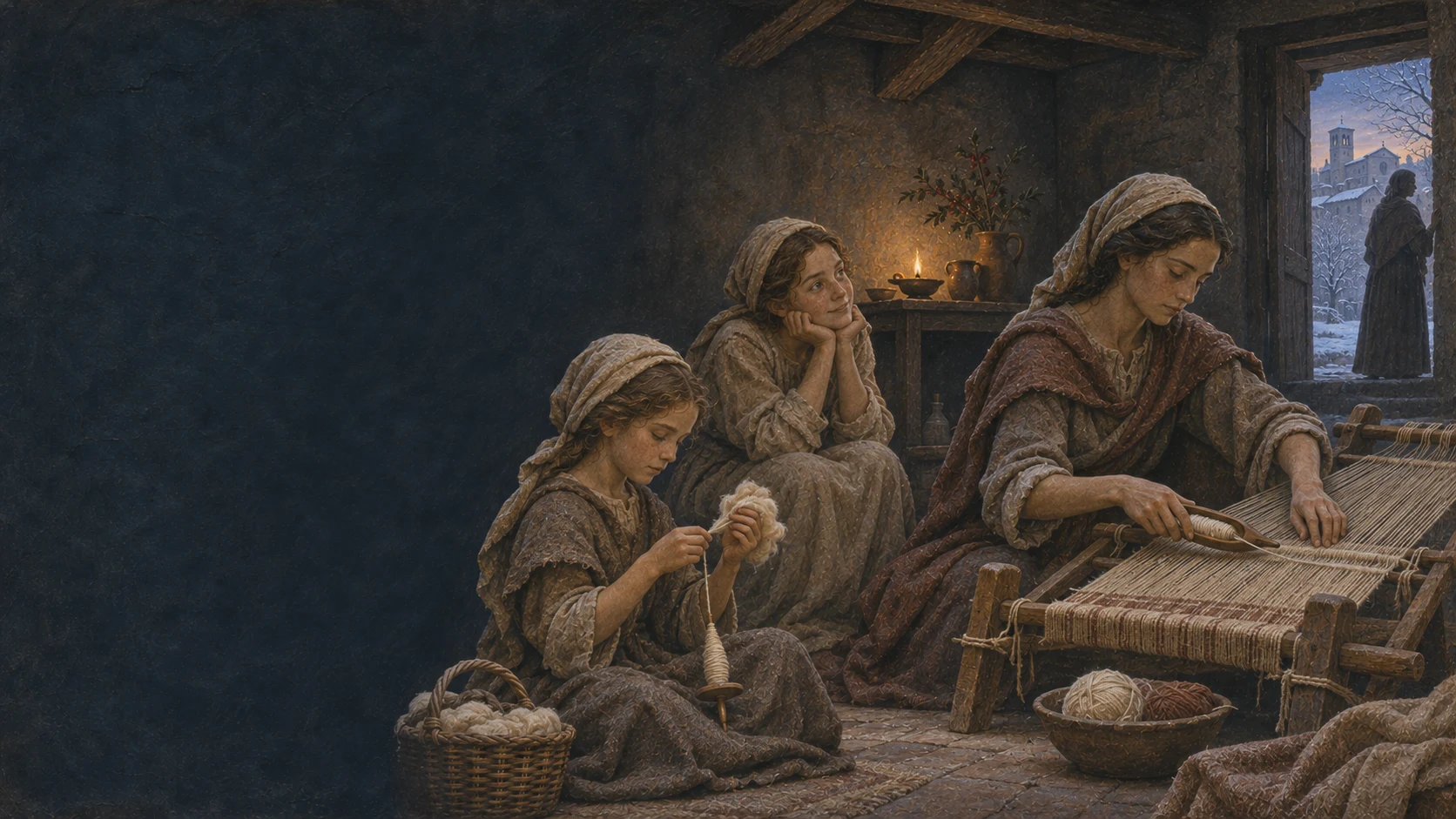
Clare had sisters.
The phrase seems small, but corrects many images. She did not appear alone before Francis, separated from every female relationship. She grew up among women who shared rooms, work, news and expectations.
Catherine would receive the name Agnes when entering religious life. Beatrice would also arrive in San Damiano. Ortolana, the mother, would do the same. Relatives like Amata and Balvina appear in the Process.
The future community didn’t erase the family.
How many daughters were in the house
Sources identify Clare, Catherine/Agnes and Beatrice as the daughters of Favarone and Ortolana. There are discussions about ages and order of birth. Devotional texts fill intervals with greater security than documents allow.
We do not know a scene in which the three posed together. The art of this chapter offers a reconstruction: sisters of different ages work with wool and loom on a cold night.
Textile work is plausible for women of her condition and reappears in Clare’s life. The exact disposition of the loom and gestures are artistic choice.
Catherine before she’s Agnes
Catherine is remembered above all for following Clare a few days later. This may make it seem that she had no previous life. She had family, expectations and will of her own.
When she decided to leave, relatives tried to recover her. The Legend narrates violence and a wonderful intervention that made her body impossible to move. The Process preserves memories linked to the conflict, but the dramatic form belongs to the hagiographic account.
The historical core is strong: the second exit deepened the family crisis. The new name, Agnes, marked a religious identity.
Later, Agnes would have responsibilities and relationships of her own. Traditions link her to the community of Monticelli in Florence. A future chapter will follow her life without reducing her to “Sister of Clare”.
Beatrice, the voice of a witness
Beatrice entered San Damiano later and testified in the Process of Canonization. Her speech is valuable because it combines kinship and religious coexistence.
She remembered the house, Clare’s decision and the years after, but she also spoke as a community sister and as a woman who considered Clare holy.
Testimony is not a camera. Proximity offers access and affection; affection also organizes memory.
Beatrice appears less in popular narratives because her arrival does not have such a dramatic escape. This reveals how stories choose spectacular scenes and leave entire lives on the shore.
The cousins and nieces of memory
Amata, Balvina and other relatives appear among the women of San Damiano. Genealogical studies differ in detail. Process is safer to recognize coexistence than to draw each line of kinship.
The presence of several women from the same network shows that Clare’s choice did not remain an isolated gesture, nor does it mean that all of them entered for the same reason.
A community can welcome relatives without becoming the property of a family. This balance required care. Clare’s authority should not distribute privileges of blood.
Destinations prepared for noble women
Marriage and monastery were important paths, but not simple personal options. Families negotiated alliances, dowries and security. Monasteries could also receive property and maintain social distinctions.
The life-form sought in San Damiano challenged part of this logic. Clare wanted common poverty, without property to guarantee the house in a traditional way.
For noble women, this meant giving up not only marriage, but also a comfortable monasticism sustained by lands.
What the sisters saw in each other
We have no letters between Clare and Catherine, no childhood conversations, and the absence hurts because we’d like to hear intimacy.
We can perceive relationships by preserved gestures: follow, live, care during illness, witness after death. They are not evidence of constant harmony. All community life contains frictions that hagiographies rarely record.
Introducing the sisters as a group always united from girls would be sentimental. Introducing them only as followers would be unfair.
A family that changes shape
In the paternal house, age, marriage and male authority organized the future. In San Damiano, women were called sisters under a common rule.
Clare remained the biological sister of some, spiritual mother of the community and abbess. These roles could overlap.
When Ortolana entered, her daughter became her religious superior, the inversion did not erase memory of her lap, education and travel, creating a new relationship.
Why tell names
Stories of saints often leave around faceless people. Name Catherine, Beatrice, Pacifica, Amata and Balvina changes the picture.
Clare did not realize her life alone. Her firmness provoked answers: some resisted, others followed, others cared, others kept memories.
The Process survives because women spoke. Even filtered by questions, translation and writing of notaries, their voices make the community visible.
The scene before the breakup
In art, the sisters are still at home together, not wearing a habit, and the future does not appear as a halo.
The scene asks the reader to imagine what sources do not record: the years in which they were simply sisters growing under the same roof.
Soon one will walk through the door, another one will go after it, another one will take time.
Clare’s sanctity didn’t destroy those bonds, so every woman needed to decide what she would do to them.
Sisters aren’t versions of each other
Catherine would be known as Agnes of Assisi after following Clare. It is tempting to mention her only as “the sister who did the same.” But her decision had her own conflict, and her life continued beyond the initial escape. Traditions link her to other communities; not all details have the same documentary security.
Beatrice took another path and entered San Damiano later. In the Process, her voice helps to preserve family memory. She knew things that the younger sisters of the community could only know by account. By testifying, she became a bridge between the house of the Offreduccio and the house of the Poor Ladies.
The three sisters do not form a line of copies. They had different ages, experiences and rhythms. Clare’s holiness does not require diminishing the choices of others.
Marriage, monastery or widowhood
For women of their position, the recognized futures were few, although the real life was always more varied. Marriage linked families and transferred dowry. Widowhood could bring some autonomy, but also vulnerability. A monastery offered religious life, protection and community, often supported by property.
Clare’s proposal complicated this map, she wanted consecration without accepting that the main security came from large properties, the path was not yet legally ready when Catherine followed it.
This explains why the family did not see only a spiritual preference. Two daughters leaving threatened alliances and possessions. The violent reaction to Catherine’s departure belongs to the Legend and the ancient memory; its details will be examined in the chapter itself.
The women the sources call “servants”
In addition to noble relatives, the house contained women of inferior position: maids, nannies, workers. Some might know Clare very well, but their names almost never appear. When the Legend praises a young lady for giving food to the poor, there is around a network of hands that cooked and transported.
We should not invent biographies to fill the silence. We should leave the silence visible. The medieval family was greater than genealogy, and history preserved unevenly those who had prestige.
In San Damiano, women of diverse origins would be called sisters, although social differences did not magically disappear. The community proposed another kinship, built by promise and daily life. This transformation began within female relations that already existed.
A memory preserved by women
What we know of Clare’s youth depends heavily on women. Beatrice spoke as a sister. Bona spoke as a companion. Pacifica spoke as a pilgrim with Ortolana and then as a religious. San Damiano’s sisters spoke about sickness, prayer, work and leadership.
Men wrote, questioned and validated the Process. The institution framed the voices. Still, in them survive details that a papal bull would never record: food sent in secret, a kiss, a fabric, a Christmas night or a mother who traveled.
Reading Clare in depth means listening to this chorus and also noticing where the male writing reorganized her speech. The family history is not decorative prologue. It is the first community of women within which her decision has become possible and painful.
Preserved names
Sources for this chapter
- Process of CanonizationTestimonies. Preserves testimonies from Beatrice and other relatives.
- Basilica of Saint Clare — historical profileCritical Genesis. Summarizes family ties and divergences.
- Social recruitment of Assisi ClarissasFemale network. Analyzes kinship and community composition.
- Fonti ClarianeCorpus. Gathers ancient texts and historical notes.
- Journal of Ecclesiastical History — canonization of ClareMethod. Contextualizes the Process critically.
- Cambridge — Poor ClaresContext. Sets the family within the history of Franciscan women.
How we read the sisters: names and later entry into San Damiano are documented; exact ages, domestic scenes and feelings remain largely unknown.