
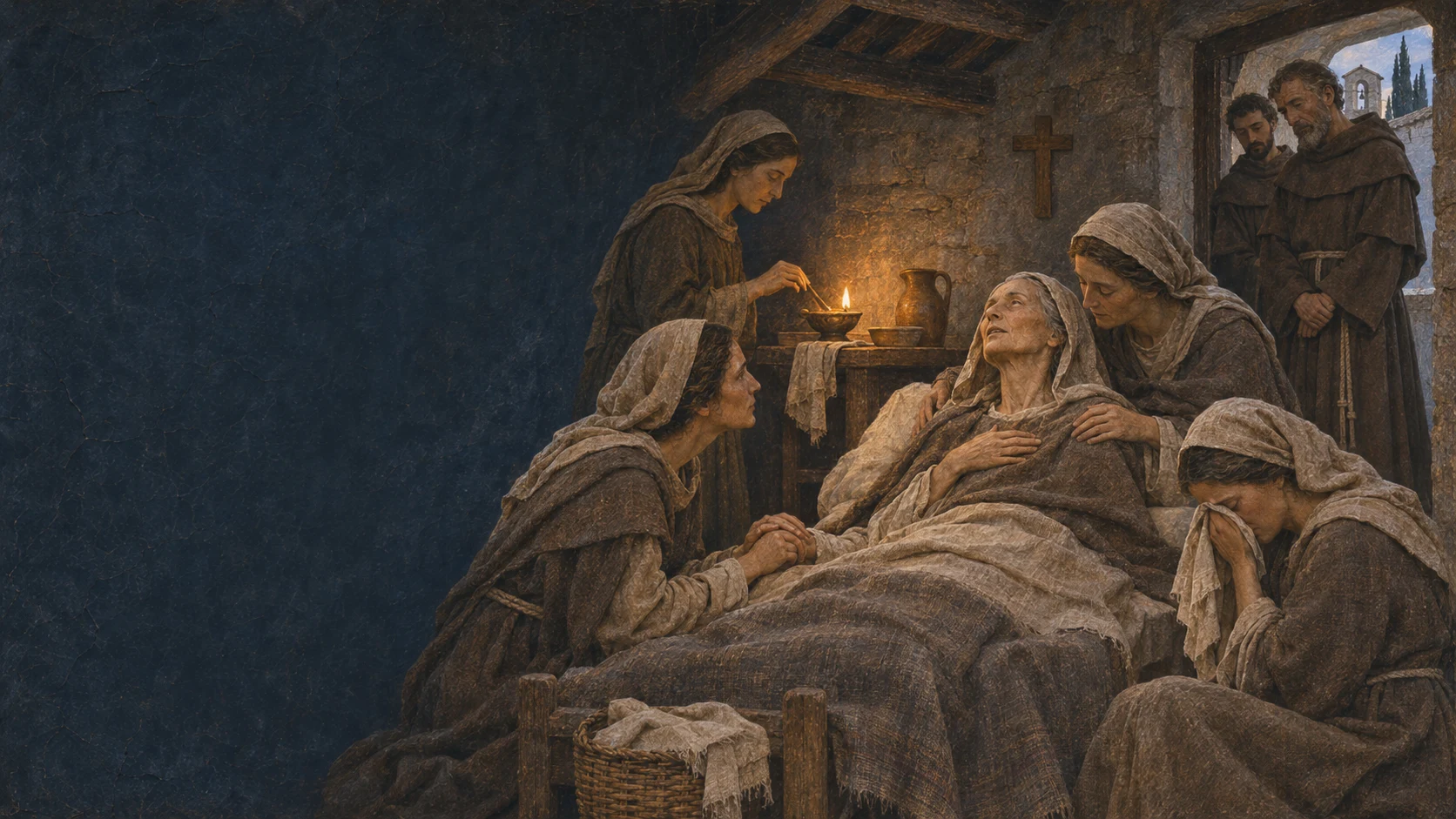
Philippa heard Clare speak and asked another sister to keep those words firmly in her memory. The sick woman was saying things those present could not fully understand. There were tears, attention, and awareness that they might lose someone whose voice they had known for many years.
This small scene reaches us through the Canonization Process. It is not the description of a death observed from outside by an all-knowing narrator. It is the memory of a woman who stood close and tried to preserve words. Before becoming a phrase repeated in books, Clare’s farewell depended on that listening.
Among the preserved words is the exhortation commonly translated as: “Go safely, for you have a good escort.” To whom was she speaking? The question was not invented by a modern reader. According to the testimony, a sister named Anastasia asked it beside the bed.
An end after many years
Clare died at San Damiano on August 11, 1253. The date places the end of a religious life begun about forty years earlier. Between the young woman who left her family and the woman in that bed stood an entire community of decisions, losses, work, and care.
The illness had not appeared only that week. The sisters remembered a prolonged sickness, with limitations that formed part of the house’s life. We do not have enough information to name it with a present-day diagnosis or precisely reconstruct its clinical course.
The end, therefore, should not be presented as a sudden passage from full health to a perfect farewell. People had been caring for Clare for a long time. Her authority had learned to reach others from a frail body, and the community had also learned to serve her.
Two memories from close by
Philippa and Benvenuta of Diambra preserve the core of the dialogue with the soul. Their versions should not be treated as identical recordings. Each brings the way the religious woman remembered the scene and answered the investigation’s questions.
This convergence offers an important basis: more than one woman associated Clare’s final days with those words. It does not allow us to recover the intonation, decide every pause, or guarantee every word of a Portuguese translation. The record passed through writing and transmission.
Care begins there. We can follow a remembered phrase without pretending we are hearing exactly the sound that crossed the room. What reaches us is close enough to move us and mediated enough to call for caution. A good narrative need not hide either condition.
Her own soul as companion
To Anastasia’s question, Clare is said to have replied that she was speaking to her own soul. It is a Christian way of addressing oneself at the moment of passage. The language relates to the prayer commending the soul, in which the person is entrusted to God.
It does not mean a second figure was sitting before the bed. Nor do we need to interpret the dialogue as a sign of mental confusion. Religious tradition had words and gestures for speaking of death, and Clare expressed herself within that world.
The escort’s meaning appears linked to God’s action throughout her life. The Creator would not be a stranger encountered only at the end. Her trust rested in the one who, according to her faith, had called, sanctified, and guarded her. The farewell looks back before moving forward.
An image of a mother
In the transmitted memory, God’s care is compared to a mother’s care for her small child. This image does not turn Clare’s weakness into shame. The person who had so often cared for others now recognizes herself as cared for.
It is a change that helps explain the tenderness of the words. Throughout life, she had needed to make decisions and uphold commitments. At the end, she does not present herself as someone who can guarantee everything through her own firmness. Safety comes from a relationship received.
The image also speaks to the language of the letters, where motherhood, welcome, and spiritual life draw close. We need not conclude that Clare was consciously repeating a passage written earlier. We can notice continuity in vocabulary without inventing the exact path of her thoughts.
Gratitude for having existed
Another phrase preserved by the sisters thanks God for creating her. The thanksgiving is not a reckoning in which every pain finds an explanation. It does not say everything was easy, or every loss disappeared. It affirms the value of an existence received.
In that sick body, the recognition carries weight. Clare did not need to recover her health to consider her own life worthy of gratitude. That does not make illness good in itself. It shows that suffering did not exhaust the way she understood who she was.
Nor should we use her words to demand serenity from every dying person. Another person’s fear and sadness are not a lack of worth. The testimony tells how the sisters remembered Clare; it does not establish a test all sick people would have to pass to deserve care.
The Rule arrived in time
During those same days, San Damiano’s form of life received papal confirmation. Innocent IV’s document is dated August 9, 1253. Philippa said that a friar brought the writing and that Clare kissed it.
It is important to separate the confirmation’s date from its physical arrival at the monastery. The sequence in the testimony links its reception to the eve of her death, while the document preserves the legal date. We need not force both records to say exactly the same thing.
The emotion of that encounter with the parchment does not depend on invented decoration. The community would have a confirmed rule to follow after the foundress. As Clare’s life ended, something she had worked for could remain in her sisters’ hands. The farewell included responsibility for the future.
People who drew near
The pope visited Clare while she was ill. Friars linked to early Franciscan history also appear in memories of her final days. The Legend names companions and organizes scenes of spiritual consolation. Each presence needs to be attributed to the source recording it.
We do not have a minute-by-minute list of who entered, left, or remained beside the bed. Nor do we know every word exchanged. Turning the infirmary into a stage for complete speeches would erase the limit of what was actually preserved.
At the center remain the sisters. They were caring for someone who was a spiritual mother to many of them. Their sadness does not appear as an obstacle to a scene of triumph. Death would remove a concrete presence from the table, prayer, decisions, and the house’s everyday memory.
A vision belongs to the person who told it
Benvenuta of Diambra reported a vision of women dressed in white and a larger figure, understood within the narrative’s Marian setting, beside Clare. The witness stated that she was awake. She also admitted that she could not clearly distinguish one of the figure’s gestures.
These two pieces of information should stay together. The Process records a declared visionary experience and its limits, rather than an apparition observed equally by everyone in the room. The Legend develops the theme as the saint’s heavenly reception.
We need not place the vision at the exact instant of the last breath. The testimonies situate memories throughout the final days. Bringing prayer, visits, confirmation of the Rule, and the vision into a single minute would produce an impressive scene that the documentation does not authorize. The farewell unfolded over time.
The attention of those who remain
The testimonies do not preserve the whole story of the women who cared for Clare. Those who helped her during the night would also need to face the next day, share the news, and relearn the house’s routine. These needs belong to the human condition of grief; they are not specific scenes we can describe without a source.
What is documented already reveals demanding attention. The sisters tried to understand words, acknowledged when they could not, and asked for help from one another’s memories. Care reached both the sick body and what the person still wished to communicate.
When approaching this bed, we would do well to follow the same pace. Listening does not require completing every silence. Sometimes it means admitting that a loved person said more than we could preserve, and that the preserved part remains valuable precisely because it does not claim to contain her entire existence.
What the sisters managed to preserve
Clare died, and the house had to continue without her. We do not know her last words with certainty. The phrase about a good escort belongs to the memory of her final days; it should not be announced as a guaranteed transcript of her final moment.
We have a papal document, testimony from women close to her, hagiographic reworkings, and later tradition. Historical reconstruction brings these parts together without claiming a complete view of the room. Where the sources fall silent, silence too deserves to remain.
Philippa had asked a sister with a good memory to listen carefully. Months later, her own voice helped preserve the farewell. Clare was no longer there to speak again; other women would have to tell what they had heard. Before the image of a saint in heaven, we find this earthly gesture of someone trying not to lose a loved person’s words.
Sources and paths for further reading
- Fonti Clariane — writings, Process, and documentsPrimary testimonies. Process: Philippa and Benvenuta of Diambra recall the words to the soul; Philippa also narrates the reception of the confirmed document.
- Legend of Saint Clare — Italian textEarly hagiography. The chapters on the final days organize visits, consolation, and transition; they should not be read as a minute-by-minute chronology.
- Regis J. Armstrong — Clare of Assisi: The LadySpecialist edition. Gathers the final accounts and confirmation of the Rule for comparison between genres.
- Clare’s writings — Stary Sącz monasteryWritings. The Rule and letters help explain the vocabulary of care, motherhood, and community responsibility.
- Clare — Fourth Letter to Agnes of PragueDocument near the end. The last surviving letter shows living relationships and concerns, without functioning as a dated announcement of death.
- Miles Pattenden — The Canonisation of Clare of Assisi and Early Franciscan HistoryAcademic research. Analyzes the context in which memories of the final days were recorded and used.
- Catherine M. Mooney — Clare of Assisi and the Thirteenth-Century ChurchAcademic research. Places the death and final writings within the community’s institutional history.
Care and precision: the dialogue with the soul is speech remembered by witnesses, rather than a proven final phrase. Benvenuta’s vision is a declared individual experience. The date of papal confirmation does not, on its own, determine the time of delivery.