
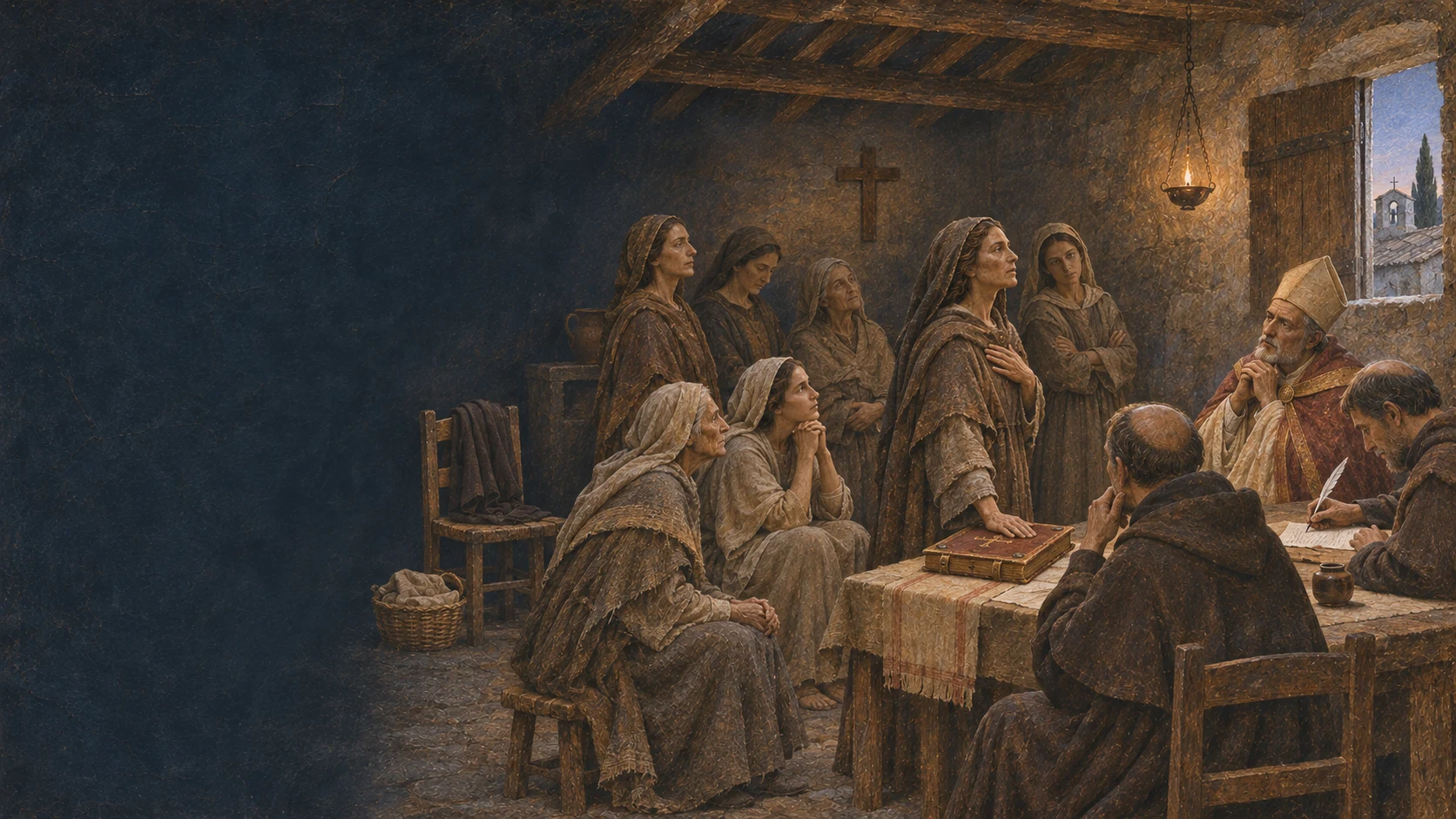
In November 1253, Pacifica of Guelfuccio was called to speak about Clare. The woman whose life she was to recall had died only a few months before. For the investigating authorities, information about virtues and miracles needed to be gathered. For the witness, this was also someone with whom she had shared years of life.
Before the memory came the oath. The religious woman had to tell the truth about what she knew. Then came the questions: how she had met Clare, what she had seen, from whom she had heard a particular story, how much time had passed. Not every answer could be complete.
The Canonization Process begins to give these voices a written form. It preserves more than an extraordinary woman observed by others. It also preserves women capable of remembering, distinguishing, admitting doubt, and transmitting a history that, without them, would be much poorer.
An order to investigate
On October 18, 1253, Innocent IV charged Bishop Bartholomew of Spoleto with investigating Clare’s life and miracles. The papal mandate belongs to the world of institutional documents: it assigns a task, names an authority, and organizes what should be established.
The surviving testimonies were collected in November, with records dated between the 24th and 29th. The investigation should not be called a criminal trial of Clare. There was no accused woman to be condemned. The aim was to gather evidence for officially recognizing her holiness.
That influenced the questions and choice of subjects. The authorities sought virtues, conversion, religious life, and events considered miraculous. They were not preparing a modern biography equally interested in every period, conflict, and detail of daily life.
Pacifica knew a long span of time
Pacifica did not offer only a general opinion about a famous saint. She had known Clare and could relate her memory to a long life together. Her testimony helps us recognize practices of prayer, austerity, service, and care.
The duration of that closeness matters, but it does not turn the witness into an observer of everything. A person can live many years in the same house and never witness a particular episode. The Process asks precisely how each piece of information reached the speaker.
That question protects history. Having seen a gesture differs from having heard a sister describe it; having heard Clare narrate an experience differs from sharing the experience. Faithfulness to the witness requires preserving these differences, rather than expanding the reach of her gaze to make the narrative more certain.
A community with names
After Pacifica, we encounter Benvenuta of Perugia, Philippa, Amata, Cecilia, Balvina, Francesca, and other religious women. Their names interrupt the impression of an anonymous community merely repeating what the abbess said.
The witnesses had different histories and positions. Some had known Clare very early; others entered later. Certain memories were linked to their own illness or care received. Others concerned the way she led the house.
We must also avoid confusing people with similar names. There is more than one Benvenuta in the sources, alongside other repetitions. Numbering and forms of names may vary between presentations, translations, and editions. Checking the person is part of the work, because a memory loses precision when assigned to the wrong witness.
Beatrice and Bona bring other doorways
Beatrice, Clare’s sister, preserves family memories that a companion arriving later could not have in the same way. Bona of Guelfuccio recalls contacts before the change of life, when she accompanied Clare to meetings with Francis.
These voices help us cross San Damiano’s doorway toward the earlier period. Even so, they do not offer unlimited access to childhood, household conversations, or every decision. Kinship and friendship increase closeness, but do not cancel memory’s limits.
There are also lay witnesses. The history does not belong only inside the monastery. Neighbors and people connected with the city knew other sides of Clare. Comparing these vantage points lets us see why no witness alone could tell the whole life.
The writer also takes part
A witness spoke; someone recorded. Questions organized the route, and the wording gave shape to what had been heard. The Process is therefore a document of mediated testimony, rather than a recording we could replay without loss.
We do not possess the complete Latin original of the proceedings. The text reached us through a later vernacular translation, linked to transmission in communities of Clare’s sisters. This condition calls for attention to manuscripts, language, and editions. It should not be hidden behind the vague claim that we have every woman’s exact words.
Nor does it make everything equally suspect. The translation preserves names, questions, answers, and distinctions of knowledge that we can study. Critical work seeks to recognize what was transmitted and assess its limits, rather than demand an impossible source or accept every line without examination.
The courage not to remember
Some witnesses do not know dates or did not see certain events. Rather than correct those gaps in the narrative, we should listen to them. An incomplete answer may show that the person did not wish to pretend to knowledge she lacked.
There are also accounts that come very close to one another because the religious women shared experiences and stories. Similarity can indicate an established community memory. It does not automatically mean that each version is a completely independent confirmation.
This is especially important in extraordinary episodes. The number of people who heard a story is not the same as the number who saw the event. Historical investigation needs to follow the information’s route. The emotion of a memory does not replace this care; often it depends on it to be received fairly.
From investigation to canonization
In 1255, Alexander IV recognized Clare as a saint. The bull Clara claris praeclara presents her life in intense language of light, virtue, and fruitfulness. It is a papal document of recognition, with a purpose different from the Process’s sequence of questions and answers.
Canonization was not the final work on her memory. The early Legend, composed afterward, organized a life for religious reading. Traditionally associated with Thomas of Celano, its authorship has been debated; we need not treat it as an undisputed signature.
Its author selected episodes, gave scenes continuity, and constructed a portrait of holiness. Some memories from the Process entered; others stayed out. That choice is historical. Comparing the two works allows us to recognize both the religious women’s closeness and the concerns of a narrative intended to circulate more widely.
The body leaves San Damiano
Clare was first buried in the church of Saint George in Assisi. Later, her body was transferred to the basilica built in her honor, in 1260. The church’s consecration took place in 1265. These are different stages that should not be compressed into a single ceremony.
The sisters also left San Damiano and settled beside the place where the foundress would be venerated. The move changed the community’s space and its relationship with the city. Memory gained a public presence of stone, altars, and visits.
The body became a relic: a material presence linked to devotion. This does not authorize repeating every later claim about physical preservation without examination. The history of the burial, the discovery of the remains in the nineteenth century, and the crypt requires its own records. Today’s devotional appearance does not function as an intact portrait of the moment of death.
Those who preserve also work
After the witnesses, other women took part in this history’s survival. Communities kept manuscripts, made copies, and sought to gather texts. Transmission did not happen on its own, as though a voice could cross centuries without needing material shelter.
This work did not always leave names. Clare’s memory therefore owes a debt to people we cannot identify. A manuscript might be preserved because a house considered it important; it might disappear when places, conditions, or priorities changed. The archive we read is the result of that uneven survival.
Recognizing this journey also changes the reader’s responsibility. A phrase removed from context can circulate easily and lose the witness who transmitted it. Restoring a memory’s name, genre, and circumstances continues the care of those who preserved it. We need not imagine perfect faithfulness in every copy to recognize how much work was necessary before these women could be heard again.
Memory continues to choose
Paintings, feasts, biographies, and communities of sisters carried Clare into other centuries. Each reception highlighted something: poverty, the Eucharist, protection of Assisi, friendship with Francis, a woman’s firmness. No image alone contains the whole life.
That is why this book distinguished Clare’s writing, institutional document, testimony, hagiography, tradition, and reconstruction. These are different ways of approaching her. Identifying them does not take emotion from history; it lets each voice be heard without receiving words or certainties it does not possess.
At the beginning of the Process there are names. At the end of our reading, they remain necessary. Pacifica, Philippa, Beatrice, Bona, and so many others did not let Clare cross history alone. They paid attention, answered, and acknowledged what they did not know. The reader’s work begins by offering their memories that same attention.
Sources and paths for further reading
- Fonti Clariane — writings, Process, and documentsDocument and testimonies. Investigation mandate and Process; check the names, questions, and distinction between seeing and hearing.
- Regis J. Armstrong — Clare of Assisi: The LadySpecialist edition. Gathers writings, Process, Legend, and papal documents with introductions to transmission.
- Miles Pattenden — The Canonisation of Clare of Assisi and Early Franciscan HistoryAcademic research. Miles Pattenden places canonization in the context of relationships among women, friars, and the papacy.
- Alexander IV — Clara claris praeclaraPapal document. Alexander IV’s bull expresses the recognition of 1255 and its official language of holiness.
- Legend of Saint Clare — Italian textEarly hagiography. Allows comparison of the continuous narrative with the individually attributed memories in the Process.
- La voce di Chiara e delle compagne — study of the Process and LegendAcademic research. Studies episodes omitted in the Legend and the place of the companions’ voices.
- Catherine M. Mooney — Clare of Assisi and the Thirteenth-Century ChurchAcademic research. Catherine Mooney examines how institutions and sources shaped Clare’s history.
- Friars Minor of Assisi — Basilica of Saint ClareInstitutional source from the shrine. Guides the history of Saint George, the basilica, and the crypt; present structures belong to different phases.
How memory reached us: the testimonies of 1253 survived through later transmission, rather than recordings or each religious woman’s autograph. Canonization, Legend, basilica, and devotion are different stages; reconstruction does not merge them into a single memory.