
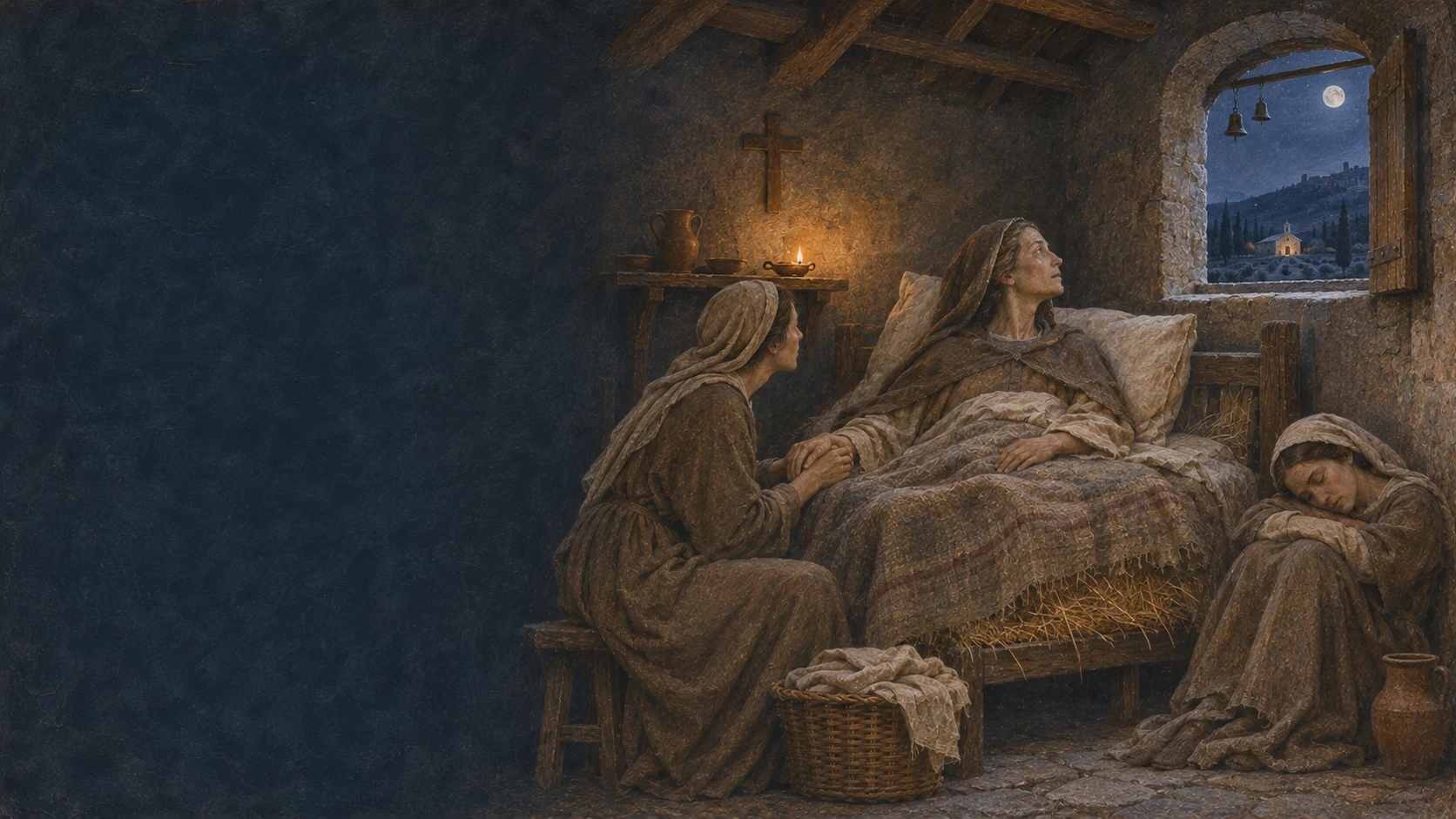
The sisters went to the place of prayer, and Clare remained in bed. It was Christmas. This is the situation that opens the memory: the feast continued, but one woman lacked the strength to join the community.
The scene need not begin with extraordinary lights. Before any narrated experience, there is an absence familiar to those who fall ill. Other people rise, reach a shared place, and sing together; someone stays where her body requires her to remain. For Clare, liturgy had been part of shared life for decades.
Later she told the sisters she had received a consolation: she had heard the office celebrated in the church of Saint Francis as though she were there. The account appears in the Canonization Process, recorded the year after that Christmas. Later, it would be developed by hagiography and associated with an invention nobody at San Damiano could have known: television.
Which Christmas is at issue
The reference to the recently passed feast in the testimonies of 1253 points toward identifying it as Christmas 1252. This date is a conclusion supported by the testimony’s context, rather than a note Clare wrote in a diary that night.
She had already known a long illness. The sources offer no diagnosis we can safely convert into a present-day disease. We know of physical limitations and a need for care; we do not know everything her body could do on any given day.
The Christmas narrative should not be confused with Greccio, where Francis had celebrated Jesus’s birth many years earlier. The distant place mentioned in this account is the church of Saint Francis in Assisi. Francis had already died, and the basilica belonged to the history of his memory.
The sisters did not all go to the basilica
A later confusion places Clare alone at San Damiano because all the religious women supposedly crossed the city to celebrate in the basilica. The Process does not require this scene. The memory speaks of sisters who went to the chapel for the office and of Clare remaining ill.
What she said she heard was happening elsewhere: the friars’ church. Keeping this difference avoids turning the episode into a community excursion that has not been demonstrated. The relevant distance lies between the bed and the celebration Clare said she followed.
Nor do we possess an exact plan of every movement that night. We do not know who stayed nearby at each moment or how long the sick woman remained without company. A phrase about loneliness expresses the narrated experience; it does not automatically provide a report of abandonment.
What Philippa told
Philippa declared that she had heard Clare’s account of the night. Her testimony’s value lies in that closeness: she is not merely repeating a story circulating much later. She had lived with the woman who had the experience and said she had heard her words.
But the limit is also precise. Philippa did not witness the distant church’s sounds from within Clare’s perception. She witnessed a communication. Between the inner event and the record reaching us stand Clare, the religious woman who heard her, the commission’s questions, and the transmitted wording.
This route does not erase the experience, but it defines the kind of evidence available. Readers can recognize that Clare described it without accepting, on that basis alone, as demonstrated the mechanism by which she might have followed a celebration beyond ordinary reach.
Other voices from the same house
Amata and Balvina also appear among the witnesses connected to the Christmas memory. One adds the sight of the Nativity scene to the content heard from Clare. This variety shows that the tradition close to her is not limited to a single formulation.
More than one religious woman knowing the account strengthens the evidence of its circulation within the community. It does not, however, create several independent observers of the same vision. If they all depend on what Clare told them, the information’s origin remains the experience she narrated.
The distinction is simple and decisive. Many people can confirm that someone described a dream; that does not mean they all dreamed the same scene. The comparison helps explain transmission, without asserting that Clare’s experience was a dream. The sources give it its own religious meaning.
The office was a form of presence
The word office designates prayer organized by hours, with psalms, readings, and chants. At Christmas, this prayer celebrated Christ’s birth with particular solemnity. For a religious woman, taking part did not mean watching a performance prepared by others.
It meant joining her own voice to a community and a history of faith. That is why being unable to get up could be deeply felt. Illness did not only interrupt movement; it changed the way someone belonged to what was done together.
We do not know which melodies Clare said she heard, in what order, or for how long. The documentation does not allow us to assemble an imaginary recording. We can recognize liturgy’s meaning without adding musical details the preserved memory does not offer.
The Legend gives consolation a shape
The early Legend presents Clare thinking about the infant Jesus and lamenting being alone. It then describes her perception of the chants at Saint Francis, with instruments and voices, and adds the visual aspect of the Nativity scene. The scene is organized as Christ’s response to her frailty.
We are dealing with hagiography. The author seeks to show that the saint, prevented from participating physically, was not deprived of the communion she desired. Illness receives a visit of comfort, in language linking a life of prayer and divine protection.
The Legend works with material from memories close to Clare, but its version does not function as independent confirmation of every detail. What it develops needs to be compared with what the witnesses actually said. A fuller narrative can be powerful as literature without being closer as documentation.
What we should not add
A luminous projection on the wall, like a screen, is a modern way of imagining the episode. It should not be presented as a literal description from the Process. The same applies to a physical journey by Clare to the basilica if taken as a conclusion from the oldest documentation.
Later traditions expanded the story in different ways. Each version needs identification. Adding Communion, transport, moving images, and altar details to a single scene would produce a mixture of layers readers could not separate.
Nor is it appropriate to offer a psychological diagnosis at a distance. We lack sufficient clinical observation to explain the perception through fever, hallucination, or any other cause. Refusing a demonstrated supernatural certainty does not authorize replacing it with an equally unsupported medical certainty.
Seven centuries later
In 1958, Pius XII declared Clare patron saint of television. The document Clarius explendescit, dated February 14, relates the patronage to the memory of the celebration followed at a distance. Here we have a modern papal act, preserved and dated.
This document proves the patronage, rather than providing a contemporary investigation of the medieval night. It shows how the twentieth-century Church found in an old account an image for a new technology, capable of carrying sound and vision to people who were absent.
The association can be understood without saying that Clare invented television or foresaw how it worked. Her experience, as transmitted, belonged to prayer and the language of miracle. Antennas, circuits, and electronic transmission belong to another history. The connection is symbolic and devotional.
The companions’ return
The sisters’ return is decisive for the story that has reached us. An experience remaining only inside Clare would not have produced the same documentary path. She needed to speak, others needed to listen, and later some agreed to tell what they had heard.
We do not know whether they all reacted in the same way. Assigning surprise, doubt, or tears to familiar faces would be invention. What we can recognize is an act of communication: the sick woman rejoined shared life by offering her own narrative of the night.
This dimension also prevents a reading centered only on the marvel. Before thinking about the reach of sounds and images, we find a community receiving the words of someone physically absent from the celebration. Her place need not be reduced to that of a person cared for in silence. Clare still had something to say, and her companions’ memory preserved those words.
A woman is heard again
The Process is a document recording testimonies; those testimonies transmit what Clare told. The Legend constructs a hagiographic presentation; later tradition expands images; the patronage of 1958 is another document, from another age. Historical reconstruction brings these parts together and must state its limits.
With these differences clear, the scene keeps its emotion. A sick woman wished to share her community’s joy and later said she had received comfort. The sisters listened and kept the account. We need not pretend to have access to Clare’s eyes and ears to recognize the importance of that listening.
When they returned from prayer, they could hear someone who had not been with them. The feast continued to be shared through words, beside a bed that was also part of the house. The sick woman’s place was not outside shared life.
Sources and paths for further reading
- Fonti Clariane — writings, Process, and documentsPrimary testimonies. Process: Philippa, Amata, and Balvina transmit words attributed to Clare about Christmas; check the numbering of the edition used.
- Legend of Saint Clare — Italian textEarly hagiography. The account of consolation in illness, paragraph 29, develops the auditory and visual aspects.
- Regis J. Armstrong — Clare of Assisi: The LadySpecialist edition. Offers comparison between testimony and biographical narrative, with introductions to the genres.
- La voce di Chiara e delle compagne — study of the Process and LegendAcademic research. Examines the relationship between the sisters’ voices and the Legend’s selection; its chronology should be checked against the testimonies themselves.
- Miles Pattenden — The Canonisation of Clare of Assisi and Early Franciscan HistoryAcademic research. Places the purpose and production of canonization records in context.
- Pius XII — Clarius explendescit, February 14, 1958Modern papal document. AAS 50 (1958), pp. 512–513: establishes patronage of television and belongs to the history of reception.
- Clare’s writings — Stary Sącz monasteryWritings for comparison. The Rule helps explain the importance of liturgy and care for sick sisters, without confirming the extraordinary experience on its own.
Rigor in the account: the sisters testify that they heard Clare narrate. There is no external proof of distant perception, wall projection, or clinical diagnosis. The 1958 act documents reception, rather than the cause of the 1252 experience.