
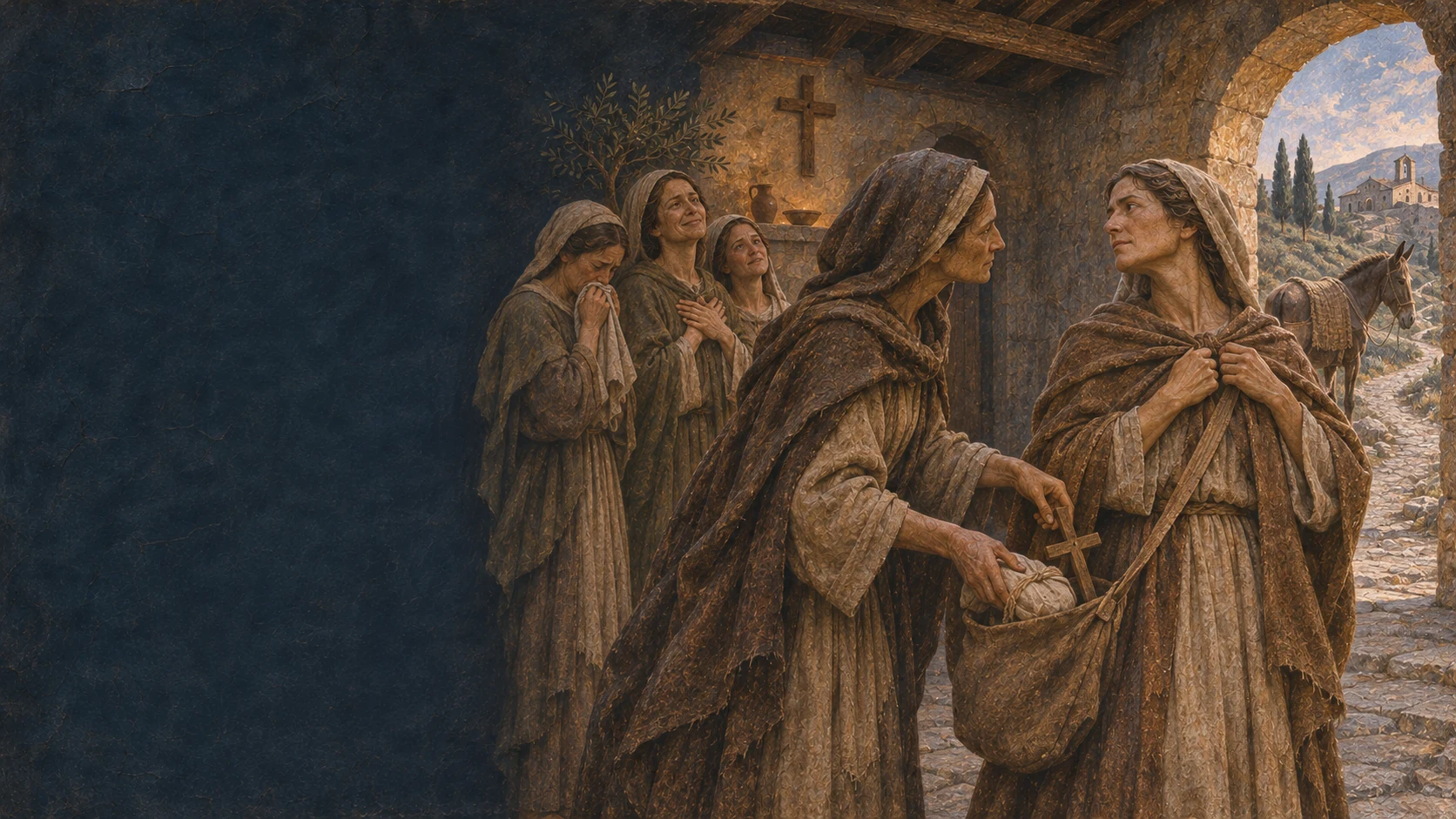
When the story reaches the relatives’ violence, Agnes of Assisi seems to fill the whole scene. A young woman refuses to return home, men try to take her by force, and Clare intervenes. Then the narrative usually rushes ahead, as though the younger sister had finished what she came to do.
But entering was only the beginning. Agnes had to live through the next day, learn a routine, find her place among other women, and later endure distance from San Damiano. Her life cannot fit into the scene in which her family tried to stop her from choosing.
Before religious life, she is known in biographical tradition as Catherine. The name Agnes became linked to her new existence and to the memory of a Christian virgin who resisted coercion. The story of the name change also reaches us through sources that need to be identified, without turning every detail into a birth record.
The same house does not produce the same person
Catherine and Clare grew up in the same family, within similar expectations. Marriages, property, and alliances involved more than a daughter’s individual wishes. A young woman’s future could be treated as the business of the entire extended family.
Sharing that world does not mean having lived through exactly the same experiences. We do not know every conversation between the two, or when Catherine recognized that she wanted religious life. Attributing her choice only to her fascination with her sister would assume what is not documented.
What the sources preserve is a firm decision to remain. Family closeness may help explain the choice, but it does not explain everything. For the young woman, following Clare also meant facing people who had power over her life and accepting a materially uncertain future.
Resistance must be read through its genre
Clare’s Legend tells of the violent attempt to remove Agnes from the religious refuge. It narrates blows, dragging, and the miraculous impossibility of moving her body. This is a scene of hagiography: it organizes the young woman’s resistance as a manifestation of divine protection.
That does not allow us to ignore the family coercion presented in the account. Nor does it allow us to narrate the body’s extraordinary weight as a measured fact confirmed by independent observers. The source seeks to show that a decision offered to God could not be overcome by relatives’ force.
Testimony and family memory help place the conflict, but they do not record every movement of the confrontation. We can discuss the choice and the tradition surrounding it without increasing the violence to move readers. Agnes’s will already deserves attention before any extraordinary detail.
After the doorway, life together
Once the community was established at San Damiano, being Clare’s sister did not spare Agnes from living with other women. The house welcomed people with different histories and temperaments. A religious family was not simply the blood family moved inside another building.
Rules and testimonies show a life of prayer, work, poverty, and service. They do not provide a daily list of Agnes’s tasks. It would be wrong to choose an occupation and present it as though we knew she had practiced it for decades.
We can, however, recognize a change in relationship. Clare was her sister and also the abbess. Agnes belonged to a community in which authority had to serve the whole. Her place cannot be explained by kinship alone, or measured by how much she resembled the foundress.
The road to Monticelli
Agnes’s history is linked to the monastery of Monticelli, near Florence. Her being sent there and the exact chronology are described differently in historical reconstructions. We should not fix a complete itinerary simply by repeating later lists of foundations attributed to the saint.
The link with Monticelli, however, lets us see something essential: the lives of the first Franciscan women extended beyond the house in Assisi. Practices needed to be passed on, local rules lived with, and other communities helped. A sister’s experience could be requested far from where she felt at home.
Such a journey should not be told as a liberating excursion or an expulsion if the sources do not say so. There was mission, obedience, and separation. What we can study is how Agnes expressed her longing, without inventing the words she may have heard when the decision was given to her.
A letter full of longing
The transmitted letter from Agnes to Clare offers a rare voice in this body of sources. She mourns the distance from her sister and the community. The separation weighs on her even as she finds welcome in the new place. The text allows us to recognize a woman who serves and misses people at the same time.
Like every medieval writing, the letter reaches us through transmission and should be read in a source edition. We do not have a diary page preserved directly from her desk. Even so, hearing the voice attributed to Agnes differs from merely receiving a biographer’s summary of her virtues.
Her longing does not contradict her religious choice. A person can want a mission and suffer from distance. She can find good women and still miss others. The document preserves this complexity, which would disappear if we made Agnes a saint incapable of hesitation or suffering.
A new group asks for her presence
Serving in a community far from Assisi required more than repeating actions learned before. The women there already had relationships, needs, and a history. The experience received at San Damiano needed to meet real people.
We do not have minutes of all those conversations. We can explain the general difficulty without writing dialogues between Agnes and sisters whose names and replies we do not possess. Responsible reconstruction recognizes the situation; unjustified invention assigns a woman words the archive did not preserve.
The letter lets us glimpse welcome and a sense of belonging being built. Agnes does not appear merely enduring an inward exile. She remains connected to her new companions, even as she desires closeness to the old ones. Her path involves widening relationships without ceasing to love her first home.
The women of the family
Clare was not the only woman to bring religious life and kinship together. Ortolana, the sisters’ mother, and Beatrice, another daughter of the family, also enter San Damiano’s memory. The Process preserves family information through women who took part in that life.
This setting offers support, but should not be idealized. We do not know how each reunion happened, what tensions remained, or how relationships changed. Having close relatives nearby could comfort; it also required recognizing that the community included women from other families.
For Agnes, the experience of leaving Assisi shows precisely that belonging did not depend only on living near blood relatives. She could carry a form of life elsewhere. Longing for her sister and responsibility for new companions belonged to the same story.
Two women named Agnes on the same parchment
In Clare’s Fourth Letter to Agnes of Prague, the sister from Assisi appears sending greetings. This is an important clue, because the correspondence allows us to place her near Clare’s final days without depending only on much later narratives.
The recipient and the author’s sister have the same name. One lives in Bohemia; the other belongs to Clare’s family. Distinguishing them helps us recognize two forms of participation in the network: distant friendship and family and community closeness.
We do not know how long Agnes of Assisi stayed beside her sister during that period, or every word they exchanged. The greeting does not justify a complete reunion scene. It does, however, let us see that her name still belonged to communication between communities in Clare’s final year.
Longing is not failure
Agnes’s letter offers a rare closeness because it does not reduce religious life to a sequence of certainties. There is room to feel separation. Readers can recognize this experience without deciding that the author wanted to abandon everything or that her mission had gone wrong.
Loving one community and learning to live with another are different tasks. The lasting first bond can sustain the second, provided it does not make it invisible. In Agnes’s transmitted voice, missing Clare does not erase appreciation for her new companions. She needed to carry a history with her and, at the same time, be truly present in the life awaiting her elsewhere.
Loss and a whole life
The Legend presents Agnes beside her dying sister and links her own death to the loss of Clare. The received chronology places Agnes’s death also in 1253, after her sister’s. Details of the farewell should retain their proper identification as hagiography.
We need not invent a secret promise or make death proof that Agnes could not exist without Clare. She had already shown the ability to choose, live with others, depart, and serve. Grief belongs to her life, but it should not swallow everything that came before.
Documents, testimony, hagiography, and tradition offer unequal parts of that journey. Our reconstruction cannot connect them without leaving gaps. Even so, a figure appears clearly enough: a younger sister who found support in Clare and then had to answer for her own steps.
Sources and paths for further reading
- Fonti Clariane — writings, Process, and documentsPrimary collection. Includes the transmitted letter from Agnes to Clare, materials about Monticelli, and Agnes’s biographical memory.
- Legend of Saint Clare — Italian textEarly hagiography. Tells of family resistance and the farewell; miraculous elements belong to the account’s religious interpretation.
- Clare — Fourth Letter to Agnes of PragueDocument by Clare. Her sister Agnes’s greeting allows her to be distinguished from the Prague recipient and placed within the final network of relationships.
- Regis J. Armstrong — Clare of Assisi: The LadySpecialist edition. Gathers sources about Clare and her companions with indications of genre and transmission.
- Catherine M. Mooney — Clare of Assisi and the Thirteenth-Century ChurchAcademic research. Helps explain women’s communities, women’s movement between places, and institutional conditions.
- How Saint Clare of Assisi Guided Her SistersAcademic study. Offers context on community relationships and authority, without replacing the scarce individual documentation about Agnes.
Limits: the transmitted letter supports the longing; the Legend supports the hagiographic narrative of resistance and farewell. Uncertain dates and movements have not been converted into a complete itinerary.