
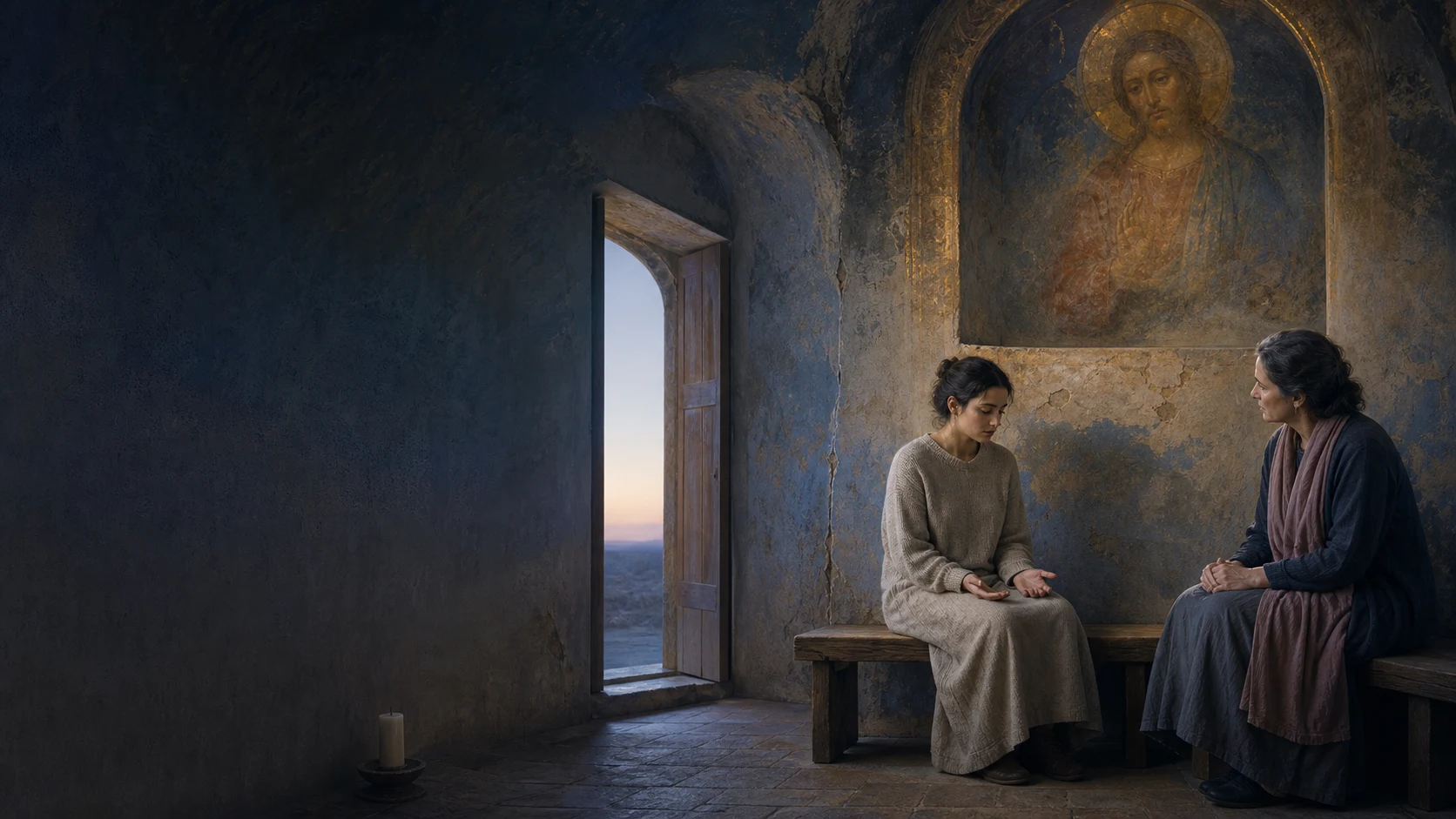
Perhaps you began a prayer and, a few seconds later, found yourself thinking about school, a conversation, a bill, or the noise in the street. Perhaps you searched for a beautiful word and found none. You may be too tired, too sad, or simply empty. Then a painful question arises: “Has God moved away from me?”
Being unable to put words together does not mean that you have stopped loving God. Distraction is part of human experience. Dryness—that time when prayer seems to have neither flavour nor consolation—has also been known in the Christian tradition for many centuries. It is not automatic proof of guilt, abandonment, or lack of faith.
In the Bible, Saint Paul teaches that the Spirit comes to help us in our weakness when we do not even know how to pray. There are days when prayer is a sentence. On others, it is a breath, a tear, or the decision to remain before God for one more minute. And there are days when resting, seeking company, and receiving care are the truest response we can give.
Where does this prayer come from?
This is an original prayer by Portal São Francisco. It is neither an ancient text nor a prayer written by Saint Francis of Assisi. It was created to welcome those who wish to pray but encounter distraction, spiritual dryness, exhaustion, or emotional suffering.
The Catechism of the Catholic Church treats distraction and dryness as real difficulties in prayer. Rather than demanding beautiful feelings, it counsels humility, trust, and perseverance. Pope Francis also explains that, in dry times, we can present our difficulties and bitterness to God as a genuine act of faith.
Francis of Assisi sought silent places, but his life of prayer was not separated from tears, illness, the care of the brothers, or encounters with the poor. Franciscan spirituality helps us come before God as creatures: not as spiritual machines, but as people with limits who receive life as a gift.
Prayer when words will not come
God of goodness,
I have come,
but today I do not know how to pray.
My mind runs to many places.
My heart feels like an empty house.
Perhaps I am tired,
perhaps wounded,
perhaps I cannot even explain what is happening.
I have no beautiful words to offer you.
Receive, then, this breath.
Receive my silence.
Receive even my desire to leave.
If I become distracted,
do not let me believe that I have failed.
If I do not feel your presence,
keep me when I cannot perceive you.
Holy Spirit,
pray within me what I do not know how to say.
Turn my sigh into a plea,
my tear into surrender,
my rest into trust.
Jesus,
you knew anguish and abandonment.
Sit with me in this place without answers.
Do not hurry my healing.
Do not let me confuse silence with rejection.
Give me a safe person to turn to,
courage to say, “I am not well,”
and humility to receive care.
Bless those who listen to me with respect:
my family,
my friends,
my community,
and the professionals who care for mind and body.
If today all I can do is remain here,
remain with me.
If all I can do is say your name,
hear your name upon my lips.
If even that is not possible,
receive my desire to desire you.
I do not need to manufacture light.
I can wait for dawn.
Into your hands I place
the little I have,
the weight I carry,
and this silence that you know completely.
Amen.
Original prayer by Portal São Francisco, inspired by Romans 8 and the Christian tradition concerning dryness in prayer.
How to pray this prayer
You do not need to finish the text. Choose the smallest possible way to pray today. It may be sitting for one minute, placing your hand over your chest, and saying: “God, I am here.” It may be slowly repeating: “Holy Spirit, pray within me.” It may be simply breathing without trying to produce any feeling.
When you notice a distraction, do not fight with your mind. Acknowledge the thought and gently return to the sentence you chose. If sleep comes because your body is exhausted, perhaps you need to sleep. Rest does not offend God.
It is also possible to pray with someone else. Ask someone you trust to stay nearby, read a psalm with you, or simply listen. A priest, religious, or spiritual director can help with questions of faith. A psychologist, doctor, or other healthcare professional can help when suffering involves the mind and body. These forms of care can go together.
If sadness, anxiety, discouragement, or tiredness persist and make it difficult to eat, sleep, study, work, or spend time with others, tell a safe person and seek professional help. If you think about harming yourself or do not feel safe, immediately contact a trusted adult and your local emergency service. Asking for help is not a lack of faith; it is an act that protects life.
The flame we do not have to make
Imagine an almost dark chapel before dawn. There is an unlit candle and a half-open door. You do not need to make the sun rise. You need only remain until the light finds the opening.
Sometimes we think that good prayer requires emotion, perfect concentration, and many words. But Jesus welcomed people who came weeping, shouting, asking questions, or merely touching his garment. The truth of the encounter did not depend on a polished presentation.
Silence can also be genuine. Yet not all suffering should be carried alone in the name of silence. God often cares for us through other people: someone who listens, prepares food, accompanies us to an appointment, or stays near during a difficult night. Receiving this care allows love to have human hands.
Perhaps today you feel nothing. Do not turn this into a verdict on your faith. The Catechism calls dryness a time when we remain with Jesus without felt consolation. Remaining may mean praying one sentence; it may mean taking part in the community; it may mean resting and returning tomorrow.
Your prayer does not need to force heaven open. The Spirit already knows the way. When words fail, entrust your silence to him. When strength fails, let someone walk beside you. You are not a spiritual failure. You are a tired creature whom love can still find.
Explore the sources
- United States Conference of Catholic Bishops — Romans 8 — a biblical passage about the Spirit coming to help us in our weakness when we do not know how to pray.
- Holy See — Catechism of the Catholic Church, 2725–2758 — presents distraction, dryness, and discouragement along the path of prayer, recommending humility, trust, and perseverance.
- Holy See — Pope Francis’s catechesis on distraction, dryness, and acedia — a pastoral reflection on common difficulties in prayer and trust in God during periods of dryness.
- Order of Friars Minor — Testament of Saint Francis — an authentic testimony in which Francis recounts his journey as a gift received from the Lord amid the realities of life.