
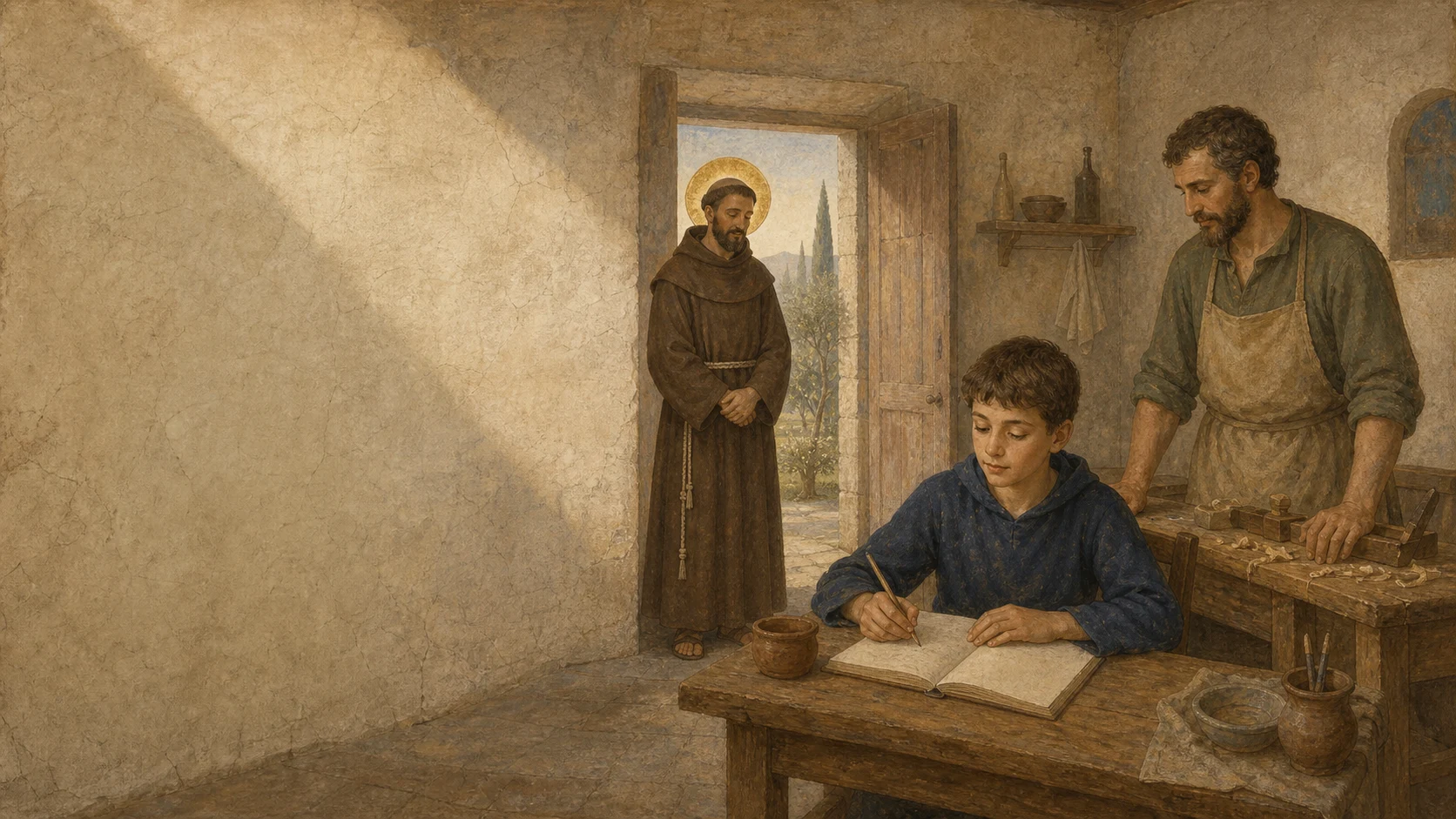
Some days we open a notebook and the words seem to run away. On others, the task list is so long that we want to give up before beginning. There are also good mornings, when an idea is born and we feel joy in learning or building something. God can meet us on all these days.
Study and work are not ways to prove that we deserve love. A grade does not measure the size of a person. Neither does a salary, a position, or a full schedule. Before any result, every person is already loved by God and possesses a dignity that no one can buy or take away.
This prayer therefore does not ask you to become a machine that never makes mistakes and never rests. It asks for attention to the possible next step, honesty in doing good, and wisdom to recognize limits. Learning means receiving part of the world as a gift. Working with dignity means placing our gifts at the service of life. Resting means remembering that the world does not depend on our hands alone.
Where does this prayer come from?
This is an original prayer by Portal São Francisco. Saint Francis of Assisi did not write it, and it does not belong to an old prayer book. It was written to accompany students and workers today, inspired by the Bible, the Church’s teaching, and the Franciscan way of carrying out each task with simplicity.
In the Rule of the Friars Minor, Francis speaks of work as a grace. He directs the brothers who are able to work to do so faithfully and devotedly, without extinguishing the spirit of prayer. His Testament also recalls that he worked with his own hands. This does not mean running until we collapse. It means doing what is ours to do with love, without making work the master of the heart.
The Church teaches that work is for the person, not the person for work. Laudato si’ adds that rest broadens our vision and restores meaning to what we do. Effort and rest can therefore dwell in the same prayer.
Prayer before study or work
Lord God,
thank you for the mind that learns,
the hands that build,
and the people who taught me what they know.
Before I begin,
I place this task before you:
the book I need to open,
the problem I do not yet understand,
the simple or difficult work
waiting for me today.
Give me attention to be fully present,
patience to learn slowly,
and humility to ask for help.
May I not be ashamed of not knowing.
May I not use what I know to humiliate anyone.
May my study seek the truth,
and may my work care for life.
Teach me to do the possible step well,
without laziness,
but also without cruelty toward myself.
Free me from the lie that says
I have worth only when I produce,
receive the best grade,
or hear everyone praise my result.
If I make a mistake, help me begin again.
If I grow tired, teach me to rest.
If someone is overburdened,
make me a presence that shares the weight.
Bless those who work without recognition,
those looking for employment,
those studying with few resources,
and those who must choose between learning and surviving.
May no person be treated as a tool.
May all work be dignified,
safe, and just.
Jesus, worker of Nazareth,
stay with me in this hour.
Saint Francis, simple brother,
teach me to serve without possessing
and finish the day with a free heart.
Receive my effort,
my limits,
and the good that may grow from here.
Amen.
Original prayer by Portal São Francisco, inspired by the Gospel and Franciscan spirituality.
How to pray this prayer
Before opening a screen or picking up a tool, take a short pause. Place your feet on the floor and relax your shoulders. Look at the actual task, not every task in the world at once. You can simply say: “Lord, stay with me in this step.”
Read the prayer slowly. Then choose one specific intention: understand a subject, work honestly, treat a colleague well, have the courage to ask a question, or respect the time to stop. If there are many tasks, write down only the next possible step. Prayer does not replace planning, study, training, or professional help; it enlightens the way we move through them.
When your attention wanders, return without insulting yourself. When your body asks for water, food, movement, or rest, listen. Caring for the body does not interfere with the mission. It means caring for a creature loved by God.
If teachers, managers, or other people demand something unjust, dangerous, or impossible, do not hide the suffering behind a prayer. Speak with a safe person, seek guidance, and ask for protection. Dignity comes before the task.
The desk can also be an altar
Imagine a wooden table in the morning. On it are an open notebook, a tool, and a glass of water. Nothing looks grand. Even so, a person there may discover a truth, repair something broken, prepare what someone else needs, or learn to serve better.
Francis did not teach his brothers to despise work. He wanted them to work faithfully, but without losing inner freedom. The task was grace, not a throne. It was service, not a measure of human worth.
Perhaps today’s best offering is to complete one page attentively. Perhaps it is to admit, “I did not understand.” Perhaps it is to share a responsibility. Perhaps it is to close the computer at the right time and sleep. Love is not only in what we finish; it also appears in the way we treat ourselves, others, and creation while we work.
When you sit down to study or work, remember: God is not waiting for a perfect performance. He is already near. You can offer intelligence and doubt, energy and tiredness. The table becomes a small altar when we place on it the truth of who we are and our desire to do good.
Explore the sources
- Order of Friars Minor — Later Rule, chapter V — preserves Francis’s direction to work faithfully and devotedly without extinguishing the spirit of prayer.
- Order of Friars Minor — Testament of Saint Francis — an authentic text in which Francis recalls his own manual work.
- Holy See — Catechism of the Catholic Church, 2427–2428 — teaches the dignity of work and affirms that work is for the person, not the person for work.
- Holy See — Laudato si’, 124–129 and 237 — relates work, care for creation, human development, contemplation, and rest.
- United States Conference of Catholic Bishops — Colossians 3 — a biblical text inviting us to do good wholeheartedly before the Lord.