
When no words seem sufficient
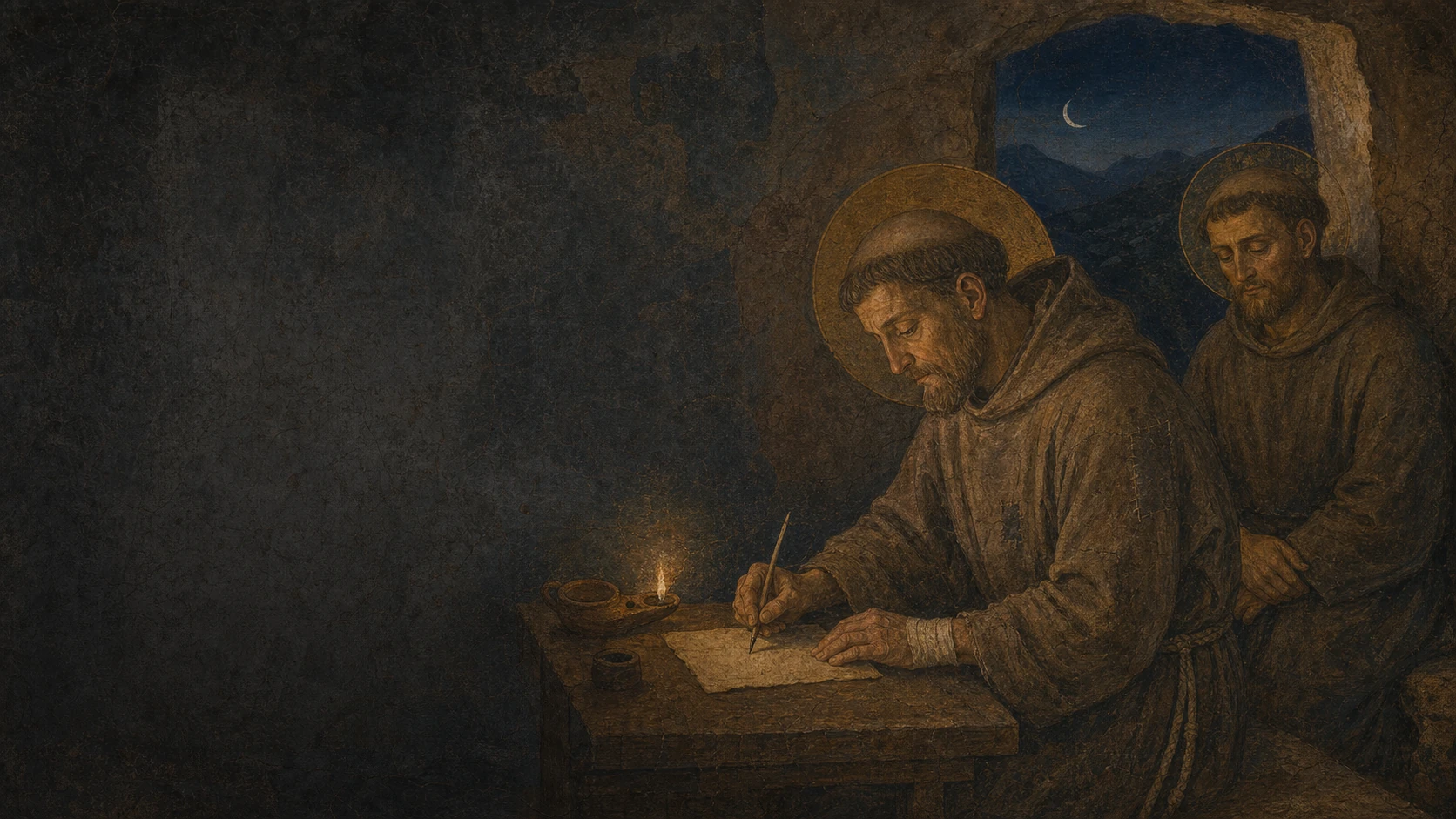
Imagine a cold night on a mountain. There are no lit streets, music, or crowds. There is stone, wind, and silence. Francis is tired, and his body carries suffering. Even so, his prayer does not begin with a complaint. It begins with two words repeated like a heartbeat: “You are.”
Sometimes we think praise means saying beautiful things because everything went well. Francis teaches something greater: praise is recognizing who God is, even while life remains difficult. It is opening a window in a dark room. The problems do not disappear, but they no longer fill the whole horizon.
This prayer does not try to explain God. Francis speaks names: holy, strong, good, love, wisdom, humility, beauty, gentleness. Each name is a small flame. Together they help us see that God is not a distant idea. God is the one in whom the heart finds safety, rest, and joy.
Where this prayer comes from
Praise written on a small sheet
The Praises of God Most High are an authentic writing by Saint Francis. Something extraordinary has survived: the small sheet of parchment, called a chartula, is still with us. On one side, Francis wrote these praises; on the other, he placed the Blessing for Brother Leo and drew the sign of the Tau. Brother Leo added a note explaining that Francis wrote the text after receiving the signs of Christ’s Passion in his body on Mount La Verna in 1224.
We therefore know this prayer not only through a copy made many years later. A witness directly connected with Francis’s hands and the friendship between two brothers remains. Franciscan tradition understands that Brother Leo was experiencing inner distress. Francis did not offer him a long theory. He gave him a sheet that said, in essence: look toward God; in God is everything the heart truly needs.
The version below is this portal’s own pastoral translation, prepared from the Latin and checked against Franciscan editions. We have kept the repetition of “You are,” the pulse of the original, and chosen clear words without changing its meaning.
Words of Saint Francis
Praises of God Most High
You are holy, Lord, the one God,
you who work wonders.
You are strong.
You are great.
You are Most High.
You are almighty king.
You, holy Father,
king of heaven and earth.
You are three and one,
Lord, God of gods.
You are good, all good, the highest good,
Lord God, living and true.
You are love and charity.
You are wisdom.
You are humility.
You are patience.
You are beauty.
You are gentleness.
You are security.
You are rest.
You are joy.
You are our hope and our happiness.
You are justice.
You are balance.
You are all the wealth that is enough for us.
You are beauty.
You are gentleness.
You are our protector.
You are our guardian and defender.
You are strength.
You are relief.
You are our hope.
You are our faith.
You are our charity.
You are all our sweetness.
You are our eternal life:
great and wonderful Lord,
almighty God,
Savior full of mercy.
Amen.
A prayer with almost no “I”
Notice something curious: Francis hardly speaks about himself. He does not list what he has done, what he deserves, or what he wants to receive. He repeats, “You are.” This does not erase his personality. On the contrary, it places his life where it belongs. When the self ceases to be the center of everything, the heart gains room to breathe.
It is also beautiful that Francis calls God humility. It may sound strange: God is the Most High, yet humble? For Christian faith, yes. Jesus did not come to crush the little ones. He drew near, served, washed feet, and gave his life. The great God does not need to diminish anyone to show his greatness.
Francis repeats “beauty” and “gentleness.” Perhaps this is no accident. Some truths need to be said more than once before they pass through fear. God is beauty when our vision has become fixed on what is ugly. God is gentleness when the world seems ruled by shouting. Repetition is not a lack of imagination; it is remaining beside a spring.
How to pray this prayer
Choose one flame and remain with it
- Be silent for one minute. Place your feet on the floor and breathe slowly. You do not need to produce a special emotion.
- Read without rushing. At every “You are,” pause briefly. Imagine that you are lighting a small lamp.
- Choose one name for God. Perhaps today you need “rest,” “strength,” “gentleness,” or “hope.” Repeat only that line a few times.
- Connect praise with life. If God is gentleness, ask for a gentle voice. If God is protector, remember someone who needs protection. If God is charity, choose an action of love.
- End with gratitude. Name one small thing for which you are grateful. It may be water, a person, an opportunity to begin again, or simply being alive.
You can pray the whole prayer or remain with a single sentence. There is no prize for finishing quickly. Praise is companionship, not a race.
A brief meditation
God is still God tonight
Perhaps you are happy today. Perhaps you are confused, like Brother Leo. Perhaps you carry a pain no one notices. Place all of it before God without hiding.
Now say slowly, “You are my hope.” This does not mean that you already know how the story will end. It means fear does not have the final word. Say, “You are rest.” This does not mean abandoning your responsibilities. It means remembering that you are loved even before you resolve everything.
Imagine the small sheet passing from Francis’s hands to Leo’s. The parchment is not large, but it holds a truth greater than the mountain: when words about ourselves fail, we can still speak words about God. Little by little, as we remember who God is, we also remember that we are not alone.
For those who want to go deeper
Sources for this page
- Order of Friars Minor — The gift of the stigmata, 1224–2024Provides context for La Verna, the composition of the Praises, and the small sheet given to Brother Leo.
- Custody of Saint Francis of Assisi — Latin text of the PraisesA transcription of the Latin original with biblical references and a Franciscan translation for comparison.
- Leo XIV — Address to the General Chapters, 20 June 2025The pope closes the meeting by praying the beginning of the Praises of God Most High and confirms its Franciscan authorship.
- Pope Francis — Address to the Secular Franciscan OrderPresents “the good, all good, the highest good” as the center of conversion of heart.
Translation note: the prayer above does not reproduce a modern translation in full. It is this portal’s own pastoral translation from the Latin Laudes Dei Altissimi. The context of the chartula is attested by Brother Leo’s note and received in Franciscan sources; details of the artistic scene are a respectful visual interpretation.