
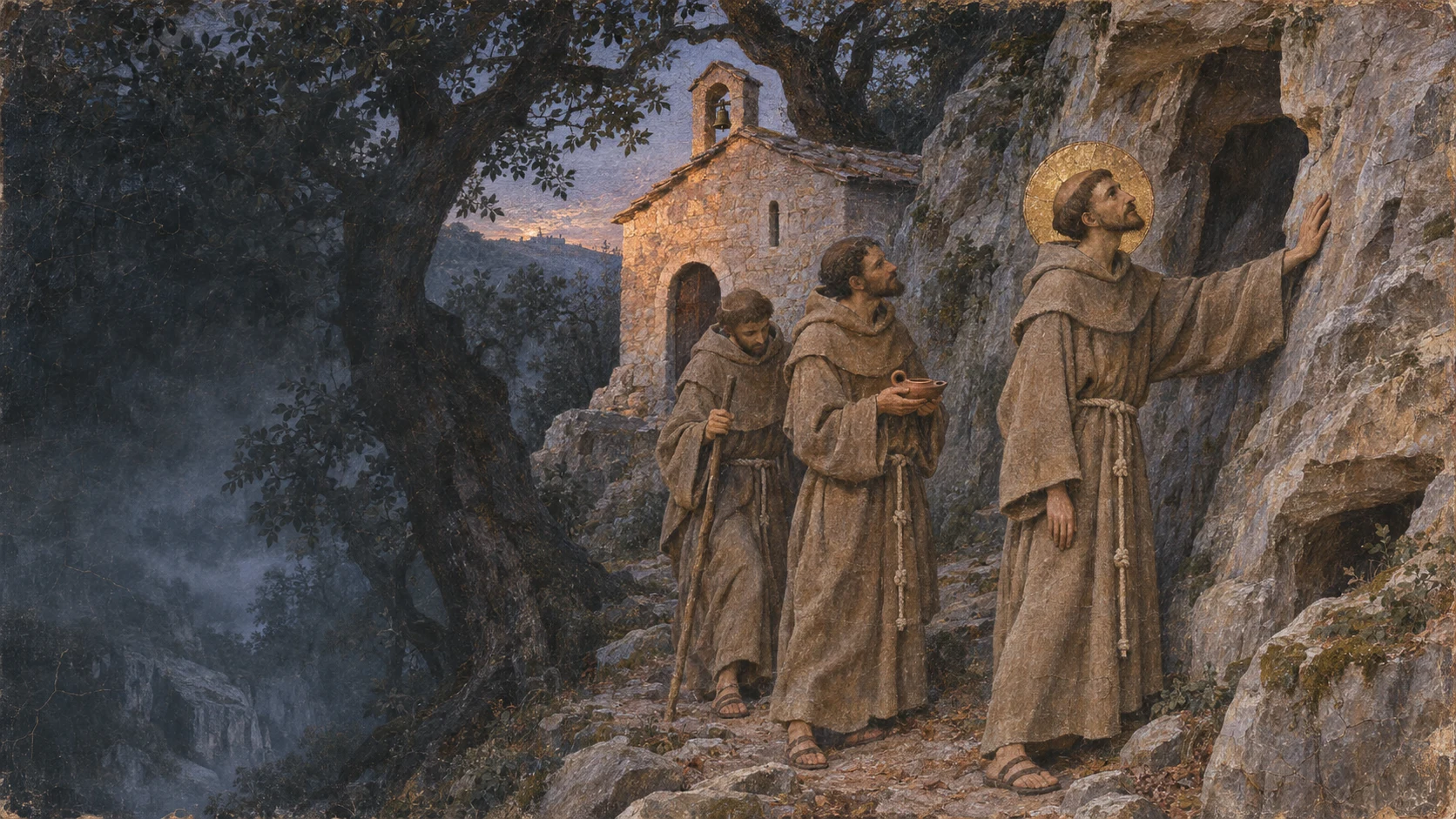
A name that sounds frightening
“Carceri” suggests a prison. But nobody brought Francis here in chains. The old name points to places of retreat: small hollows where someone chose to withdraw, like closing a door to hear more clearly what is happening inside the heart. This was solitude freely sought, never a punishment.
The hermitage stands on the slopes of Mount Subasio, about four kilometres from Assisi. Today there are walls, arches, corridors, altars, and structures built over many centuries. When the Franciscan movement began, however, the setting was much simpler. Official Assisi sources describe a small chapel surrounded by woodland and natural caves. Francis and some of his first companions climbed up here to pray.
These broad outlines are firmly established historical facts: the site is ancient, its Franciscan connection reaches far back, and the first brothers spent periods in retreat. What we cannot do is look at every stone now standing and say, “Francis touched this very wall.” The buildings grew after his lifetime. The place remained; its shape changed.
The climb
We can reconstruct one possible morning. It is still dark when three brothers leave Assisi. They carry bread, perhaps a small water vessel, and simple cloaks against the cold. They say little. The path climbs through olive groves, then enters a forest of holm oaks. The sounds of the town fade. Footsteps, birds, and wind remain.
This scene is a narrative reconstruction. No chronicler recorded the food, the hour, or the number of steps that morning. It draws on the actual landscape, the brothers’ simple way of life, and the Franciscan practice of travelling on foot. It brings the reader closer without pretending that we possess a lost diary.
Francis did not seek the mountain because he despised people. He needed time among others and time in silence. In towns, he preached, cared for the sick, met poor people, and tried to reconcile enemies. At the hermitage, he let all of this rest before God. Then he went down again.
A brotherhood of solitude and care
Francis wrote a short text called the Rule for Hermitages. It does not name the Carceri, but it shows how the brothers were to arrange a retreat. They should live in very small groups. Some would act as “mothers,” attending to practical needs; others would devote themselves more fully to prayer. Later, they could exchange roles.
It is a beautiful and demanding idea. Franciscan silence does not mean abandoning everyone in a separate cave. Someone prepares food, protects the peace of the place, and notices when another needs help. Even in solitude, there is brotherhood.
This text is a primary source, meaning that it comes from Francis himself. It gives us a more reliable window than many legends. It does not prove that every detail was followed exactly at the Carceri, but it reveals the kind of hermit life he wanted.
Perhaps one brother was in the chapel. Another was among the rocks. A third looked after the little community. This was no contest to see who could pray the most. It was a way of making room for God while remembering both the body and the brother.
Stone, tree, and water
The mountain teaches without speaking. Stone takes centuries to change. A tree grows in silence. Water finds a passage where there seemed to be no way through. Francis, who would call the sun, water, and earth his brothers and sisters in the Canticle of the Creatures, did not see creation as mere decoration. It was company and a sign of something beyond itself.
Places like this probably helped train his attention. That is a plausible historical interpretation, not a statement recorded by a witness. We know that Francis sought lonely places, and we know that his writings speak of creation as family. The connection makes sense, but we cannot establish it as precisely as a date on a document.
In the woods, human beings cease to be the centre of everything. A bird does not sing to impress us. A rock does not move because we are in a hurry. The heart learns a different pace.
Caves with names
Visitors find spaces associated with Francis and various companions: the caves of Brother Leo, Brother Bernard, Brother Giles, and others. These names belong to the tradition of the place. Generations of friars and pilgrims have repeated them, helping to preserve the memory of the first brothers.
But tradition is not the same as a sign put up in 1220. We have no documents proving that each person occupied the precise hollow identified today. We can honestly preserve the names while acknowledging that they are not archaeological certainties.
A tradition can convey something true without working like a photograph. It reminds us that Francis did not live alone. Around him were different faces, temperaments, and stories. The named caves turn an abstract idea—“the first companions”—into a brotherhood that seems to breathe among the stones.
The bird and the silence
Early stories about Francis often bring him close to animals. Around the Carceri, too, stories grew of birds that listened to him or announced the hour of prayer. Some versions emerged and developed within devotional memory, often without any identifiable witness from Francis’s lifetime.
These stories belong to Franciscan tradition, rather than to the information we can verify through administrative records. They express a conviction: a heart at peace with God begins to treat creation without cruel domination. Even when we cannot know whether a particular bird perched on a particular branch, we understand why people kept the story.
For a young reader, the question need not be only, “Did it happen exactly like that?” It can also be, “Why did so many people want to remember Francis as someone animals did not fear?” The answer points to his gentleness.
What Francis might have heard
Perhaps nothing extraordinary. Perhaps leaves, insects, breathing. Prayer does not always bring a clear answer. Francis knew exhaustion, doubts, and conflict within his own brotherhood. Withdrawing did not erase these problems. It helped him see them in a different proportion.
This passage is a contemplative reconstruction. We do not know Francis’s exact thoughts on a particular afternoon at the Carceri. We do, however, know his prayers and the real difficulties of his life. So we may imagine him bringing his worries into silence without claiming to have overheard his conversation with God.
Perhaps he realised that the brotherhood did not belong to him. Perhaps he asked for courage to go back down. Perhaps he simply stayed there, without words.
The hermitage grew
After Francis died, new generations continued to seek out the place. The small original site expanded. Tradition connects an important part of the fifteenth-century building work with Brother Bernardine of Siena and the Franciscan renewal movement known as the Observance. Narrow corridors and small cells began to wrap themselves around the rock.
Visitors today therefore encounter two histories at once. There is the landscape where Francis and his companions sought quiet. And there is the architecture built by friars who, centuries later, wanted to continue that same practice.
The mistake would be to imagine the whole complex already complete when Francis was young. Its real wonder is greater: each generation added a layer, like pages in a manuscript. The stonework of the later Middle Ages is authentic; it simply does not all come from the same period.
Climbing up to come down again
The heart of the Carceri is not escape from the world. Francis always returned. Solitude that never leads to love can become a hiding place. Franciscan solitude prepares the way for meeting others, service, and peace.
Think of an arc: the climb reduces the noise; silence puts the heart in order; the descent brings the person back to others. Without the descent, the movement remains unfinished.
Perhaps this is the place’s most timely lesson, even for those living far from Umbria. We do not need a cave of our own. We can set aside a few minutes without a screen, walk among trees, stand at a window, or sit quietly. The aim is not to disappear. It is to return more attentive.
What remains
The woodland of Subasio remains, though it too has changed. The cold stone remains. The small chapel remains, surrounded by later buildings. So does the memory of poor men who understood that the human heart needs room.
We do not know which step Francis paused on, how often he climbed, or which birds sang that day. We know enough to recognise his path: closeness to the poor, prayer, brotherhood, and return.
At the Carceri, the idea of a prison changes. This place does not hold people captive. It loosens the grip of hurry, vanity, and the illusion of controlling everything. Among stone and leaves, Francis learns again to be small. And that is why he returns to the valley with a more generous heart.
Annotated sources
- City of Assisi, “Carceri Hermitage”. Official introduction to local heritage; confirms the location, original chapel, and use of the site by Francis and his companions. Read
- Italian Ministry of Culture, “The Places of Francis: Carceri Hermitage”. Italian eighth-centenary portal; useful for the general history and for distinguishing the original site from later extensions. Read
- Francis of Assisi, “Rule for Hermitages”. Short primary source on small groups, prayer, and brotherly care; does not describe the Carceri alone. Historical English edition, PDF
- Noel Muscat, OFM, studies of Franciscan hermitages. Franciscan scholarly overview that places contemplative practice within the sources and avoids projecting the later friary onto the thirteenth century. Read PDF
- Umbria Region, Museum of the Basilica of Saint Francis and the Perkins Collection. Institutional material on art and local history, useful for understanding successive layers of Assisi’s Franciscan heritage. Read PDF
- Thomas of Celano and early Franciscan compilations. Essential hagiographical sources for Francis’s habit of seeking solitary places; they should be read as devotional writing, rather than as modern official records.
- Oral tradition and signs at the sanctuary. Preserve cave names and bird stories; valuable religious memory, but not archaeological proof of every individual association.