Rivo Torto has neither the brilliance of a square nor the delicacy of a painted chapel. Its name comes from a winding watercourse on the plain: a crooked stream. According to Franciscan sources, Francis and his first companions lived there in an abandoned, cramped shelter.
The place matters precisely because it seemed unsuitable.
Today a shrine stands over the memory of the old hovel. Inside the church, stone walls form small compartments venerated as the first shelter. A visitor might think this is an intact house from 1209, protected without change. The history is more complex. There were buildings, an earthquake, reconstruction, and restoration. What we see preserves a topographic tradition and old materials, but we cannot identify every stone as the direct witness of a gesture by Francis.
To enter Rivo Torto, then, we must do the opposite of what we did at the Portiuncula: mentally remove the later church and imagine damp ground, a nearby road, fields, leper houses, and a shelter so poor that nobody would have wanted to turn it into a monument.
Before there was an Order
At the beginning, nobody could look at the group and say for certain what it would become. Francis had left the merchant’s path. Bernard of Quintavalle, Peter Catani, and other men drew near. Lists of the first brothers vary among sources and do not let us make a perfect calendar of every arrival.
They did not yet possess the structure the Order of Friars Minor would later have. There were no provinces, schools, or friaries across Europe. There was a shared decision: live according to the Gospel, work, serve people who were despised, and proclaim peace.
Rivo Torto gives that period a body. The shelter stood outside the walls of Assisi and near the roads of the plain. The brothers could reach places where people affected by leprosy lived. Francis’s Testament places mercy toward lepers at the beginning of his conversion. It does not say all that experience happened at Rivo Torto, but the geography helps us see that service was not a distant idea.
The group lived at the edge: close to the city but not settled in its safety; close to farmland but without a farm of their own; close to excluded sick people whom many preferred to avoid.
A roof that taught without speaking
The early lives describe the hovel as a narrow place. The brothers had to fit bodies, cloaks, and a few belongings into a building that may once have served farm work. We do not know its original plan exactly. The word “tugurium” itself conveys a hut or humble shelter.
It is tempting to call such poverty beautiful. It is not beautiful to someone who sleeps wet. Cold hurts. Hunger shortens patience. Lack of room turns a small noise into a disturbance for everyone.
That is exactly why Rivo Torto may have been a school. The ideal of fraternity had to survive closeness. A tired brother was not a fresco figure; he breathed loudly, took up space, and perhaps answered sharply. Forgiving someone beside you is different from loving all humanity in your thoughts.
Sources say Francis wrote the brothers’ names on beams or marked places of prayer so each person could pray without disturbing another. The detail is old, but it should not become certainty about inscriptions preserved today. It communicates a real need: even in a tiny shelter, they had to make some inner space.
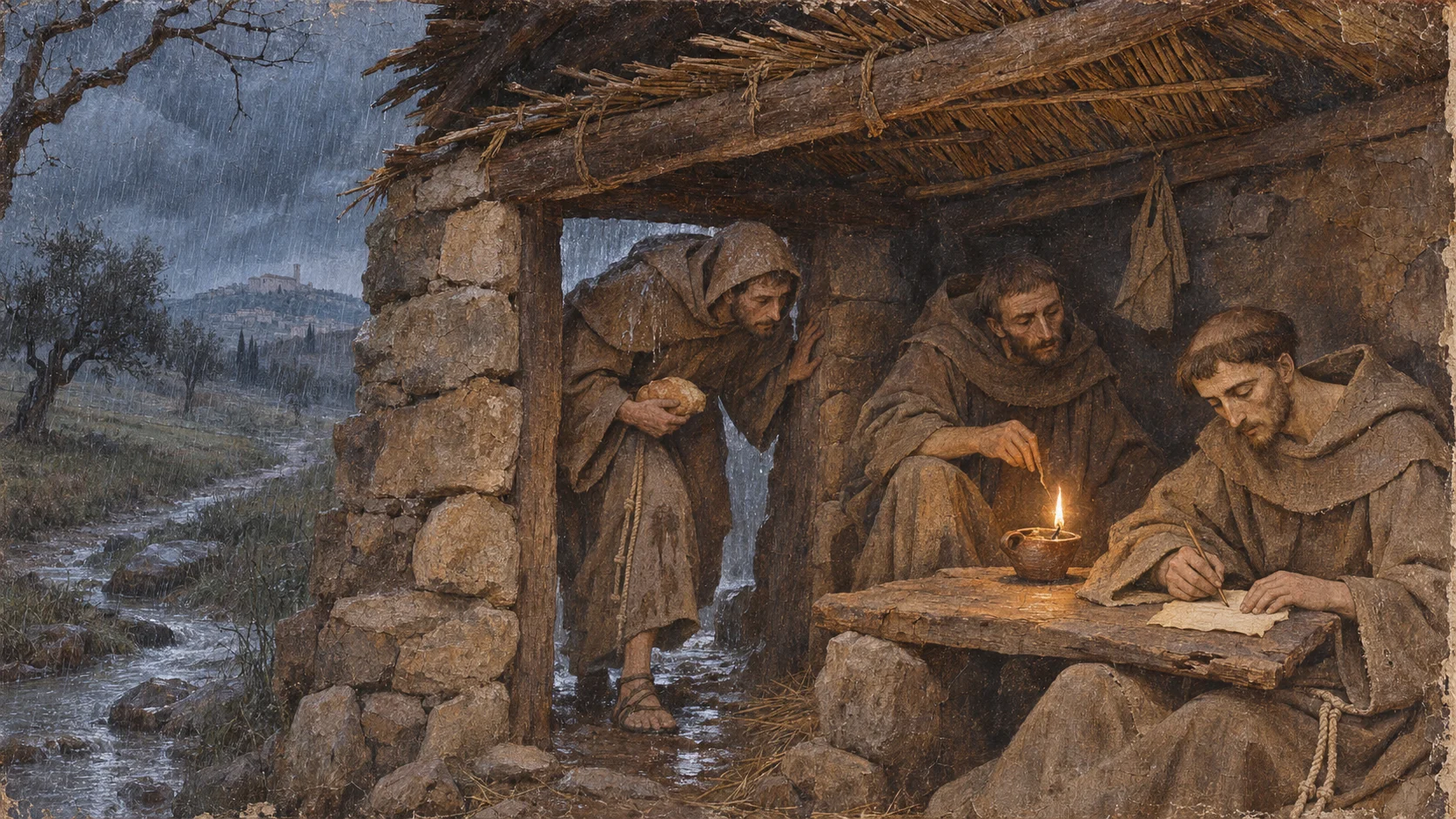
In the art for this chapter, a strip of dark wall remains open on the left. On the right, the brothers share bread and writing. The composition does not try to show a ceremony. The extraordinary thing is that they manage to remain together.
The first form of life
When the group reached about twelve men, Francis went to Rome to seek confirmation from Pope Innocent III. The sources agree about the journey and oral approval of a form of life, although they tell the meeting with different details and symbols.
The text presented to the pope does not survive as a separate document. Francis later recalled that he had a brief, simple form written and that the pope confirmed it. Scholars try to recognize fragments in the later Rule of 1221, but they cannot reconstruct it word for word.
Rivo Torto is commonly linked with the preparation of this first rule. It is a plausible association between the place’s memory and the fraternity’s early phase. We do not, however, possess a parchment dated “Rivo Torto” or a table identifiable as the one on which it was written.
That is why our image shows only a small piece of parchment, not a readable page. Francis and his brothers lived in a culture where writing mattered, but life came before the archive. The document was born to serve a choice already being practiced.
Some narratives tell of Innocent III’s dream: he supposedly saw a small man holding up the Lateran basilica as it was about to fall, and recognized Francis in the dreamer. The scene became powerful in art. It is a hagiographic tradition about the meaning of approval, not a fact verifiable in a record of the pope’s night.
The man and the donkey
One of the best-known Rivo Torto episodes almost resembles a little comedy. A farmer arrived wanting to use the shelter for his donkey and drove out the brothers, or entered while repeating an order to the animal. Francis preferred to leave rather than argue over possession of the place.
Versions differ. The center of the account fits the Franciscan refusal to appropriate: the group did not defend the hovel as owners. The story explains the move to the Portiuncula.
We cannot prove the farmer’s name, the day, the words, or every outline of the episode. It belongs to the early biographies and reveals how the community wanted to remember the transition. They did not leave because they had found a more comfortable house; they left because they would not turn poverty into a new territory defended by force.
The donkey also keeps the place from becoming too solemn. A fraternity that would influence kings and universities could be displaced by an ordinary rural need. The world did not stop to recognize a beginning.
The landscape of the excluded
The present shrine is surrounded by roads and modern buildings, but the historic plain can still be read. Between Assisi and Santa Maria degli Angeli lay fields, waters, and small care institutions. Regional heritage materials emphasize Rivotorto’s connection with that landscape.
Francis did not choose the plain simply because he liked nature. People and work the city put out of sight were there. Medieval hospitals were not modern hospitals. They offered some shelter and care, often connected with religious institutions, but disease remained marked by fear.
When the Testament says that what seemed bitter became sweet, it does not describe every sick person being cured or exclusion being solved. It describes Francis himself changing as he came near. Rivo Torto recalls that conversion has a social address: it takes a person close to those they once avoided.
We should also avoid confusion. The exact location of every leper house and the frequency of every visit are not always known. The region supports the context; it does not turn each later story into an archaeologically located event.
Stone built around poverty
Over the centuries, the faithful wanted to protect the shelter’s memory. A small church was built in the fifteenth century. A larger building followed. In 1853 an earthquake caused severe damage, and the shrine was rebuilt in a nineteenth-century neo-Gothic style.
The result may feel strange: a relatively recent building guards the memory of an early thirteenth-century hut. We need not hide that difference. It is the visible history of memory building protection around something fragile.
The interior walls called the Sacro Tugurio are presented as remains of the shelter. They deserve respect, but the long building history calls for precision. The traditional location is old; the present form has undergone intervention. We should not promise the reader an untouched photograph in stone.
The monument tells us as much about the first brothers as about the generations that refused to forget that beginning. Each rebuilt Rivo Torto in its own language. The neo-Gothic church speaks the nineteenth century; the remembered hut speaks medieval poverty; the road outside speaks our time.
The place that was not enough
Rivo Torto could not support the growing group. It was small, precarious, and vulnerable. That does not mean it failed. Some houses fulfill their purpose by preparing departure.
The brothers learned there that a written rule does not replace shared life. They learned to pray near one another, work without accumulating, and move when the space no longer belonged to them. Then they went to the Portiuncula, and the story grew to another scale.
Readers may want to preserve Rivo Torto as the pure moment before problems. But the problems were already there: little room, insecurity, differences among people, the need for organization, and relationships with authority. The purity of the beginning was not the absence of difficulty. It was the willingness to respond without abandoning the Gospel.
Our invented scene ends on a rainy night. The lamp gives little light. The parchment shows no words. One brother offers another bread. Outside, a crooked stream runs.
None of them knows that a church will be built over that memory. Perhaps that is better. At that moment, they do not need to imagine a monument. They only need to make room for the next tired body to enter.
Stones checked
Sources for this pilgrimage
- Comune di Assisi — Sanctuary of RivotortoOfficial guide. Summarizes the hovel tradition, the first brothers’ presence, and the shrine’s history.
- Umbria Tourism — Rivotorto and the historic landscapeRegional heritage. Connects the shelter, plain, leper houses, and architectural phases.
- Medieval Sourcebook — early lives of FrancisNarrative sources. Allows comparison of the first brothers’ life, journey to Rome, and departure from the hovel.
- Franciscan Institute — guide to the early sourcesCritical method. Explains the relationship among Francis’s writings, biographies, and medieval compilations.
- UNESCO — Assisi and the Franciscan sitesCultural landscape. Helps readers see the Franciscan places as a whole connected with the city and Mount Subasio.
- Benedict XVI — visit to AssisiSpiritual memory. Places the early sites within the journey of conversion and fraternity.
- Saint Francis 800 National CommitteeItalian public research. Provides context for Francis’s material and documentary legacy.
How we read this place: the first brothers’ stay in the area, the shelter’s precariousness, and the journey to Rome belong to the early historical core. The names on the beams, the farmer, and the donkey are episodes from medieval biographies. The interior, rain, bread, lamp, and parchment in the art are a responsible reconstruction.