
Christmas on the mountain
It was December 1223. Greccio, in the Rieti Valley, lay among mountains, woods, and small farms. Francis knew the region and was friends with a man named John. Thomas of Celano, his first biographer, calls John a good and faithful man. Later, local tradition gave him the name Giovanni Velita.
Here we already find two levels of certainty. It is documented in a very early source that Francis asked a man named John for help. His full identification as Giovanni Velita comes from later local tradition. It may preserve a true memory, but not all these details appear in the account closest to the events.
Francis sent for him about fifteen days before Christmas. He wanted to prepare something for the night of 24–25 December. He did not explain it like a theatre director. He said he wished to remember the Child born in Bethlehem and somehow see the hardships he suffered because he lacked the things a baby needs.
Francis’s request
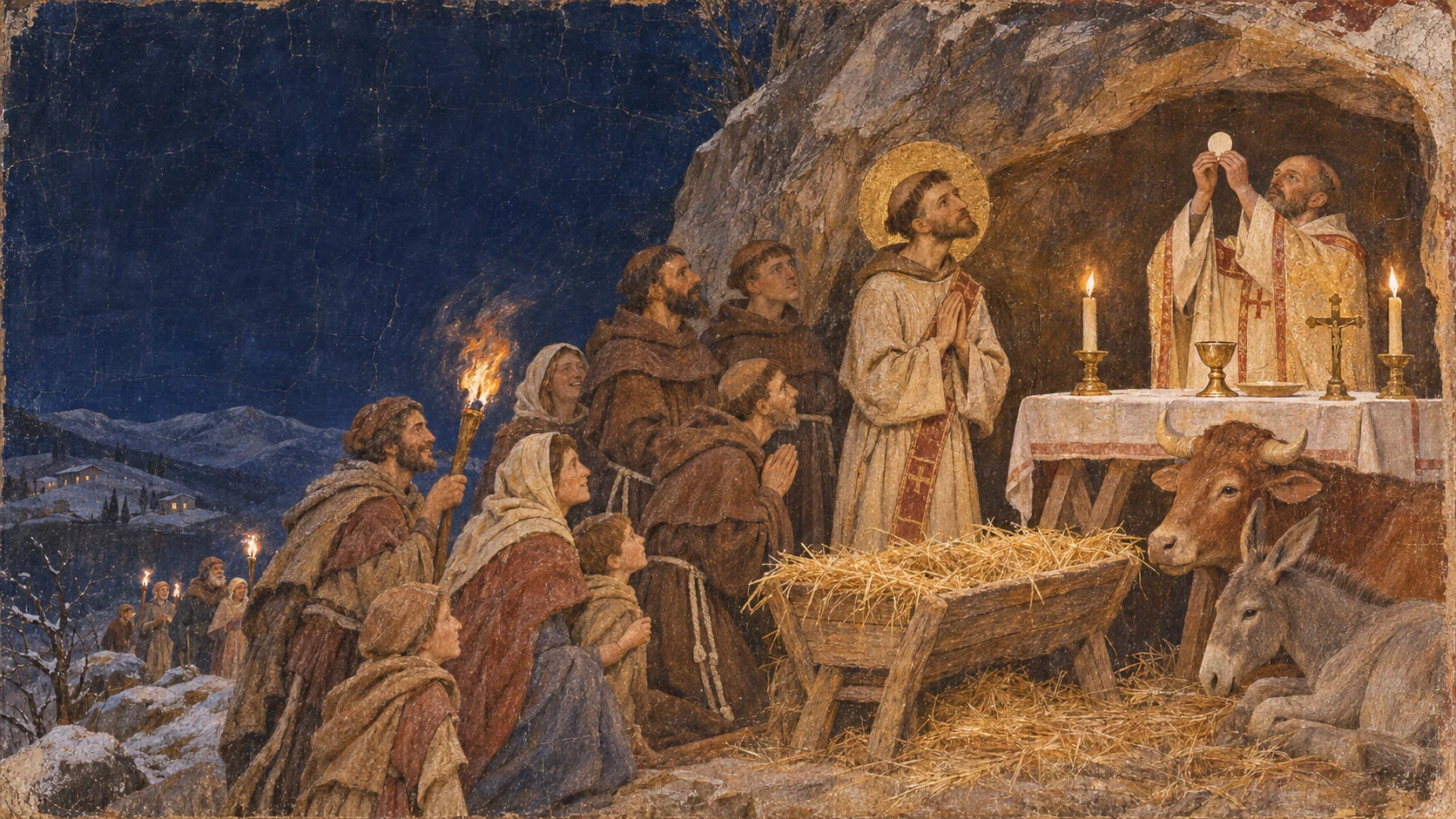
According to Celano, Francis asked for a manger filled with hay, and for an ox and a donkey to be brought. A manger was a trough from which animals ate. It was neither pretty nor clean like the miniatures kept in boxes. It smelled of straw and animals. This poor, ordinary reality was exactly what he wanted to contemplate.
There was no child playing Jesus. There were no actors dressed as Mary and Joseph. This comes as a surprise, because people often call Greccio the “first living nativity scene.” The phrase is useful, but it can mislead. The event of 1223 was different from modern performances. At its heart were the empty manger, the animals, and the Mass.
This point is well supported historically by Thomas of Celano’s account and is also recalled by Pope Francis in his letter Admirabile signum. The familiar nativity scene with figures developed in many ways afterwards. Greccio gave it a decisive impulse, but all the forms we know today did not spring into being that night.
Lights along the path
When night came, men and women from the surrounding countryside climbed up carrying torches and candles. Franciscan brothers came too. The woods filled with light. Voices echoed against the stones. In that cold season, the air would have stung their faces and smoke would have made their eyes smart.
Celano describes the people, lights, singing, and woodland. The precise cold, the smells, and the sting of smoke are plausible sensory reconstruction. They help us enter the scene, but they do not appear as measurements in a report.
Today, a large sanctuary clings to the rock at Greccio. It preserves the memory of that night. In 1223, however, the later buildings were not all there. We should imagine a rougher, simpler place, prepared for an unusual celebration.
Mass over the manger
A priest celebrated the Eucharist over the manger. Francis, who was a deacon, wore the vestments proper to his ministry, sang the Gospel, and preached. Celano says his voice was strong and sweet. He spoke of the birth of the poor King and called Jesus the “Child of Bethlehem.”
This connection matters deeply. Francis did not simply want to copy a distant scene. The manger became an altar. The poor Jesus of Bethlehem and Christ present in the Eucharist were, for him, the same Lord, making himself small and near.
The villagers were not an audience watching from a distance. They sang, held lights, and celebrated. Ordinary people were part of what happened. A mystery that seemed to belong to another land and a time many centuries earlier came close to the lives of Greccio’s farming families.
The child seen by John
Celano adds a marvellous episode. A virtuous man had a vision: there seemed to be a sleeping child in the manger, and Francis gently woke him. The biographer explains the image’s meaning: Jesus had been forgotten in many hearts, and through Francis his memory was awakening again.
This is a hagiographical vision, passed down in a religious account. It should not be presented as though everyone there saw a physical baby. The text itself speaks of a vision granted to one person and immediately explains its spiritual meaning.
We can respect the faith of the account while remaining historically clear. What happened before everyone was the celebration with a manger, hay, animals, brothers, and local people. The child in the manger belongs to the visionary experience Celano relates.
Hay taken home
After the celebration, people kept some of the hay. Celano says it was given to sick animals and that men and women received healing. The story shows how the participants regarded the place and the objects touched by the celebration.
These healings belong to the early hagiographical tradition. We have no veterinary records or medical examinations. For the biographer, they signalled that all creation benefited when Christ’s birth was remembered with faith.
Later, a chapel was built where the manger had stood. The memory was no longer only a spoken story: it acquired walls, paintings, and pilgrims. Centuries of building gathered around the rock.
Did Francis invent the nativity scene?
The short answer is that he created a new and powerful way to celebrate Christmas at Greccio, but did not single-handedly invent every representation of Jesus’s birth. Christians had painted and carved the Nativity long before 1223. Medieval celebrations and dramatisations existed too.
What makes Greccio special is the combination: a real place, a manger, animals, local people, and the Eucharist, brought together to make Christ’s humility visible. The Basilica of Saint Francis in Assisi warns that simply calling Francis the “inventor of the first nativity scene” is an oversimplification.
So “first nativity scene” is a phrase from popular tradition. “The Greccio celebration described by Celano” is a more precise historical statement. Precision does not lessen its beauty. Instead, it lets the night recover its original power.
Seeing with bodily eyes
Francis wanted to “see” the poverty of Bethlehem. This was no idle curiosity. He knew that the body learns. The weight of straw, the animals’ breathing, the cold, and the wavering light could teach what an often-repeated phrase, heard without attention, no longer could.
Jesus was not born in a palace. God entered the helplessness of a baby. For Francis, that changed the way people should look at the poor. If the Lord chose to be small, nobody should be despised for having little.
Greccio joins contemplation to justice. Anyone moved by the manger must recognise people who still cannot find shelter today. The tenderness of the nativity scene is no escape from pain. It calls us to protect vulnerable lives.
A reconstructed night
We can imagine a girl arriving with her family. She holds her mother’s hand and watches the ox. She cannot understand the whole sermon, but she sees Francis bending over the hay and hears the word “Bethlehem.” As she goes home, the torchlight sways along the path.
This girl is a character created for a reconstruction. No source records her name. We do know, however, that men and women from the region took part. Openly imagining her helps us see that history was made by more than saints and nobles. Children, farmers, and families whose names are lost were there that night too.
Perhaps this was one of Francis’s gifts: bringing ordinary people into sacred history as participants with a place of their own.
What remained at Greccio
The rock remained, and on it a sanctuary gradually took shape. The yearly celebration remained. Artists kept the image alive in paintings. The custom of setting up nativity scenes spread through homes, churches, and public squares across the world.
A Franciscan way of teaching remained too. Francis did not begin with a complicated explanation. He prepared a concrete experience and let straw, night, and prayer awaken questions. For anyone teaching a child, Greccio offers a suggestion: truth can reach the mind by first passing through attention, beauty, and care.
But what matters most may be invisible. Greccio teaches us to look again at something familiar. Many people had already heard the story of Bethlehem. Francis prepared a place where they could experience it through their senses and affections.
There was no luxury that night. There were straw, animals, bread and wine, country voices, and a dark mountain. The extraordinary did not erase the ordinary. It appeared within it.
That is why Greccio still feels close. Whenever someone bends towards a fragile life, offers shelter, or recognises God in what is small, the torchlit road stretches through the night again.
Annotated sources
- Thomas of Celano, First Life of Saint Francis, Greccio chapter. Earliest and fundamental account, written a few years after Francis’s death; describes the manger, animals, Mass, preaching, and vision. It is hagiography and should be read according to that genre.
- Municipality of Greccio, “History of the Nativity Scene”. Official town page on the event and its local memory, including the Giovanni Velita tradition. Read
- Greccio Sanctuary, historical introduction. Guides visitors through the site, the rock, and the surviving buildings. Read
- Pope Francis, Admirabile signum (2019). Official letter retelling Greccio from Celano’s account and stressing that there were no statues, but a manger, hay, an ox, and a donkey. Read
- Regional Directorate of National Museums, Lazio, remembrance of Greccio. Italian institutional source for the sanctuary’s historical and cultural setting. Read
- Basilica of Saint Francis of Assisi, “The Nativity Scene at Greccio”. Historical and artistic reading that warns against the simplification of calling Francis the sole inventor of the nativity scene. Read
- Visit Lazio, “The Living Nativity Scene of Greccio”. Useful for distinguishing the historical celebration of 1223 from modern living nativity performances. Read