Who was Saint Francis?
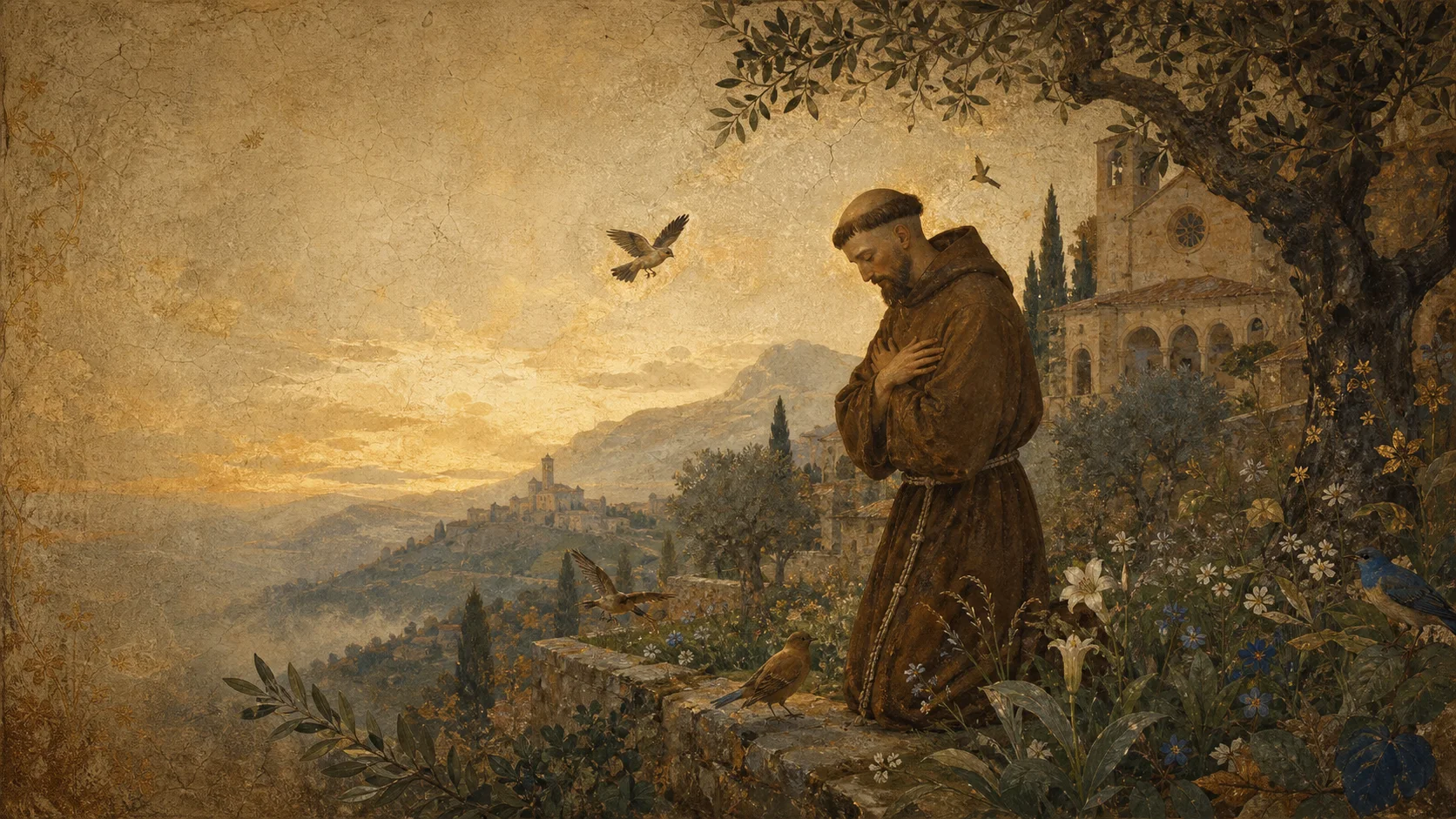
Saint Francis of Assisi was an Italian Christian who sought to live the Gospel in a simple, practical way. He was born into a wealthy family, dreamed of becoming a knight and took part in a war. After a long inner transformation, he chose to live among the poor, care for the sick and proclaim peace.
He did not set out to create a large organization. He wanted to follow Jesus. Other people saw how he lived and asked to join him. This was the beginning of the fraternity of the Friars Minor.
Why is he still important?
Francis brought together things that many people tended to separate: prayer and work, love of God and care for nature, faith and encounters with people who thought differently.
He called creatures brothers and sisters. This was not because he believed nature was God, but because he recognized that we all receive our existence from the same Creator.
His life continues to raise questions that are very relevant today: how much do we really need to own? How can we build peace without avoiding the truth? What happens when we stop treating people and creatures as objects?
In brief
- He was born in Assisi around 1181 or 1182.
- He fought in the war between Assisi and Perugia and was taken prisoner.
- He underwent a gradual conversion, shaped by encounters with people who were sick and poor.
- He prayed and worked on rebuilding the chapel of San Damiano.
- His first companions joined him around 1208.
- He met Sultan al-Malik al-Kamil in Egypt in 1219.
- He celebrated Christmas at Greccio in 1223 with a living Nativity scene.
- He composed the Canticle of the Creatures near the end of his life.
- He died on 3 October 1226, near the Portiuncula.
The word that sums up his path
Fraternity. For Francis, no one walks alone. Another person becomes a brother or sister. Water becomes a sister. A poor person is no longer a distant problem. Even suffering itself can be faced in company.
Francis was not perfect. He was someone who learned to begin again—and made beginning again a path for many others.