
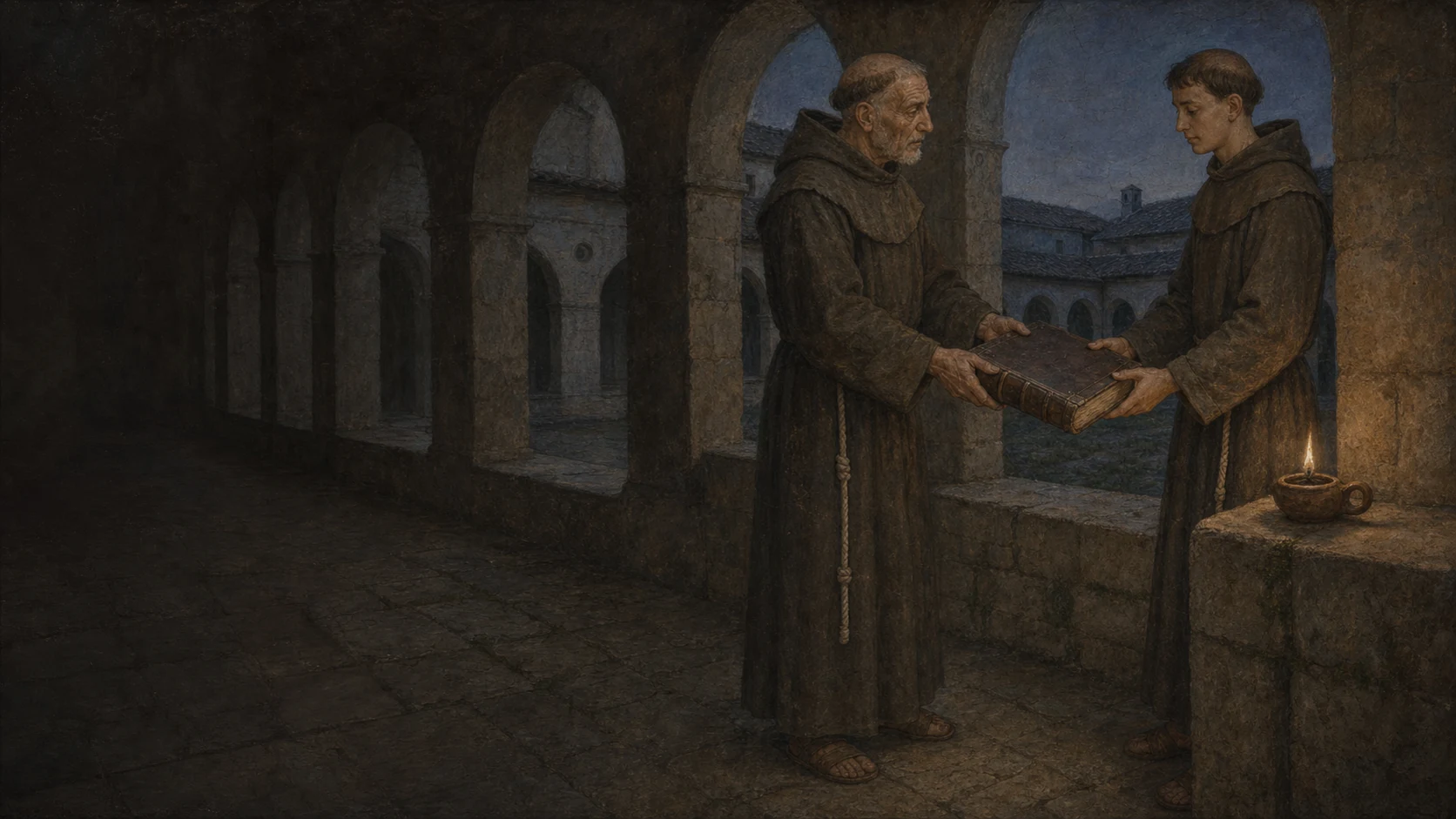
A book passes from hand to hand
The cloister is almost dark. The last light touches the arches and leaves the courtyard in the cold. Beside a small lamp, an elderly friar holds a worn leather codex. The young man before him reaches out with both hands to receive it.
The book is heavy. Some leaves are darker; others bear corrections in the margins. A strip of leather has repaired the spine. Nothing about it looks new.
This scene is a reconstruction. We know of no exact moment when two friars made such a handover. Yet from the 13th to the 15th century, Franciscan texts survived in precisely this way: kept, read, copied, corrected and carried from one house to another.
What Francis left did not travel through time like a fragrance sealed inside a bottle. It traveled because people opened the vessel many times.
The parchment of the Rule
On 29 November 1223, Pope Honorius III confirmed the Rule of the Friars Minor through the bull Solet annuere. The document still preserves the words meant to organize the fraternity: to live the Gospel in obedience, without property and in chastity.
The parchment is a physical object. It was made from prepared skin and received ink and a seal. It could be folded, stained, stolen or destroyed by fire. Its survival was not automatic.
But the Rule did not endure merely because one sheet was protected. It was copied into other manuscripts, read in communities and used when decisions were made. Every generation had to ask how to obey a short text in a changing world.
That question caused conflict. What did “appropriate neither house, nor place, nor anything” mean when a community needed a church, books and bread? Who would be responsible for buildings? Could a friar use money through another person? The Rule remained central precisely because it did not provide a simple answer for every future situation.
Enduring is not the same as standing still.
Codex 338 and the missing melody
The old library of the Sacred Convent in Assisi contains a manuscript known as Codex 338. Its oldest sections were prepared in the 13th century. It brings together writings by Francis, texts about the Order, liturgical material and narratives about the saint and Clare.
Someone planned it to protect important material from the wear of the originals and to make communal reading possible. One volume could hold law, prayer and memory.
It contains one of the earliest copies of the Canticle of Brother Sun. The copyist left space for the music. The melodic line, however, was never written in.
That emptiness teaches us much. We retain the words about “Brother Sun,” “Sister Moon,” water, fire and earth. We do not retain the sound that accompanied them with the same confidence. Perhaps the melody was still known by ear and no one thought it necessary to record it at that moment. Later, it was lost.
The past reaches us with both presences and gaps. A blank space can be as honest as a full page.
Brother Leo’s small sheet
Another object survived by an even more delicate route. After receiving the stigmata, Francis wrote the Praises of God and a blessing for Brother Leo. The little parchment bears words, lines and signs associated with Francis’s own hand. Leo added notes explaining why he kept the sheet.
It is not a luxurious book. It is a keepsake between two people.
Leo lived for decades after his friend’s death. He recounted episodes, wrote observations and protected memories. Other companions also spoke. Their voices reached later generations through different works: accounts by Thomas of Celano, the Legend of the Three Companions, the Assisi Compilation and texts that incorporated earlier testimony.
None of these works is a recording. An author selected, arranged and explained. Some memories passed through spoken retelling before reaching parchment. Others were adapted to answer the debates of their time.
Even so, without those hands, many of Francis’s gestures would have disappeared.
When one memory takes another’s place
In 1266, the Order adopted Bonaventure’s Major Legend as the official account of Francis’s life. The general chapter ordered earlier lives to be withdrawn from circulation. This was a medieval way of giving the fraternity a shared narrative.
The result also brought loss. Earlier texts were endangered, and some survived in only a few copies. Centuries later, scholars had to compare manuscripts to recover voices that had nearly faded away.
Bonaventure did not simply intend to deceive. He wrote for an Order already large and divided by questions of poverty, study and authority. His Francis taught unity and presented the saint as entirely oriented toward Christ.
But an official version never contains all the memory of a family. Beneath it, stories continued to be told in refectories, on roads and in small communities.
Stone, wood and the question of poverty
The first brothers had slept in simple shelters. As the Order grew, churches and friaries appeared in cities across Europe. It is better to call their inhabitants friars, not monks: their way of life was tied to preaching, travel and contact with the city, although they also shared communal prayer and spaces of silence.
Some houses remained small. Others acquired enormous naves, cloisters, study rooms, infirmaries and libraries. Masons, carpenters and local people contributed. Powerful families offered land and wanted burial places inside the churches.
The stone that protected books and welcomed people also raised an uncomfortable question: how could a poor fraternity live in such rich buildings?
No answer can make everything tidy. The friaries served education, prayer, preaching and care. They also drew friars closer to prestige, money and urban disputes. The Franciscan Middle Ages held both generosity and contradiction.
The sisters associated with Clare lived in monasteries, within forms of enclosure. They did not all follow exactly the same Rule. Some communities received norms that allowed common property; others defended a stricter poverty. The memory of San Damiano crossed different places without producing a single female experience.
Books that could travel
Francis mistrusted learning used to dominate others. Even so, the Order became one of the great communities of study in the Middle Ages. Friars taught, prepared sermons and built libraries.
Not every book was an enormous volume chained to a shelf. Research into Franciscan manuscripts from the 13th to the 15th century has also found smaller notebooks, compilations and portable books. A friar would gather biblical passages, sayings from teachers, examples for preaching and useful notes.
The leather became marked by fingers. Wax dripped onto it. A page might be scraped and used again because parchment was expensive. Later, paper made some volumes lighter and cheaper.
A library was not by definition the opposite of poverty. It could be a tool for service. But the danger remained: gathering knowledge to rise above others. Francis’s old warning—not to extinguish the spirit of prayer—continued to haunt the reading tables.
Stories that flowered late
In the 14th century, a Latin collection called the Actus beati Francisci et sociorum eius gathered stories about Francis, his companions and friars from the Marches. It was probably composed between the 1320s and 1340s, about a century after the saint’s death.
Between approximately 1370 and 1390, much of this material passed into Italian in the Fioretti, the “Little Flowers of Saint Francis.” By the end of the 15th century, the work was already circulating in print.
The Little Flowers preserved unforgettable scenes: conversations, journeys, animals, temptations and reconciliations. Some retain early traditions; others were coloured by many decades of transmission and by the concerns of communities defending strict observance.
We should read them as a window, not a camera. They reveal Francis, but they also reveal how the 14th century wanted to remember Francis.
Perhaps that is precisely why they reached so many hearts. Documented history provides the trunk. Tradition brings forth flowers—beautiful, fragrant and not always easy to separate from the later garden.
Returning to the source
During the 14th and 15th centuries, friars debated once again how to live the Rule. Some groups demanded absolute poverty and entered into serious conflict with the authorities of the Church and the Order. Others formed movements of Observance, seeking simpler houses, common discipline and a return to the original ideal.
They were not perfect knights rescuing a pure past. Among them were holiness, politics, severity, courage and new divisions. Every reform chooses an image of the origins and risks using it as a weapon against someone else.
Even so, the desire to “return to Francis” shows that his memory remained capable of judging the present. The Rule was not merely a relic. It still unsettled people.
What truly crossed the centuries
By the end of the 15th century, much had changed. The first companions were dead. Some chapels had been enlarged. Pigments had fallen from walls. Manuscripts had been lost to fire, damp, travel and neglect. Stories had acquired details that no witness could confirm.
But something endured in objects and practices: a copied Rule, the name of a poor man remembered in prayer, a sister caring for one who was ill, a friar sharing bread, a preacher trying to speak without contempt, a copyist saving words before the old leaf fell apart.
This is the fragrance of the title. It is neither a physical miracle nor a scent preserved in stone. It is the presence a life leaves when other lives receive it and turn it into action.
In the reconstructed cloister of our image, the young man finally holds the codex. The elder does not hand over a perfect past. He gives him worn pages, containing truths, choices and absences.
Now the book weighs upon other hands.
Traces that remained
Sources for this chapter
- BeWeB — 800 years of the Confirmed RuleDocument and institutional context. It presents the Rule's approval by Honorius III on 29 November 1223 and manuscripts that transmitted the text.
- Library of the Sacred Convent — Codex 338Description of the medieval manuscript. It explains its composition, communal purpose and early copy of the Canticle with space for an unrecorded melody.
- International Society of Franciscan Studies — digitised manuscriptsResearch collection. It documents the medieval formation of the Sacred Convent's library and the preservation of its codices.
- René Hernández Vera — Franciscan manuscripts in PaduaAcademic research. A study of books, readers, large libraries and portable compilations from the 13th to the 15th century.
- Jacques Dalarun and others — at the origins of the Little FlowersSource study. It places the Actus between 1327 and 1337 and explains its relationship with the later Italian collection.
- Caroline Bruzelius — friars in the medieval cityArchitectural history. An analysis of the usefulness of friaries and the tension between professed poverty, donations and monumental buildings.
- UNESCO — Assisi and its Franciscan sitesHistorical and artistic dossier. It gathers the buildings, paintings and material traditions that made Assisi a center of medieval memory.
How to read this chapter: the handover of the codex is a symbolic reconstruction based on real practices of copying and reading. Dates and features of Codex 338, the Rule and the Actus-Fioretti come from documentary studies. “Fragrance” is a metaphor for cultural and spiritual continuity, not a claim of a supernatural phenomenon. Later texts preserve memories, but they also reveal the choices and conflicts of those who wrote them.