
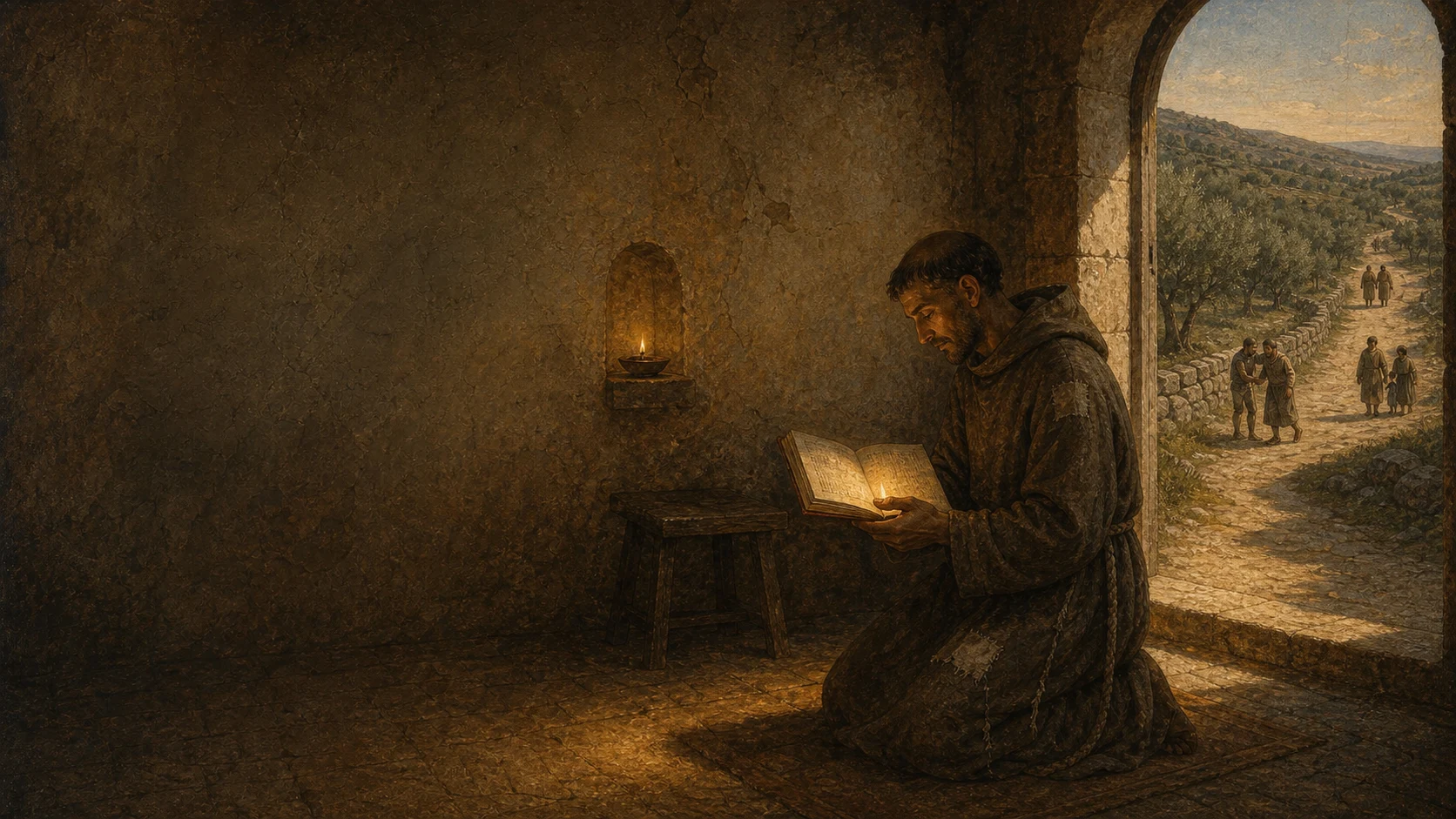
The small church was still immersed in shadow when a voice began to read the Gospel.
Francis listened. There was no grand music and no crowd waiting for him. There were only those ancient words, spoken slowly: go out on the road, proclaim that the Kingdom of God is near, care for the sick, give freely, and carry neither gold, silver, nor two tunics.
Someone else might have thought, “This is a beautiful passage to remember.” Francis asked a more dangerous question: “What if Jesus is saying this to me as well?”
The earliest Franciscan accounts place a decisive moment of listening like this at the Portiuncula. Written after the events, they do not allow us to reconstruct every gesture. Yet Francis himself left one certainty in his Testament: the Most High revealed to him that he should live “according to the pattern of the Holy Gospel.”
He did not want to admire Jesus from a safe distance. He wanted to place his feet where the words of Jesus pointed.
It was not a book for decoration
In Francis’s time, owning a book was rare. Every copy was made by hand, and few people could read. The Gospel was known mainly when it was proclaimed in church or kept in memory.
Francis had profound respect for the sacred words. But that respect did not end at the page. If the Word came from God, it called for a response.
We can memorize a saying about forgiveness and continue feeding a quarrel. We can sing about poor people and never look into the eyes of someone asking for help. We can call Jesus Teacher while accepting only the teachings that do not change our plans.
Francis recognized this distance. The Gospel was not a spiritual museum piece. It was a door.
Three sayings and a life set in motion
An early tradition says that when Bernard of Quintavalle wished to follow the same path, he and Francis opened the book of the Gospels. The passages spoke of sharing with poor people, taking nothing for the journey, and renouncing oneself to follow Jesus.
The account has the symbolic form of the early biographies: the book opened three times and gave three clear answers. This is not a method for making decisions at random. Its message is different: the fraternity began when the words of Jesus became choices.
“Sell what you have and give to the poor” took the form of possessions being shared.
“Take nothing for the journey” took the form of brothers walking without the protection of accumulated money.
“Take up your cross and follow me” took the form of a life that did not flee every suffering but remained beside those who suffered.
These were not three tests designed to display courage. They were three ways of allowing Jesus to occupy the center.
Poverty born from an encounter
If someone gives up everything simply to say, “I am better than you,” that person has not learned the Gospel. Wealth has been exchanged for pride—and pride can imprison us too.
Francis did not choose poverty because food, shelter, and clothing were bad. He gave thanks for every gift and insisted that sick brothers be cared for. The problem arose when owning became more important than loving, when protecting objects mattered more than welcoming people.
Jesus presents the Kingdom as a treasure that fills someone with joy. First comes the discovery of being loved by God; then comes the freedom to share. Without that encounter, poverty would be mere lack. With Jesus at the center, it could become space: hands free to serve, light steps that go out to meet others, and a table with room for another brother.
Francis did not imitate Jesus’ clothing like an actor. He sought the movement of his heart: to receive everything from the Father and turn what was received into a gift.
When the proclamation gained hands
Jesus did not send the disciples only to speak. In the same Gospel, proclamation and care walk together: say that the Kingdom is near, heal, cleanse, and give freely.
Francis’s life took this direction even before his fraternity was organized. In his Testament, he recalls that seeing people with leprosy seemed bitter and repulsive to him. Then the Lord led him among them, and Francis showed mercy. Afterward, what had seemed bitter was changed into sweetness.
Notice the order: he did not wait until he felt completely prepared to draw near. He approached, served, and was transformed.
The Gospel gained hands when he cared for wounds. It gained a face when he called “brother” someone whom the city kept at a distance. It gained feet when he crossed the road he would once have used to escape.
Francis would proclaim peace in words. But before any speech, his body had to stop saying, “Your pain has nothing to do with me.”
Without glosses, not without understanding
The Franciscan path is sometimes summed up with the expression sine glossa: to live the Gospel “without gloss.” This does not mean rejecting study or ignoring context. The Church reads the Scriptures as a whole, guided by faith, reason, and the community.
Francis used similar language at the end of his life when he asked his brothers not to add explanations to the Rule and the Testament that would weaken what they had promised. His concern was very human: we can always invent an elegant excuse for not changing.
“Forgive—yes, except that person.”
“Share—yes, when I have much more.”
“Serve—yes, if everyone notices.”
The shortcut begins when we use many words to escape a simple word. Living without shortcuts means asking sincerely: which part of Jesus’ teaching am I trying to turn into an exception for myself?
The Rule began with a Person
As the number of brothers grew, they needed common guidance. There was work, travel, conflict, illness, and decisions to make. Their form of life could not depend only on one day’s enthusiasm.
Even so, the Rule confirmed by Honorius III in 1223 begins by declaring that the life of the Friars Minor is to observe the Holy Gospel, living in obedience, without anything of their own, and in chastity.
The center was not the Rule itself. It was Jesus.
The directions protected a relationship and also protected the little ones. No one was to use the fraternity as a ladder to become important; even the person who coordinated it was called a minister and servant.
Francis remained within the Church. He sought approval, recognized ministers, and wished to live the Gospel in a Catholic way. His radical commitment was not a solitary adventure. It was a response accompanied by brothers, corrected through communion, and nourished by prayer.
Close the book and open the door
The Gospel without shortcuts does not require everyone to make the same choices as Francis. A child, a mother, a teacher, and a friar have different responsibilities. Following Jesus does not erase our story; it gives that story direction.
Perhaps you are not called to travel without a bag. But you may notice that you keep things you never use while someone else lacks what is necessary. Perhaps you will not cross Umbria proclaiming peace. But you can stop a school conversation from turning someone into an object of ridicule. Perhaps you will not care for the wounds of a person with leprosy. But you can sit beside someone everyone avoids.
The Franciscan question is not “How can I appear radical?” It is: “How can this word come alive in me today?”
A page of the Gospel remains silent on the table. When someone listens to it, closes the book, and opens the door, the Word begins to walk again.
To keep in your heart
Jesus is not looking for admirers at a distance
Francis understood that the Gospel was not given to make our bookshelf more beautiful, but to make our love more concrete. We do not need to accomplish everything at once. We need to stop using excuses to avoid the first step.
The Word becomes a path when my feet accept the direction Jesus gives.
A gesture for today
Choose one phrase and give it hands
Read Matthew 10:7–10 slowly. Choose just one verb from Jesus: go, proclaim, heal, or give. Then do one small, hidden action that goes with it: walk over to someone who is forgotten, speak a word of peace, care for someone who is tired, or offer something without expecting praise.
Prayer in silence
When your Word calls
Jesus, Teacher of simple paths,
do not let me hide your voice
beneath my excuses.
Give me eyes to recognize you in those who suffer,
free hands to share what I have received,
and courage to begin with the step I can take.
When I want only to admire you,
invite me once more to follow you.
May your Word find in my life
an open door.
Amen.
For those who want to go deeper
Sources for this chapter
- Gospel according to Matthew, chapter 10 — Ave Maria BibleThe sending of the disciples, proclamation of the Kingdom, freely given care, and the direction to travel without wealth.
- Testament of Saint Francis — Order of Friars MinorA text dictated by Francis at the end of his life: the encounter with people with leprosy, the revelation of the Gospel form, and the request to observe the Rule in a Catholic way.
- Rule of 1223 — Order of Friars MinorThe text confirmed by Honorius III, whose first chapter defines the brothers’ life as observance of the Holy Gospel.
- “To Live and Follow” — Ministers General of the Franciscan FamilyPresents the Earlier Rule as a text born from life and guided by the footsteps of Jesus.
- Celebrating the Rule 1223–2023 — Order of Friars MinorExplains the Gospel as the heart of the Rule and identifies the account of passages opened by Francis and his first brothers as a later tradition.
- Gaudete et Exsultate, 97–98 — VaticanA Church reflection on accepting Jesus’ demands without excuses that remove their force and recognizing the dignity of those who suffer.
The scenes at the Portiuncula and the opening of the Gospels are known through Franciscan biographies written after the events. This chapter presents them as an early tradition, while treating the *Testament* and the Rules as writings of Francis and his first fraternity.