
The face that interrupts the journey
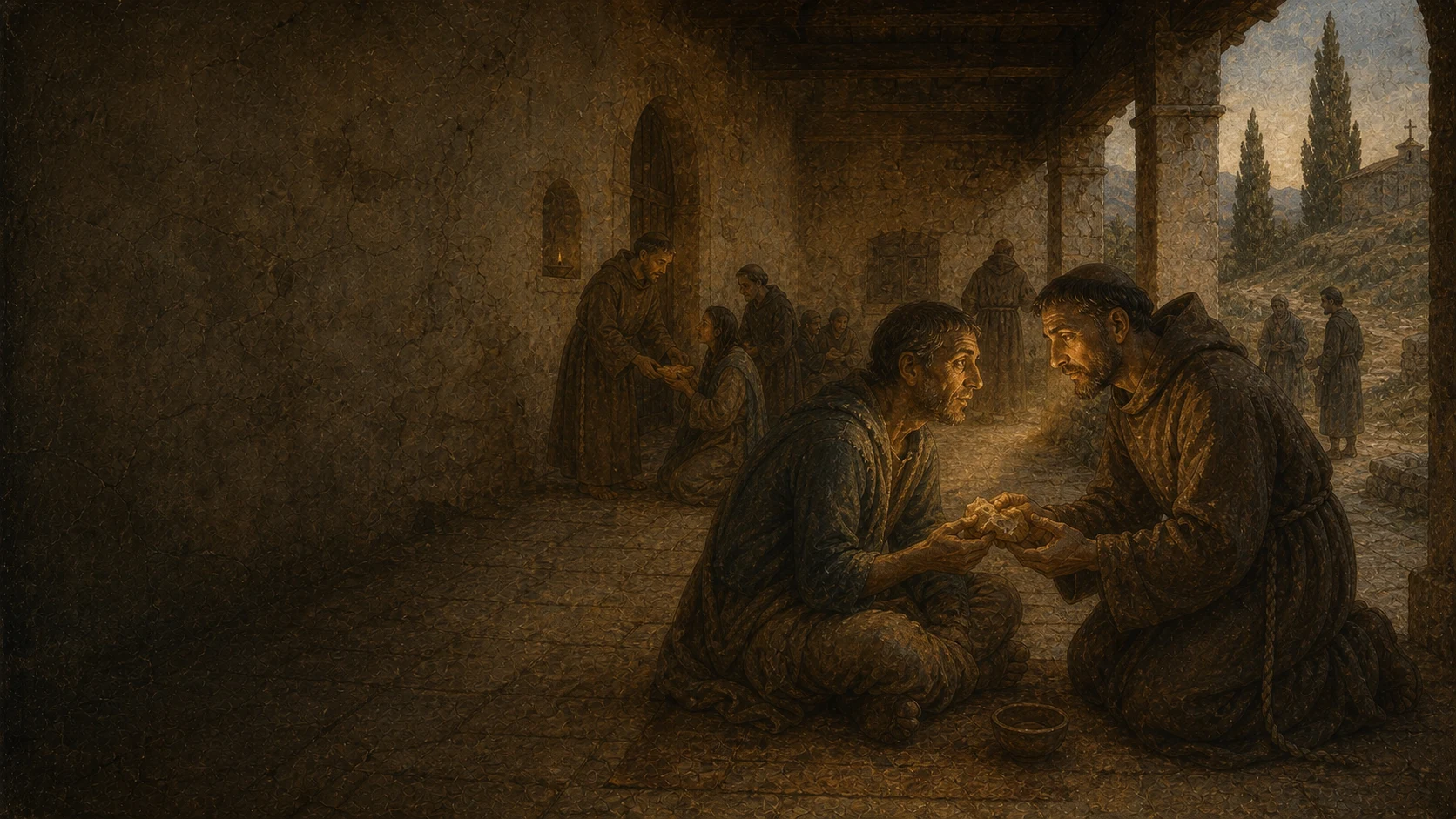
A man sits beneath the portico of a small church. His clothes are worn. His body seems tired. Many people have passed him. Some left bread. Others looked away. Almost no one asked his name.
Francis approaches and kneels. He does not remain standing like an important person granting a favor. He lowers himself to the man’s level. He breaks the bread, but does not hand it over hurriedly. First, he looks at him.
In the artwork, the light exists between the two faces. Jesus does not appear behind the man like a ghost. Two people recognize one another. It is in this space of attention, respect, and sharing that the Gospel invites us to perceive Christ.
He did not merely say, “Be kind to these people.” He said something capable of changing how we see: “You did it to me.”
A question that comes at the end
In Matthew 25, Jesus describes the Son of Man separating people as a shepherd separates sheep from goats. What appears in this scene is not a test about difficult religious statements. The question is direct: when someone needed food, water, welcome, clothing, care, or company, what did we do?
Something is surprising: both those who helped and those who ignored others ask when they encountered Jesus. Neither group realized it was him.
The righteous did not care for others to win applause or accumulate points before God. They cared because someone stood before them. Jesus later reveals that to receive that person was to receive him.
Indifference, meanwhile, can look ordinary: “I am busy,” “someone else will handle it,” “I do not want to get involved.” The Gospel removes this shelter. The face turned into scenery belongs to Jesus’ family.
The memory Francis chose to keep
At the end of his life, Francis dictated his Testament. He could have begun by recalling crowds who listened to him, important journeys, or the pope’s approval of his form of life. He began differently: he said that seeing people affected by leprosy had seemed bitter to him and that the Lord led him among them. There, he said, he showed mercy.
Today the disease is called Hansen’s disease and it can be treated. Medieval texts use the word “lepers.” At that time, this label also carried fear and social rejection. Sick people could be excluded from ordinary life and treated as if their illness were their entire identity.
Francis’s biography preserves the encounter in which he crossed through fear and approached a sick man. But its deepest point is not to repeat the scene as an adventure. It is to notice what Francis chose to say: the Lord led him to people he had avoided.
He does not claim that he saved those people. He says that he was transformed. What seemed bitter became sweet. Mercy changed not only the day of the person who received care; it changed the eyes of the person who approached.
Living nearby, not visiting from above
With the birth of the fraternity, drawing near ceased to be a single event. In the Earlier Rule, completed in 1221, the brothers are invited to rejoice when they live among people considered insignificant and despised: poor, weak, sick people and those left along the roadsides.
That is more demanding than handing over some help and leaving: live among them.
Whoever stays close learns names, stories, abilities, and desires. They discover that a person experiencing homelessness is not “homelessness.” That an illness does not erase humor and dreams. That a migrant is not a problem arriving, but a life crossing a border.
To be lesser is not to pretend that we have no value. It is to reject the step that puts us above others: to sit at the same table, listen before deciding, and allow those who usually only receive to speak and participate as well.
In closeness, the other person ceases to be a case and becomes a brother or sister.
Christ does not erase anyone’s face
Saying that we meet Jesus in poor people requires care. A poor person is not a disguise worn by Christ. They do not lose their own face, name, and freedom to become a spiritual lesson for us.
Recognizing Christ in that person means taking their dignity even more seriously. If I see Jesus in a hungry child but do not ask what that child needs, something is wrong. If I photograph my help and expose a family, I have placed my own image at the center. If I offer only what I wanted to discard, I may merely be emptying my wardrobe.
Mercy does not use another person’s suffering to make us feel good. It allows their real need to interrupt our plans.
Pope Francis reminds us that poor people are not numbers, but people to encounter, listen to, and welcome. For every Christian community, this closeness is a form of faithfulness to Jesus.
Charity and justice are not enemies. Giving bread today and asking why bread is lacking are both part of love.
Mercy has bread and a chair
Matthew 25 presents very concrete actions: feeding, giving drink, welcoming, clothing, caring, and visiting. None of them can be done through positive thoughts alone.
Sometimes a person needs food, medicine, clothing, or protection. Prayer does not replace the care we can provide. At other times, a person needs a chair beside us and to be heard without someone trying to fix their life in five minutes.
The Good Samaritan in Luke 10 approaches the wounded man, tends him, takes him to a safe place, and pays for his care. His feeling becomes a sequence of decisions.
Helping responsibly also means recognizing limits. Children should never approach dangerous situations alone. A serious crisis may require professionals or prepared adults. Asking for help can make mercy more genuine.
In the image, four hands hold the bread. The giver does not dominate. The receiver is not reduced to passivity. The sharing creates a table even before a table exists.
The forgotten who are very close
Not every forgotten person is far away or on the streets. Sometimes that person sits at the back of the classroom. It may be the classmate everyone laughs at, the elderly woman whose stories no one wants to hear, the child who has arrived from another country, the sick relative who receives fewer and fewer messages, or someone who made a mistake and is treated as though they can never change.
Some forms of suffering do not appear on the face. Someone may smile in photographs and believe that their presence makes no difference.
Finding Jesus among the forgotten begins when we learn to notice. Then comes the approach. Only then do we discover what gesture is truly needed.
Perhaps it means sharing a snack, using the correct name, stopping a cruel joke, or inviting someone who was left outside the circle. Larger situations require organized communities, public policies, and sustained work. But no change should lose sight of people’s real faces.
At the end of Matthew 25, Jesus does not leave his disciples searching for a hidden presence in some impossible place. He draws near clothed in human need.
Francis learned not to flee this encounter. By placing himself at the level of the person the world diminished, he saw something more difficult and true than a supernatural light: a brother.
And Jesus was there.
To keep in your heart
Jesus does not remain behind the forgotten face
He comes to meet us in that face. Mercy begins when we stop seeing a problem and recognize a person: with a name, a voice, dignity, and something to teach us.
The path to Jesus can begin when my eyes stop hurrying past someone.
A gesture for today
Offer presence before offering answers
Think of someone safe and nearby who is often left out. Approach without turning the person into a project. Call them by name, sit at the same level, and ask a genuine question: “How are you?” Then listen to the end. If there is a practical need you can meet responsibly, agree on the action with that person—do not decide everything alone.
Prayer in silence
When you pass before me
Jesus, brother of the little ones,
slow my steps
when I want to pretend I did not see.
Free me from help that humiliates,
from kindness performed for attention,
and from haste that never learns names.
Give me eyes able to encounter,
ears that offer a home,
and humble hands ready to share.
May I not seek your face far away
while leaving someone nearby alone.
Lead me to mercy that listens,
cares, protects, and remains.
Amen.
For those who want to go deeper
Sources for this chapter
- Gospel according to Matthew, chapter 25 — Ave Maria BibleThe judgment of the nations and Jesus’ identification with those who are hungry, thirsty, without welcome or clothing, sick, or imprisoned.
- Testament of Saint Francis — Order of Friars MinorFrancis’s memory of being led by the Lord among people with leprosy and showing mercy.
- “To Live and Follow” — Ministers General of the Franciscan FamilyPresents the Earlier Rule and its call to live among people who are despised, poor, sick, and left at the margins.
- Message for the Third World Day of the Poor — VaticanReminds us that poor people are not statistics but people to encounter, and that this encounter brings us close to the face of Christ.
- Catechesis on mercy and almsgiving — VaticanExplains that helping requires stopping, looking someone in the eyes, and understanding the person’s need without turning charity into a display.
- Catechesis on the preferential option for the poor — VaticanPresents Matthew 25 as a measure of Christian authenticity and closeness to the forgotten as the mission of the whole Church.
The scene beneath the portico was created as a contemplative image for this chapter; it is not presented as a documented historical episode. Francis’s encounter with people affected by leprosy is recalled briefly from his own *Testament*, without reconstructing details he did not record. The historical word “lepers” is explained because using it as a label today can reduce and harm people.