
A house where no one is the center
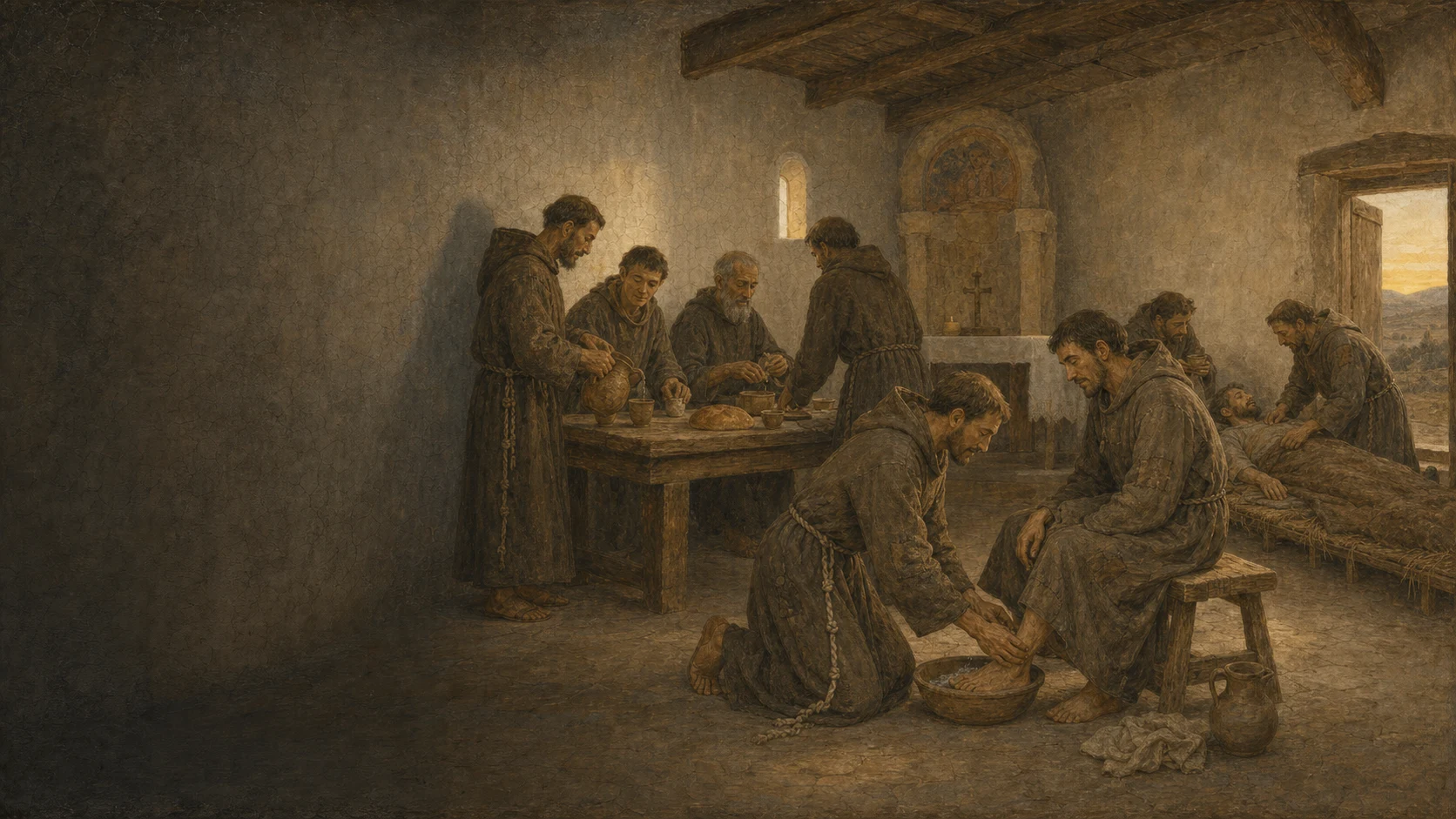
The day ends at the Portiuncula. The last light enters through the door and finds a small house: rough walls, a wooden table, bread, a pitcher, and tunics worn by the road.
On the right, Francis kneels before a newly arrived brother. There is dust on the traveler’s feet. Francis washes them in a clay basin. Nearby, some brothers prepare the meal. In the background, others adjust a sick brother’s blanket and offer him water.
This image is contemplative. It does not claim that an afternoon exactly like this was recorded. It gathers into one scene gestures belonging to the Gospel and the Franciscan way of life: welcoming, serving, sharing, and caring.
Notice that no one occupies a throne. The brother washing feet needs those who cook. Those who cook need the person who brought the bread. The sick brother receives care today; perhaps he cared for someone yesterday. No one is complete alone.
This is how Francis’s fraternity began: not as a group of admirers gathered around a celebrity, but as brothers received so they could follow Jesus together.
Jesus called different people
The first disciples were not a group that would naturally have worked well. They included fishermen, a former tax collector, and a man called the Zealot. They came from different histories and temperaments.
They also failed. James and John desired places of honor. Peter promised courage and then denied knowing Jesus. Judas betrayed him. When Jesus was arrested, the disciples fled.
The Gospel does not hide these cracks. This matters because Christian fraternity is not a club for perfect people. It is the school where real people learn to love like Jesus.
At the Last Supper, Jesus knew these weaknesses and still washed their feet. The gesture did not approve every wrong; it taught that correcting, forgiving, and beginning again cannot be joined to domination. The sign of the disciples would be love made visible in their relationships.
“The Lord gave me brothers”
Years later, Francis recounted the beginning of his vocation in the Testament. When he spoke of the arrival of his first companions, he did not write, “I found followers,” or “I persuaded people to join my project.” He wrote: “The Lord gave me brothers.”
That short sentence changes everything.
A personal follower increases the leader’s importance. A brother is a gift from God, not property. He has a voice, a conscience, wounds, and a vocation of his own. He is to be heard, not collected.
Francis also said that after receiving brothers, the Most High revealed to him that he should live according to the pattern of the Holy Gospel. First came the gift of fraternity; then the path was recognized and written down simply.
Francis still guided the community and took part in writing the Rules. But his companions did not belong to him. They were Friars Minor: brothers who chose the place of the lesser one.
The table in the Acts of the Apostles
Acts describes Christians persevering in teaching, fellowship, the breaking of bread, and prayers. They shared their possessions so that no one would be abandoned.
This was more than eating together. The table said, “Your hunger concerns me too.” Prayer remembered that God kept the community alive. Sharing said, “What I have received can care for someone.”
Acts does not idealize that Church. Debates and injustices in food distribution soon appeared. The apostles had to listen when some widows were being overlooked and organize the service better.
Communion is not hiding problems to look holy. It is allowing truth to come to light and transform the way we live. A community may sing beautifully and still need to learn to notice who was left without bread.
Minister means servant
In many places, the word “minister” seems to mean an important person. In the Franciscan family, it must retain the meaning of service.
The Rule calls those responsible ministers and servants of the other brothers. It asks them to correct with humility and charity. If someone cannot live the Rule, he must be able to approach them and speak without fear.
Responsibility does not mean controlling everything. A good minister organizes, listens to those who are silent, and does not turn people into pieces. He never uses “obedience” to demand something contrary to conscience or the Gospel.
Being “lesser” does not mean hiding our gifts. It means using strength without crushing and knowledge without humiliating. Jesus tied a towel around his waist: the greater the responsibility, the more necessary it is to stoop and serve.
When brothers quarrel
The first friars were not stained-glass figures. They came from varied backgrounds and did not always understand the fraternity’s future in the same way. As it grew, tensions arose over study, houses, poverty, and organization.
This is why Franciscan sources speak so often of patience, mercy, and correction. People do not write so much about forgiveness when no one ever hurts anyone.
Correction is not humiliation. In Matthew 18, Jesus teaches us to begin with a personal conversation. Francis asks for humility and charity. Truth is necessary, but it must not be used as a stone.
Nor should we call “peace” a silence that protects abuse, violence, or injustice. There are situations in which we must approach a trusted adult, the community, or the responsible authorities. Mercy does not erase protection for the victim or the consequences of a serious act.
A mature fraternity learns to say, “This hurt me”; “I was wrong”; “How can I repair it?” Conflict can become a narrow doorway into a truer love.
Eyes that do not deny mercy
In a letter to a minister, Francis asked that no brother seeking mercy should leave without finding it in the minister’s eyes. Even if he fell again, he should be loved so that he could return to the Lord.
This does not mean pretending that wrongdoing does not exist. It means refusing to reduce a person to their worst moment. A merciful gaze can still correct, set boundaries, and ask for reparation; it simply does not say, “You are worth nothing now.”
The Admonitions also warn against anger at another person’s sin. Sometimes someone does wrong and we feel superior. Whoever corrects another to display their own virtue has already lost sight of the brother.
Fraternal care first asks, “How can I help him return to the truth?” It also accepts the question, “What have I still failed to see in myself?”
The sick brother is the measure of the house
The Rule does not permit a sick brother to be abandoned. It asks the others to serve him as they would want to be served. This simple sentence tests every community.
It is easy to celebrate fraternity when everyone walks at the same pace. Love appears when someone cannot keep up: a person who is sick, sad, disabled, or overburdened.
In the painting, the sick brother is in the background, but he has not been forgotten. While some care for him, someone prepares the table and another washes the traveler’s feet. Love spreads through small responsibilities.
Perhaps you cannot resolve a classmate’s suffering. But you can sit nearby, call an adult, or share a task. Fraternity begins when we ask, “Who needs me to draw near?”
One heart, many voices
Acts says that the community of believers was of “one heart and one soul.” This does not mean everyone acquired the same personality or never disagreed. Christian unity does not turn people into copies.
A common heart is born when different gifts serve the same love. One plants, another studies, another welcomes, another notices who is suffering. No gift is enough by itself or permits contempt.
Francis did not receive pieces for his private project. He received brothers with whom he was to discern the work of God. Fraternity was not an extra after prayer; it was a place where prayer had to take bodily form.
At the Portiuncula of our imagination, the sun is nearly down. The table is not ready yet. Tomorrow’s conflict has not happened yet. The sick brother still needs water. Even so, the Kingdom has already begun: a knee touches the ground, bread passes from hand to hand, and no one needs to be the center to be loved.
To keep in your heart
A brother is not someone who belongs to me; he is someone God entrusts to my love.
Jesus did not gather people who were all alike or promise life without conflict. He taught his disciples to serve, speak the truth with charity, share, and begin again.
A gesture for today
Do the service that receives no applause.
At home, school, or in the community, choose a small task that helps everyone and is usually overlooked: set the table, pick something up, welcome a newcomer, or help someone with an activity. Do it without announcing it. Then silently give thanks for someone whose service often goes unnoticed.
Prayer in silence
Jesus, brother who kneels
Jesus,
you knew your friends’ tired feet
and were not afraid to touch the dust.
Free me from the desire to be the center.
Give me courage to serve,
humility to accept correction,
and gentleness to speak the truth.
When a brother falls,
do not let my gaze close the door.
When I fall,
teach me to ask for help and begin again.
Make our differences into a table,
our conflicts into a path of reconciliation,
and our hands into a home for those in need.
Amen.
For those who want to go deeper
Sources for this chapter
- Gospel according to John, chapter 13 — Ave Maria BibleThe washing of feet, the example of the serving Teacher, and the command to love as Jesus loved.
- Acts of the Apostles, chapter 2 — Ave Maria BibleThe community persevering in teaching, fellowship, the breaking of bread, prayer, and sharing.
- Acts of the Apostles, chapter 4 — Ave Maria BibleThe image of “one heart and one soul” and care so that no one was in need.
- Testament of Saint Francis — Order of Friars MinorThe memory “the Lord gave me brothers,” the revelation of the Gospel form, and Francis presenting himself as a lesser brother and servant.
- Rule of 1223 — Order of Friars MinorThe life of the Friars Minor, care of the sick, and the service of ministers, who must correct with humility and charity.
- Address to the Franciscan Family on minority — VaticanExplains why “lesser” describes the Franciscan way of being a brother and exercising relationships and responsibilities.
- Address to the Chapter of the Friars Minor Conventual — VaticanPresents fraternity as a gift always under construction and recalls the mercy Francis requested in the Letter to a Minister.
- Encyclical Letter Fratelli tutti — VaticanReturns to Francis’s open fraternity, able to recognize and love a brother or sister near or far away.
The foot-washing scene at the Portiuncula is a contemplative composition, not an identified historical episode. The phrase “the Lord gave me brothers” comes from the *Testament*. The explanations of ministers, correction, care of the sick, and minority are based on the Rule and the documents listed; no narrative speech was invented and attributed to Francis.