The road at dawn
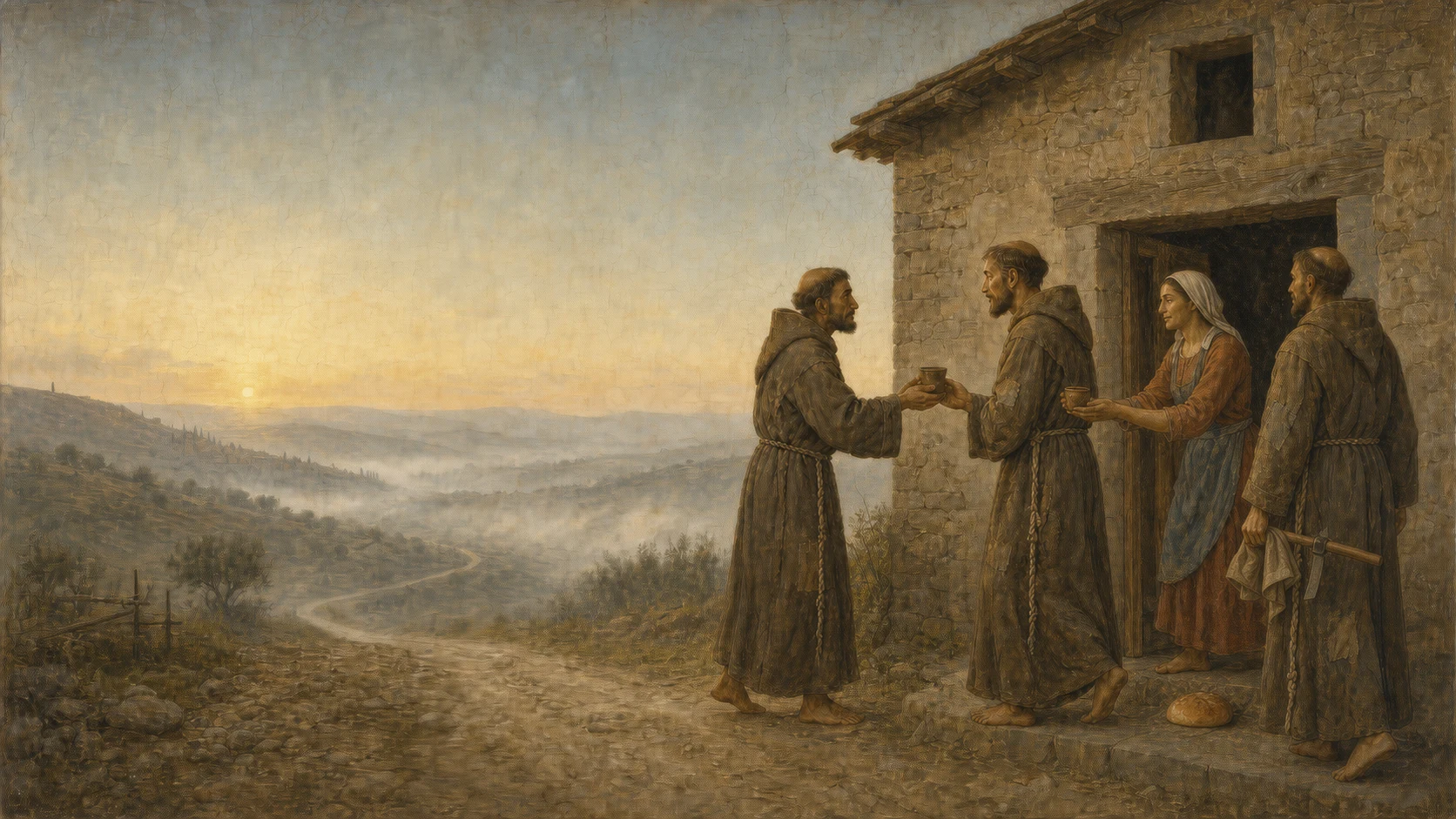
The sun is still rising over the hills of Umbria. A dirt road disappears into the mist. On the right, Francis and two brothers stop before a stone house. Their tunics are patched. None carries a purse. One carries simple tools for work. Near the door is a loaf of bread the brothers have just left. A farmer offers them water in a clay cup.
This contemplative scene does not depict a documented event, but it brings together true features of the first fraternity: work, sharing, and hospitality.
No one stands above anyone else. The woman offers water and has received bread; the brothers receive and also share. Something greater than a coin passes among them: trust.
This is how Francis understood the poverty of Jesus. Not as an empty pit in which life loses its dignity, but as a path where hands cease grasping and learn to offer, work, and receive.
When a thing becomes our owner
Possessing something is not automatically wrong. A family needs shelter, food, and some money; a worker deserves wages. The goods of creation can serve what is good.
The problem begins when what we hold begins to hold us: we measure our worth by what we own, keep excess while someone else lacks what is necessary, or become so afraid of losing that we no longer share.
In Luke 12, Jesus tells the story of a man whose harvest was immense. He thought only of building larger barns and securing many years of comfort. He did not ask who was hungry. He did not give thanks. He did not realize that his own life could not fit inside the barns. Jesus called him a fool because he confused an abundance of things with being rich before God.
As a merchant’s son, Francis knew the promise of security offered by cloth, coins, and prestige. When he followed Jesus, his question changed from “How much can I keep?” to “How can I live the Gospel in freedom?”
“Without anything of their own”
The Rule of 1223 summarizes the life of the Friars Minor in strong words: to observe the Gospel, living in obedience, without anything of their own, and in chastity. This did not mean that each brother should be abandoned without food or care. It meant that none should build his life on the right to say, “This is mine and I alone decide; other people do not matter.”
Within the fraternity, what was needed was received and used, but not clutched like a private fortress. A tunic was for clothing. A tool was for work. A simple house was for welcome and rest. Nothing was to become a throne.
Francis joined “without anything of their own” to obedience and fraternity. The brothers needed to listen, share, and pay attention to one another’s needs.
Franciscan poverty is not a contest to see who can suffer most. It is a school of relationship: we are neither absolute owners nor self-sufficient; we receive, and we are responsible for the good of others.
Jesus sent them out lightly
In Matthew 10, Jesus sends the disciples to proclaim that the Kingdom is near, care for the sick, and give freely what they have received. He tells them to travel without gold, silver, or a bag. They were to enter homes, offer peace, and receive the food that was offered.
Traveling in this way required trust in God and in the goodness of others. Those who welcomed them also received gifts: peace, care, and news of the Kingdom. It was an exchange of gifts.
Francis heard in these words a form of life. His brothers walked as lesser brothers, without the power of weapons or the protection of wealth. Their vulnerability silently said, “We have not come to dominate you.”
Trust is not carelessness. A person who trusts still plants, cooks, repairs the roof, and looks after their health; they simply do not make security an idol or try to control the whole future.
Tools in their hands
Francis’s Testament corrects a misleading picture: that the brothers wanted to live without doing anything. Francis recalls that he worked with his own hands and says that he wanted the other brothers to devote themselves to honest work as well. Those who did not know how were to learn.
The Rule teaches that brothers capable of working should do so faithfully and devoutly. Work could not extinguish the spirit of prayer, but prayer could not serve as an excuse for uselessness either. Under the discipline of that early Franciscan beginning, they could receive necessities as compensation, but not money.
Work supported the fraternity, kept idleness away, and made service possible. This is why the tool appears in the art: hands empty of possessions can be full of responsibility.
Not all work is just. Honoring work does not mean accepting exploitation, danger, or unjust wages. Dignified work respects the body, rest, family, and the humanity of the worker.
When a brother becomes ill
If a brother fell ill on the road, he was not to be abandoned. The Rule tells brothers to make their needs known in confidence and to serve the sick brother as each would wish to be served.
Limitations do not cancel dignity. No one needs to prove productivity to deserve food, shelter, and affection. The person carrying the tool today may need to be carried tomorrow.
Care for sick brothers shows that “without anything of their own” never meant “with no one to care for me.” True Franciscan security did not rest in a hidden private reserve, but in brothers willing to become family.
A community can call itself poor in the way of Jesus only if it protects its most vulnerable members. If it saves money by denying medicine to someone who needs it, it has not embraced the Gospel; it has merely shifted the burden onto the sick person.
A free choice is not imposed destitution
Francis chose to leave privilege. Millions of people, however, do not choose to be born without food, lose their home, or flee a war. This is deprivation: what is necessary has been taken away or never arrived.
Romanticizing this destitution would be cruel. We must not look at a hungry family and say they are closer to God simply because they suffer. Jesus fed crowds, healed sick people, and proclaimed good news to the poor. The Christian community is called to share and to confront the causes of injustice.
Evangelical poverty begins with a free decision: limiting our consumption, refusing luxury that separates us, using goods gratefully, sharing, and standing beside those deprived of their rights. It does not push another person down; it steps off the pedestal to help them rise.
At twelve years old, you do not need to give away something your family needs in secret. You can avoid waste, talk with those responsible for you, and learn prudent generosity.
Bread passes from hand to hand
Matthew 6 speaks of birds and lilies to free us from anxiety. They receive food, sun, rain, and earth: creation lives through relationships.
On the road in our painting, the brothers leave bread and receive water. Tomorrow they may work at another family’s harvest. Later, someone may care for one of them. Life circulates. No one is only a benefactor; no one is only in need.
Following without possessing means learning this movement. It is being able to give thanks without shame when we need to receive. It is offering without making someone else feel small. It is working without turning the result into a reason for superiority. It is caring for things without allowing them to take the place of God and people.
Francis did not find freedom because he had nothing. He found freedom because he discovered to whom he belonged: to God the Father and to the family of brothers and sisters the Gospel had given him.
To keep in your heart
What is necessary is a gift; excess can become a wall.
Jesus does not teach us to abandon life, but to place it in the order of love: God first, people as sisters and brothers, and things as tools for care and sharing.
A gesture for today
Put one thing back into circulation.
With the permission of the person who cares for you, choose something good that is sitting unused—a book, toy, coat, or school supply—and send it to someone who can use it. Clean or repair the object before giving it. Do not offer damaged leftovers: offer care.
Prayer in silence
Lord of open hands
Jesus, companion on the road,
free me from the fear that hoards
and the pride that does not know how to receive.
Give dignity to my work,
tenderness to my care,
and joy to what I share.
May I never call destitution beautiful
or use your Gospel to abandon someone.
Teach me to seek your Kingdom first,
to recognize what is enough,
and to walk with hands available.
Amen.
For those who want to go deeper
Sources for this chapter
- Gospel according to Matthew, chapter 6 — Ave Maria BibleThe heart’s treasure, trust in the Father’s care, and the invitation to seek first the Kingdom and its righteousness.
- Gospel according to Matthew, chapter 10 — Ave Maria BibleThe sending of the disciples without gold or a bag, to proclaim, care, and give freely.
- Gospel according to Luke, chapter 12 — Ave Maria BibleThe parable of the rich fool and the call not to make possessions life’s final security.
- Rule of 1223 — Order of Friars MinorDefines the brothers’ life as following the Gospel “without anything of their own” and addresses work, non-appropriation, and fraternal care.
- Testament of Saint Francis — Order of Friars MinorRecalls the simple life of the first brothers, manual work, and the desire to remain guests and pilgrims.
- Letter to the Franciscan Family for the eighth centenary of the Rule — VaticanPresents the Gospel as the center of the Franciscan form of life and explains the expression “without anything of their own” within that path.
- Constitutions of the Friars Minor Capuchin — care of the sickPreserves the Franciscan direction to serve a sick brother as each person would wish to be served.
The road scene was created as a contemplative image, not as an identified historical event. The explanations of work and care are grounded in the Rules and the *Testament*; no narrative words have been attributed to Francis.