The church was so poor that the morning entered through its cracks.
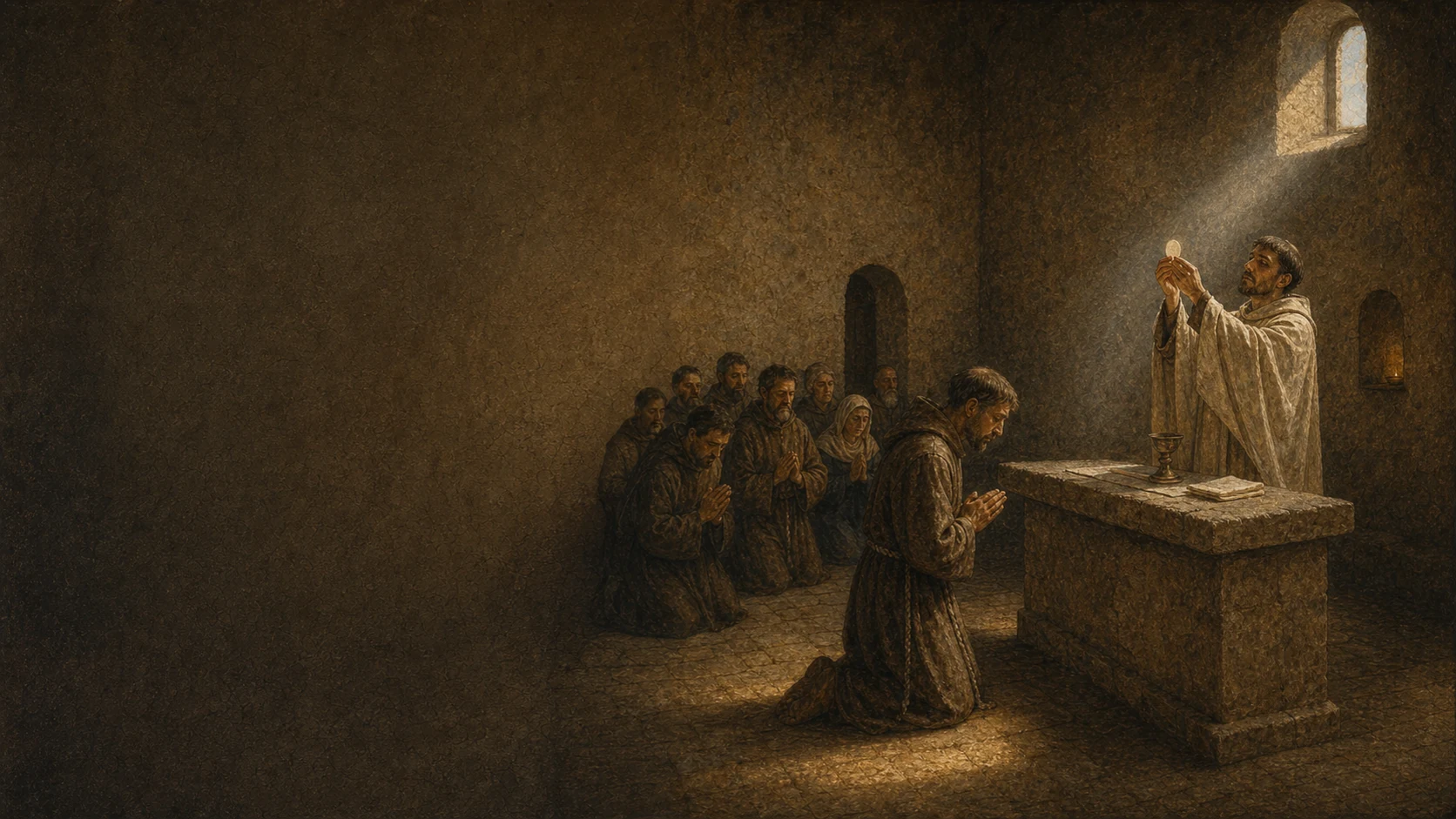
There was no gleaming marble. The altar was simple, and the priest’s vestments already showed the work of the years. Friars and local residents crowded into the small space. Among them, Francis knelt.
When the priest raised the consecrated bread, Francis did not see an ordinary thing that someone had decided to make important. In faith, he recognized a presence: Jesus giving himself once more to his people under the humble appearance of bread.
It was a mystery like everything that most moved him in the Gospel. In Bethlehem, the Son of God came as a child. On the cross, he gave himself. In the Eucharist, he remained close, humble to our eyes, and offered as food.
For Francis, kneeling was not a flight from the world. Before Jesus, it was learning how to return to the world: grateful, attentive, and ready to become a gift.
A word that means thank you
The word Eucharist comes from a Greek word meaning “thanksgiving.” Before sharing the bread at the Last Supper, Jesus gave thanks to the Father. The Church continues to do the same: she gathers the gifts of creation and human work, listens to the Word, remembers Christ’s self-offering, and gives thanks.
Gratitude is more than quickly saying “thank you.” It is recognizing that life did not begin with us. We have received creation, people who taught us, opportunities to begin again, and, above all these gifts, Jesus himself.
Francis recognized gifts where others saw only small things and returned praise to the Giver. At Mass, this gratitude found its center: the greatest gift was Jesus himself.
The bread received opens the hand to share bread.
Not merely a remembrance
When a family looks at a photograph, they remember someone they love. The person in the picture does not begin to live inside the paper. The Eucharist is different.
In Catholic faith, after the consecration at Mass, the bread and wine truly become the Body and Blood of Christ. They retain the characteristics of bread and wine, but their deepest reality has been transformed by God. Jesus is present whole, alive, and real.
This does not mean his body is cut into pieces, nor that the host is a magical object. The risen Christ offers himself sacramentally: a true presence we receive in faith.
The priest does not invent this presence. In the Church’s celebration, he speaks the words of Christ in the ministry he has received. The power belongs to God; the gift is Jesus.
The Eucharist is therefore a remembrance, but not an empty one. In celebrating Christ’s one self-offering, the Church is reached by his love today.
Francis’s amazement
In the first of his Admonitions, Francis compares what the apostles saw with what the Church contemplates. They looked at the humanity of Jesus and, enlightened by the Spirit, recognized the Son of God. We see bread and wine and are called to believe in the living Body and Blood of Christ.
Francis then writes that every day the Lord humbles himself and comes to us upon the altar. Jesus does not lose his dignity; divine love stoops down and draws near.
This filled Francis with amazement. The Most High fit within the poverty of a church. The one who created wheat accepted being received as bread.
Reverence, then, was not fear of coming close. It was wonder because Jesus had come so close.
Francis did not celebrate Mass as a priest
In the art for this chapter, a priest stands behind the altar and elevates the host. Francis remains slightly below, kneeling with empty hands. This distinction matters.
The early Franciscan sources and the Church’s tradition present Francis as a deacon, not a priest. As a deacon, he could serve in the liturgy and proclaim the Gospel, as he did at Greccio. But he did not preside at Mass or consecrate the bread and wine; that ministry belongs to bishops and priests.
We have no text in which Francis explains why he did not seek priestly ordination. His humility helps us understand this attitude, but we must not turn a possibility into certainty.
Francis saw priesthood as a holy service, but his vocation was different. He shows that being close to the altar does not mean occupying every role. There is beauty in presiding, serving, and participating attentively.
Respect without making people into idols
In the Testament, Francis recalls the faith God gave him in priests. Even though he knew human frailty, he honored the ministry through which Christ offered his Body and Blood to the people.
This does not mean pretending that every priest is always right. Reverence does not eliminate accountability. A crime, abuse, or injustice must be stopped and reported to trusted adults and authorities. No role in the Church gives anyone permission to harm another person.
The priest does not take Jesus’ place or become the owner of the community. He serves. And the people unite their own lives with the prayer.
Healthy reverence does not manufacture religious celebrities. It points to Christ.
Clean cloths, gathered words
Francis wrote to clerics and custodians because he found churches and liturgical objects treated carelessly. He spoke of chalices, vessels, corporals—the small cloths used with the consecrated bread—and the places where the Eucharist was kept. He asked that everything be dignified and clean.
He also gathered writings containing the names and words of the Lord when they had been abandoned. His devotion took concrete form: cleaning, storing, repairing, gathering.
Fine fabric does not buy God’s presence. A poor church can celebrate with dignity. Poverty is not an excuse for neglect; wealth does not guarantee love.
What is precious deserves attention. Exterior care does not replace the heart, but it reveals what the heart has learned to love.
Receive the Body, recognize the body
Saint Paul wrote to the Christians in Corinth because the meal that should have united them was revealing divisions. Some ate abundantly while others went hungry and were humiliated. Paul therefore recalled Jesus’ words over the bread and cup and asked each person to examine themselves and discern the Body.
Preparing for Communion includes faith, respect, and conscience. When we need it, we seek reconciliation. This examination should not imprison sensitive people in endless fear: it calls us to truth, conversion, and trust in mercy.
How can we receive the Body of Christ at the altar and humiliate his body in the community? Communion calls for reconciliation, sharing, and attention to those left without a place at the table.
Francis did not separate the altar from the road. The same Jesus he adored in the bread sent him to serve the little ones. Reverence became care; presence received became presence offered.
To keep in your heart
Jesus draws near to make us a gift
In the Eucharist, Christ does not visit us to be kept far from life. He gathers, feeds, and sends us. Francis knelt before the altar because he recognized the humble love of Jesus; then he rose to care for words, churches, and people.
I receive the living Bread with gratitude and learn to share the life I have received.
A gesture for today
Prepare a place with care
Before the next Mass, arrive a few minutes early. Put away your phone, breathe, and silently give thanks for three gifts received this week. Notice whether there is something simple you can do: arrange a leaflet, pick up a piece of paper, make the pew welcoming, or create space for someone. During Communion, pray without hurry: “Jesus, thank you for drawing near to us.”
Prayer in silence
Bread that gives itself
Jesus, living Bread come down from heaven,
you draw near without noise
and entrust your love to our fragile hands.
Give me the attentive eyes of Francis:
may I recognize you in faith,
receive you with gratitude,
and care gently for what is holy.
Free me from fear that paralyzes
and distraction that fails to notice.
Gather what is divided within me
and teach me to leave no one without a place.
After I meet you at the altar,
make my life bread that is shared,
a friendly presence, and thanksgiving.
Amen.
For those who want to go deeper
Sources for this chapter
- Gospel according to John, chapter 6 — USCCBThe sign of the loaves and Jesus’ teaching about the living bread, his flesh given for the life of the world.
- First Letter to the Corinthians, chapter 11 — USCCBThe account of the Lord’s Supper, self-examination, and Paul’s warning concerning the community’s divisions.
- Saint Francis of Assisi — First Admonition: “The Body of the Lord”Franciscan contemplation of Christ, who comes daily in humility and is recognized in faith in the consecrated bread and wine.
- Testament of Saint Francis — Order of Friars MinorFrancis’s faith in priests, the Body and Blood of Christ, and the sacred words he wished to gather and keep with dignity.
- Writings of Saint Francis — letters to clerics, custodians, and the whole OrderTexts in which Francis asks for reverence toward the Eucharist and practical care for chalices, corporals, cloths, places of reservation, and written words.
- Benedict XVI — Meeting with young people in Assisi, 17 June 2007Confirms that Francis was a deacon, not a priest, and explains his veneration for priests as ministers of the Body of Christ.
- Catechism of the Catholic Church, 1373–1381 — VaticanThe Catholic presentation of Christ’s true, real, and substantial presence in the Eucharist and the conversion of the bread and wine.
The opening narrative imagines a small Mass in Umbria to bring the reader close to Francis’s spirituality; it does not describe a specific documented event. The artwork deliberately distinguishes the celebrating priest from Francis kneeling as a deacon. The sources confirm his Eucharistic reverence and diaconal ministry, but contain no conclusive explanation from Francis himself of why he did not receive priestly ordination.