
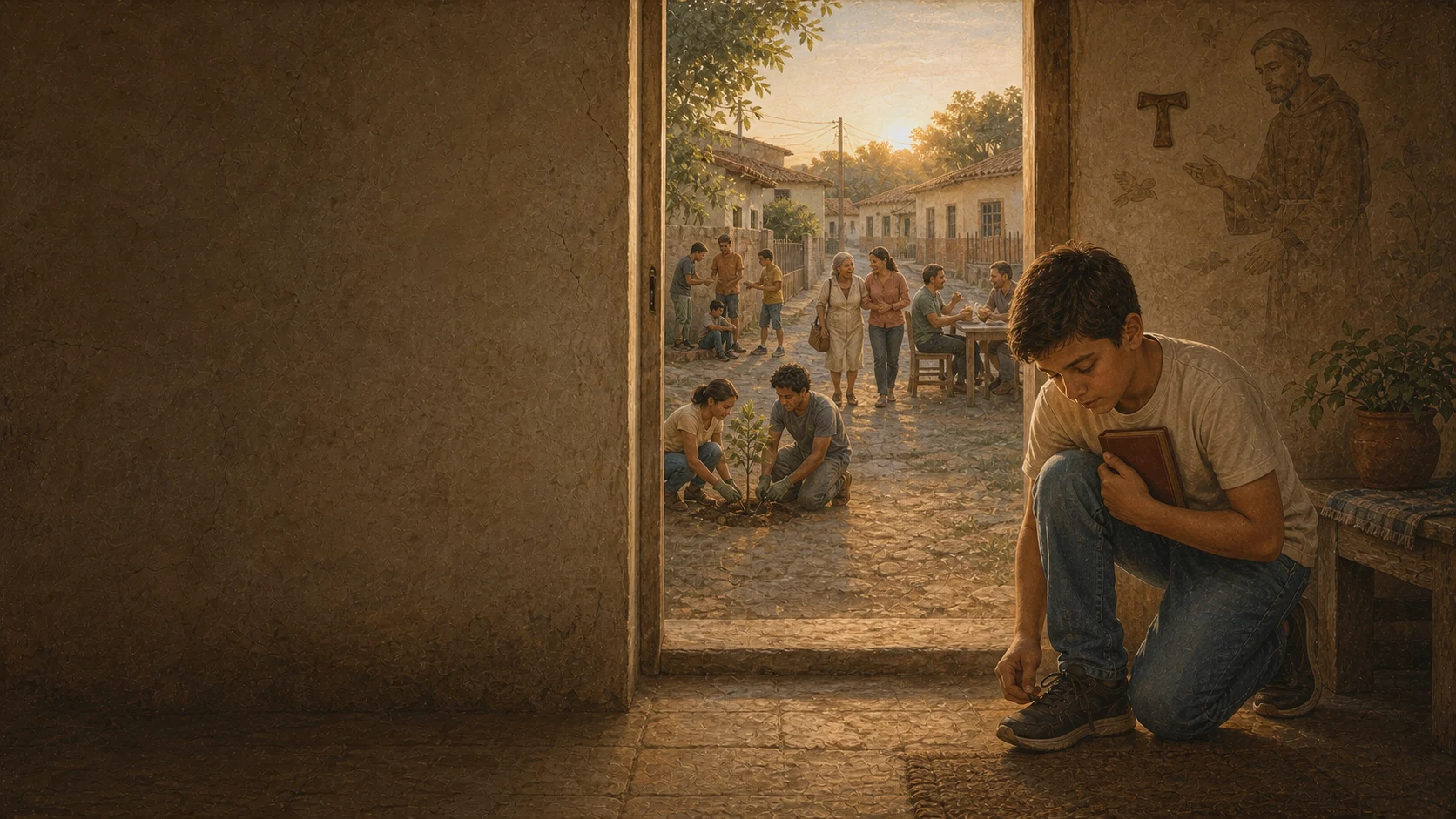
The first light of morning enters through the door. A young person closes the Gospel, holds the book near their heart, and bends down to tie their shoes.
Outside, the neighborhood wakes. People plant, support an elderly woman, share bread, and stand beside someone who was being humiliated. There is no applause. Even so, something holy is happening.
We have reached the last page, but Jesus does not say, “Keep all of this as a beautiful memory.” He says: “Follow me.” Following is a word that needs feet. Francis did this on the roads of Umbria. We can do it at home, at school, in the parish, in the square, or before a screen.
You do not need to become a friar. You need to let the Gospel encounter the life you have.
The path begins on the ground beneath your feet
Sometimes we imagine that a holy life must happen far away. But Jesus formed his disciples at meals, on roads, in boats, and in homes. He washed feet, welcomed children, and entered conversations others avoided.
Francis also began where he was. In the Testament, he recalls that the Lord led him close to people with leprosy and that, as he showed mercy, bitterness was changed into sweetness.
The ground beneath your feet may be the kitchen after dinner. Following Jesus can mean helping before someone asks, listening to a family member to the end, or apologizing without adding an excuse.
At school, it may be the corridor where someone stands alone. Sitting nearby says with the body, “You are not invisible.” In the face of bullying, it means not laughing, calling classmates closer, and seeking a responsible adult. Christian courage does not increase violence; it interrupts isolation.
Bringing peace inside the screen too
The internet seems to be made of weightless things, but our words reach real people. A cruel comment or an image shared without permission can harm someone.
Being lesser online means rejecting the need to win every argument. Before posting, we can ask: is it true, necessary, and respectful? When someone is attacked, we can offer support, report the abuse through the proper channels, and call an adult when there is danger.
This is not remaining silent before injustice. We can defend one person without destroying another and disagree without turning someone into an enemy.
Free hands in a culture that tells us to buy
Almost every day we are told that we lack something we need in order to be happy. Simplicity does not declare objects evil. It asks whether we use things or whether they are using our heart.
We can care for what we have, repair before replacing, lend, donate, and speak as a family before buying. We can want something without turning that desire into a command.
Laudato si’ reminds us that avoiding waste, saving water and energy, separating waste, and planting things educate us for greater responsibility. No single gesture solves the environmental crisis, but small gestures form people capable of acting together.
Francis called creatures sisters because he recognized the same Creator. Caring for the earth and caring for poor people are not competing missions: those with the least protection usually suffer first from environmental damage.
The apron and the towel
At the Last Supper, Jesus tied a towel around his waist and washed the disciples’ feet. The Teacher took the servant’s place.
Serving does not mean doing everything to please people or allowing exploitation. Service arises from the freedom of Jesus: I can bend down because my dignity does not depend on appearing superior.
There are many ways to wear that towel today. Parents educate their children, a student explains a subject without humiliating anyone, a professional works honestly, someone accompanies a sick person, or someone helps maintain a public square.
Some people are called to Franciscan religious life. Others are called to marriage, priesthood, consecrated lay life, or Christian service as single people. Teachers, artists, farmers, scientists, and students can follow Jesus. The forms change; the movement is to receive life as a gift and place it at the service of others.
No one follows alone
A solitary spirituality soon grows tired. Jesus gathered disciples. Francis received brothers. Christian faith has a communal home: the Church.
In the community, we meet people we would not have chosen and learn that they too belong to Christ. We listen to the Word, pray, and serve beyond our own circle. When the community fails, we seek truth and conversion.
In the sacraments, we celebrate what God does. In the Eucharist, Christ feeds and gathers us. In Reconciliation, we tell the truth, receive forgiveness, and begin again. Children and adolescents must never keep a situation of abuse or danger to themselves: they need to seek a safe adult. Forgiveness does not hide evil or prevent justice.
Prayer sustains everything. We can begin with five minutes, a psalm, or an honest conversation with Jesus. Prayer returns us to the world with a heart less full of noise.
The face that was before us
In Matthew 25, Jesus identifies himself with those who are hungry, thirsty, without welcome, sick, or imprisoned. The righteous did not realize they were serving the King himself.
This surprise keeps love from becoming a spectacle. The person receiving help is not scenery for our goodness: they have a name, gifts, and dignity. Often, that person helps us too.
Fratelli tutti asks whether we will pass by or become neighbors. This can begin with bread, time, or presence and grow into community action against the causes of suffering.
We will not always know what to do. We can ask and act with others. Jesus did not place the whole world in our hands. He placed someone before us and gave us brothers and sisters with whom to walk.
The page ends; the response begins
Perhaps you think, “I will never manage it.” Francis also had to learn and begin again. Holiness is not a flawless performance; it is friendship with God transforming real choices.
Do not wait to feel extraordinary. Love comes dressed as an ordinary task: tidying, listening, studying, sharing, defending, caring, praying. Today’s step is worth more than a promise postponed forever.
In the image, the Gospel remains close to the heart and the shoes are being tied. Beyond the door there is no perfect world, but there is someone we can approach.
Francis belongs to history. The way of Jesus belongs to this morning.
To keep in your heart
You do not need to live Francis’s life; you need to offer your own life to Jesus.
The Gospel takes different forms in every vocation, age, and place. What unites them all is a listening heart, a sustaining community, and a love willing to become concrete.
The last page does not close the path. It leaves the door open.
Seven days to begin
One step each day, without hurry or display
- Day 1 — Listen: read Luke 9:23 slowly and remain in silence for two minutes.
- Day 2 — Serve: do a household task before anyone needs to ask.
- Day 3 — Draw near: speak with someone who is usually left out, without turning the person into a project.
- Day 4 — Simplify: choose one unnecessary purchase to postpone and set aside something good to share.
- Day 5 — Care: prevent some waste and care for one small part of creation.
- Day 6 — Rebuild: stop a chain of mockery, apologize, or offer peace in a conversation.
- Day 7 — Gather: take part in Mass and bring the week’s steps to the altar. Then choose one to continue.
If you fail one day, do not turn the plan into guilt. Begin again the next day. The purpose is not to pass a test; it is to allow one gesture to become a path.
A prayer in silence
At the door of a new morning
Jesus, companion on the road,
I keep your Word close to my heart
and place my small steps before you.
Teach me to recognize your face
in my family and in those left outside,
to use my words to protect,
my possessions to share,
and my hands to care for the earth.
When I fall, raise me.
When I think myself greater, make me lesser.
When fear closes the door,
remind me that you walk with me.
Feed me at your table,
gather me into your people,
and send me out again in peace.
May the Gospel not end in my eyes,
but continue in my life.
Amen.
For those who want to go deeper
Sources for this chapter
- Gospel according to Luke, chapter 9 — USCCBJesus’ invitation to take up the cross each day and follow him.
- Gospel according to Matthew, chapter 5 — USCCBThe Beatitudes, hunger for justice, and the mission of those who make peace.
- Gospel according to Matthew, chapter 25 — USCCBJesus recognized in the person who is hungry, thirsty, without welcome, sick, or imprisoned.
- Gospel according to John, chapter 13 — USCCBThe washing of feet and the humble service Jesus offered the disciples.
- Testament of Saint Francis — Order of Friars MinorFrancis recalls showing mercy among people with leprosy, the greeting of peace, and his life in the Church.
- Rule of 1223 — Order of Friars MinorFranciscan life defined as observance of the Gospel of Jesus Christ.
- Laudato si’, especially 209–232 — VaticanEducation for care, simplicity, small daily gestures, and common commitment to creation and poor people.
- Fratelli tutti, especially 56–86 — VaticanThe parable of the Good Samaritan as a call to cross distances and become a neighbor.
- Catechism of the Catholic Church, 1322–1419 — VaticanThe Eucharist as the source and summit of Christian life and communion with Christ and the Church.
The house and neighborhood in the image are a contemporary composition, not a historical episode. The closing prayer is original to this portal. The chapter presents the Franciscan path as an inspiration for every Christian vocation, without confusing the life of every baptized person with the vows proper to the Friars Minor.